
IBDP Economics 3.6 Demand management—fiscal policy SL Paper 2- New Syllabus
Question
Read the extracts and answer the questions that follow.
Text A — The economy of Argentina
Argentina, the third-largest economy in Latin America, has experienced several cycles of high economic growth and deep recessions over the last 70 years. It has vast natural resources in energy and agriculture and potential for renewable energy. Its leading exports include soybeans and beef products, which contribute significantly to gross domestic product (GDP) and employment and are major sources of foreign currency. However, Argentina faces unfavourable climate conditions that create problems for the agriculture sector. A drought in 2023 caused over 20 billion United States dollars (USD) in losses for soybean farmers.
Argentina faces high relative poverty rates despite redistribution policies such as transfer payments. Argentina is known for extensive government intervention, including price ceilings on rent and strong protection for labour unions and workers.
For many years, Argentina managed its exchange rate by limiting the amount of foreign currency that citizens could purchase as well as by restricting imports. The aim was to protect reserve assets and prevent currency depreciation. This led to the establishment of an informal (unofficial) foreign exchange market and discouraged foreign direct investment (FDI). However, the foreign currency limitations resulted in an overvalued currency and failed to stop the level of reserve assets from decreasing.
In 2018, Argentina requested a loan from the International Monetary Fund (IMF) to help fund its budget deficit and large external debt repayments. However, Argentina defaulted on its debt repayments to the IMF, which led to low consumer and business confidence, causing large FDI and portfolio investment outflows. To receive future loans, the IMF requires Argentina to promote good governance, reduce government spending, increase reserve assets and control inflation.
In 2022, Argentina’s economic challenges continued with high inflation and a persistent budget deficit, leading to unsustainable debt. High inflation has led to declining real wages. Moreover, uncertainty about future prices has contributed to lower business investment.
Text B — Argentina’s new economic reforms
In December 2023, Argentina’s new government initiated reforms to help solve its economic challenges. The new economic reforms included:
- deregulating markets, such as removing price controls and restrictions on buying foreign currency
- privatization of 41 state-owned enterprises to improve efficiency, including the national airline, rail networks, state media, and major oil, water and sewage companies, many of which were recording losses and burdening the government budget
- increasing labour market flexibility by reducing labour union power and lowering labour costs
- reducing government spending by cancelling infrastructure projects, reducing the size of the public sector and eliminating transport and energy subsidies.
The immediate result of removing restrictions on foreign currency purchases was a large depreciation of the Argentine peso (ARS), Argentina’s currency, as predicted by speculators. Moreover, inflation increased to over 250 %. The new government maintained that while the reforms may cause a short-term recession, the policies would ultimately lead to long-term price stability and economic growth, despite predictions that relative poverty rates could increase to 60 %. However, the government has stated it will continue spending on programmes to decrease poverty.
To address the budget deficit and maintain a trade surplus, the government increased taxes on cigarettes and imposed tariffs on imports such as laptops. Income taxes were increased, but the level of income on which no income tax is paid was raised from ARS 1.35 million to ARS 1.55 million per month.
The IMF supported the reforms and agreed to grant future loans to Argentina. The loans are important to establish international credibility and finance government spending.
Table 1: Argentina’s exchange rates
| Year | Argentine peso (ARS) per US dollar (USD) |
|---|---|
| 2023 (before removing foreign exchange market restrictions) | 350 |
| 2024 (after removing foreign exchange market restrictions) | 820 |
Text C — Education and productivity in Argentina
Despite significant investments in education, achievement levels are not improving. Experts recommend that Argentina focus on improving the quality of education to decrease poverty rates and increase the economy’s productive capacity. Additionally, Argentina’s low female labour force participation rate indicates an underutilized resource. An improved education system could increase female participation in the economy and raise household incomes.
Table 2: Development data for Argentina
| Indicator | 2013 | 2022 |
|---|---|---|
| Gini coefficient | 0.409 | 0.420 |
| Relative poverty rate (%) | 30 | 40 |
| Human Development Index (HDI) | 0.845 | 0.842 |
| Gender Inequality Index (GII) | 0.356 | 0.287 |
Table 3: Economic data for Argentina
| Indicator | 2013 | 2022 |
|---|---|---|
| Real GDP (USD billion) | 593.86 | 598.31 |
| Nominal GDP (USD billion) | 526.32 | 631.31 |
| Gross national income (USD billion) | 540.19 | 619.14 |
| Net trade in goods and services (USD million) | −694 | 5440 |
| Inflation rate (%) | 10.9 | 94.8 |
| Unemployment rate (%) | 7.1 | 6.8 |
| Exports (% of GDP) | 10.7 | 16.3 |
| Female labour force participation rate (%) | 48 | 50 |
| Government (national) debt (% of GDP) | 40.1 | 89.5 |
| Government budget (% of GDP) | −1.9 | −4.2 |
| Government employment (public sector) (% of total employment) | 18.0 | 23.4 |
(a) (i) Define the term relative poverty indicated in bold (Text A, paragraph 2). [2]
Show Answer
Relative poverty occurs when a person’s income is too low to maintain the typical or socially acceptable standard of living in their country. It is commonly measured using a poverty line set at a certain percentage of median or average income.
(a) (ii) Define the term depreciation indicated in bold (Text B, paragraph 2). [2]
Show Answer
Depreciation is a decrease in the value or exchange rate of a currency, usually occurring in a floating or managed exchange-rate system as a result of changes in the demand for and supply of the currency.
(b) (i) Using information from Table 1, calculate the cost of importing raw materials valued at USD 1200 in Argentine pesos (ARS) in 2023 and in 2024. [2]
Show Answer
From Table 1:
2023:
\(1200 \times 350 = 420\,000\)
Therefore, the cost of importing raw materials worth USD 1200 in 2023 was:
ARS 420 000
2024:
\(1200 \times 820 = 984\,000\)
Therefore, the cost of importing raw materials worth USD 1200 in 2024 was:
ARS 984 000
The cost increased substantially because the Argentine peso depreciated, meaning more pesos were required to purchase one US dollar.
(b) (ii) Sketch a business cycle diagram and indicate a period of economic growth and a period of recession on the diagram (Text A, paragraph 1). [3]
Show Answer
A business cycle shows fluctuations in economic activity, usually measured by changes in real GDP over time. Economic growth occurs when real GDP is increasing, while a recession occurs when economic activity and real GDP are falling.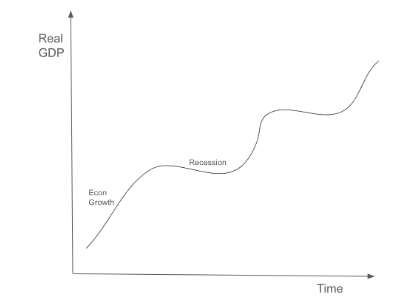
The upward-sloping section represents a period of economic growth, while the downward-sloping section represents a recession. The horizontal axis may represent time and the vertical axis may represent real GDP, output, real income or economic activity.
(c) Using a demand and supply diagram to indicate the total cost of the subsidy to the government, explain how eliminating energy subsidies may affect government spending (Text B, paragraph 1). [4]
Show Answer
A subsidy is a payment by the government to producers that reduces their costs of production. In the case of energy, the government may pay producers an amount per unit of output or absorb part of their production costs.
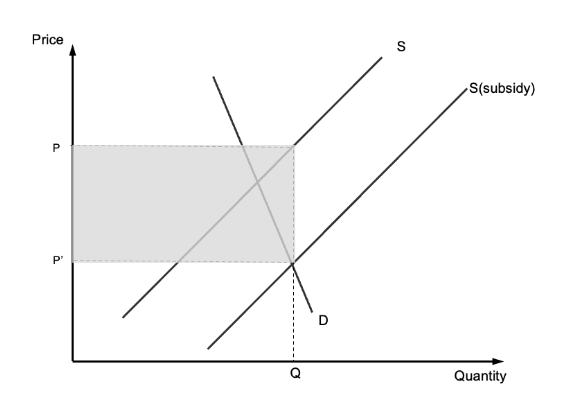
On the diagram, the subsidy shifts the supply curve downwards because producers’ costs are reduced. The vertical distance between the original supply curve and the subsidized supply curve represents the subsidy per unit. The government’s total cost of the subsidy is represented by the subsidy per unit multiplied by the quantity produced and consumed.
By eliminating energy subsidies, the government no longer has to pay producers a subsidy for each unit of energy produced or absorb part of their production costs. Therefore, government spending on subsidies will fall.
This can help reduce the government budget deficit and allow the government to redirect expenditure towards other priorities, such as education, healthcare or debt repayment. However, removing the subsidy may increase energy prices and therefore place upward pressure on inflation and household costs.
(d) Using an exchange rate diagram, explain how speculation in the foreign exchange market might influence the value of the Argentine peso (ARS) (Text B, paragraph 2). [4]
Show Answer
Speculation occurs when participants in the foreign exchange market buy or sell a currency because they expect its future value to change. If speculators expect the Argentine peso to depreciate, they have an incentive to sell pesos before their value falls.
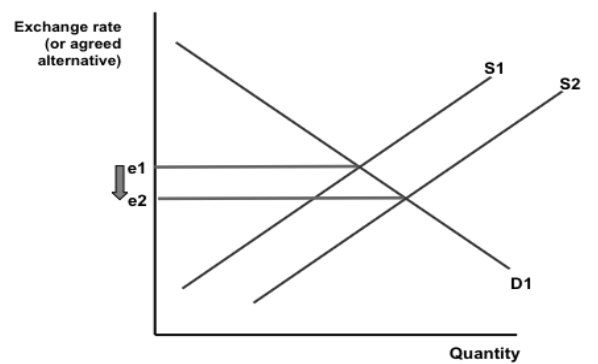
The selling of pesos by speculators increases the supply of Argentine pesos in the foreign exchange market. This shifts the supply curve of pesos to the right. The new equilibrium results in a lower value of the peso, representing a depreciation.
Speculators may sell their pesos to purchase foreign currencies before the peso loses further value, or they may plan to buy pesos back later at a lower price. Therefore, expectations of depreciation can themselves contribute to the depreciation of the currency.
This is consistent with Text B, which states that the removal of restrictions on foreign currency purchases resulted in a large depreciation of the Argentine peso as predicted by speculators.
(e) Using a poverty cycle diagram, explain how improving the quality of education in Argentina may help to break the poverty cycle (Text C). [4]
Show Answer
The poverty cycle describes a self-reinforcing process in which low incomes lead to low savings and investment, resulting in low productivity and continued low incomes.
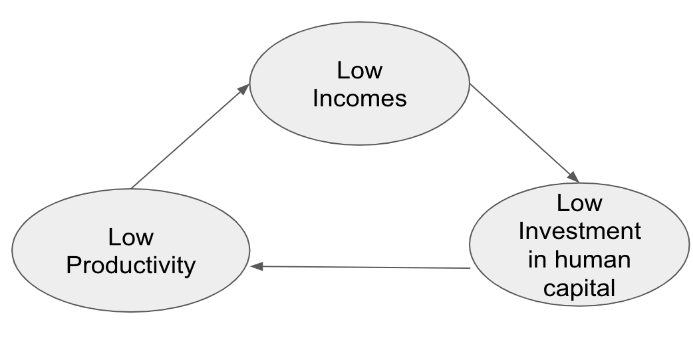
Improving the quality of education increases investment in human capital. Better education can improve workers’ knowledge and skills, increasing labour productivity and the economy’s productive capacity.
Higher productivity allows workers to produce more output and can increase their incomes. Higher household incomes can increase savings and investment, further increasing productive capacity and economic growth.
In Argentina, improved education could also increase female labour force participation, which would make greater use of an underutilized resource. This could increase household incomes and further reduce poverty.
Therefore, improving education can break the poverty cycle by increasing human capital and productivity, leading to higher incomes, greater savings and investment, and ultimately higher economic growth and development.
(f) Using a Lorenz curve diagram, explain how the income distribution changed in Argentina between 2013 and 2022 (Table 2). [4]
Show Answer
A Lorenz curve shows the distribution of income among households. The further the Lorenz curve lies below the line of perfect equality, the greater the degree of income inequality.
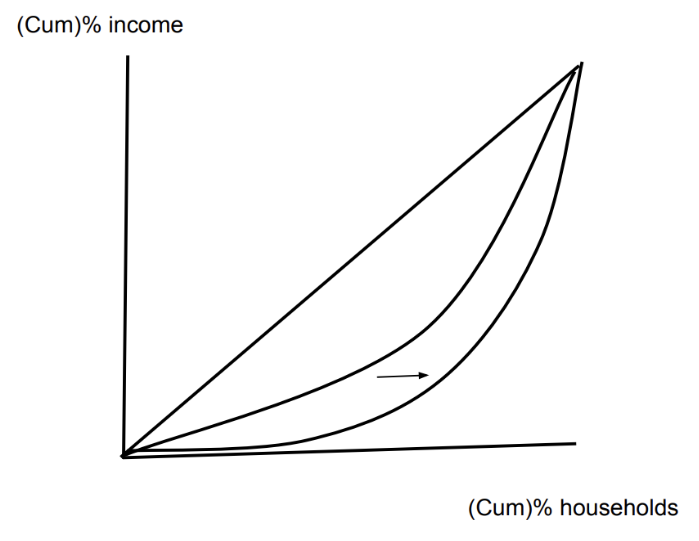
According to Table 2, Argentina’s Gini coefficient increased from 0.409 in 2013 to 0.420 in 2022.
A higher Gini coefficient indicates greater income inequality. Therefore, the income distribution in Argentina became more unequal between 2013 and 2022.
This can be represented by an outward shift of the Lorenz curve, further away from the line of perfect equality. Therefore, the poorest households received a relatively smaller share of total income compared with the distribution in 2013.
(g) Using information from the text/data and your knowledge of economics, evaluate the likely consequences of Argentina’s new economic reforms on its economy. [15]
Show Answer
Argentina’s new economic reforms represent a major shift towards a more market-oriented economy. The reforms include deregulation, privatization, labour-market reforms, contractionary fiscal policy, removal of subsidies and exchange-rate controls, as well as changes to taxation and tariffs. Their consequences are likely to differ between the short run and long run and across different macroeconomic objectives.
Economic growth may benefit in the long run from deregulation and privatization. Deregulation removes restrictions such as price controls and foreign-currency controls, allowing markets to allocate resources more freely. Privatization of 41 state-owned enterprises may improve efficiency because many of these enterprises were making losses and placing a burden on the government budget.
Privatization may also encourage private investment and improve productivity. If private firms operate the enterprises more efficiently, resources may be allocated towards their most productive uses, increasing productive capacity and potentially shifting the economy’s long-run aggregate supply to the right.
Similarly, increased labour-market flexibility may reduce labour costs. Lower labour costs can reduce firms’ costs of production, potentially shifting short-run aggregate supply to the right. This may increase real output and employment. Greater flexibility could also encourage foreign firms to invest in Argentina, increasing FDI.
However, the reforms may cause a significant short-run contraction. The government is reducing spending, cancelling infrastructure projects, reducing the size of the public sector and eliminating subsidies. This represents contractionary fiscal policy, which reduces aggregate demand.
Lower government spending reduces aggregate demand and can cause lower real GDP and higher cyclical unemployment in the short run. This is particularly significant because the public sector accounted for 23.4% of total employment in 2022. Therefore, reductions in public-sector employment and infrastructure spending could worsen unemployment in the short term.
On the other hand, reducing government spending can improve fiscal sustainability. Argentina’s government debt increased substantially from 40.1% of GDP in 2013 to 89.5% of GDP in 2022, while the government budget deficit increased from 1.9% to 4.2% of GDP. Reducing expenditure can therefore help lower the budget deficit and reduce the need for additional borrowing.
It may also improve international confidence and help Argentina satisfy the conditions associated with IMF support. Greater fiscal credibility could encourage foreign investment and improve access to international finance.
A major concern is the effect on inflation. Argentina already had extremely high inflation, reaching 94.8% in 2022. Removing subsidies and allowing the peso to depreciate can increase prices. In particular, a weaker peso makes imported goods and imported raw materials more expensive, creating cost-push inflation.
The removal of foreign exchange controls caused the peso to depreciate from 350 ARS per USD in 2023 to 820 ARS per USD in 2024. This makes imports more expensive. Consequently, businesses using imported inputs face higher costs, while consumers face higher prices for imported goods. This could worsen the cost of living and increase poverty in the short run.
However, removing exchange-rate controls may have long-term benefits. The previous restrictions created an informal foreign exchange market, resulted in an overvalued currency and discouraged FDI. Removing these distortions may improve transparency in the foreign exchange market, increase export competitiveness and encourage FDI. A more competitive exchange rate may also help Argentina maintain its trade surplus.
The elimination of transport and energy subsidies is also likely to have mixed effects. In the short run, removing subsidies raises the prices of essential goods and services. This is likely to disproportionately affect low-income households and increase relative poverty. It can also increase firms’ operating costs, reducing short-run economic growth.
However, the government will save money previously spent subsidizing energy and transport. This reduces government expenditure and can improve the fiscal balance. In addition, higher energy prices may encourage consumers and firms to conserve energy and use resources more efficiently.
The income-tax reforms may have some positive effects on income distribution. Although income taxes were increased, the tax-free income threshold was raised from ARS 1.35 million to ARS 1.55 million per month. This provides some protection to lower-income earners while increasing government revenue from higher-income taxpayers.
Higher tax revenue could help the government finance debt repayment and maintain poverty-reduction programmes. A more progressive tax structure could also help reduce inequality. This is particularly important because Argentina’s Gini coefficient increased from 0.409 to 0.420 between 2013 and 2022, indicating a worsening income distribution.
Nevertheless, higher taxation can reduce disposable income and consumption, creating a contractionary effect on aggregate demand. Its impact on inequality will also depend on whether wages increase sufficiently to keep pace with Argentina’s very high inflation.
Privatization may improve efficiency and reduce the government’s need to finance loss-making state-owned enterprises. It may generate immediate government revenue and encourage private investment. However, privatization may also result in short-term job losses as firms restructure. If private firms increase prices for essential utilities, the policy could further increase relative poverty and reduce living standards.
Similarly, import tariffs and higher cigarette taxes may increase government revenue and help support the trade balance. However, tariffs increase the domestic price of imported goods and may therefore contribute to inflation. They can also be regressive because lower-income households may spend a greater proportion of their income on essential consumer goods.
Economic development is therefore more uncertain than economic growth. Some reforms, such as privatization, labour-market flexibility and greater FDI, may increase productivity and productive capacity in the long run. However, cuts to infrastructure spending could reduce long-term productive capacity. This is particularly important for Argentina because improvements in agriculture, energy and renewable energy require adequate infrastructure.
There is also a significant social cost. The reforms may initially increase unemployment, reduce real incomes and increase poverty. Argentina’s relative poverty rate was already 40% in 2022, and the reforms were expected to increase poverty further in the short run. Therefore, the government may need targeted transfer payments and other poverty-reduction measures to protect vulnerable households.
Overall evaluation: Argentina’s reforms are likely to create substantial short-run costs but potentially significant long-run benefits. Contractionary fiscal policy, subsidy removal and the depreciation of the peso may reduce aggregate demand and increase inflationary pressures and poverty in the short term. These effects may also worsen unemployment and living standards.
However, the reforms could improve fiscal sustainability, resource allocation, productivity and investor confidence. Deregulation, privatization and greater labour-market flexibility could increase productive capacity, while removal of foreign exchange controls could encourage FDI and improve export competitiveness. The support of the IMF may also improve Argentina’s international credibility.
The success of the reforms will depend heavily on the government’s ability to manage the short-run social costs while maintaining the reforms long enough for their supply-side benefits to emerge. Cutting infrastructure spending too deeply could undermine long-term growth, while excessive austerity could increase unemployment and poverty.
Therefore, the reforms are likely to be beneficial for Argentina’s long-term economic stability and productive capacity if implemented effectively, but the short-run consequences are likely to include lower economic activity, higher unemployment and greater poverty. A balanced policy approach that maintains fiscal discipline while protecting essential infrastructure and vulnerable households would be more likely to achieve sustainable economic growth and development.
Most-appropriate topic codes (CED):