
IBDP Economics 4.4 Economic integration SL Paper 1- New Syllabus
Question
(a) Explain two possible advantages of trade protection. [10]
(b) Using real-world examples, discuss the advantages and disadvantages of a country being a member of a trading bloc. [15]
Most-appropriate topic code (CED):
• TOPIC 4.4: Economic integration
▶️ Answer/Explanation
(a) Answer:
Trade protection refers to government policies that restrict free international trade in order to protect domestic producers from foreign competition. Common forms include tariffs, quotas and subsidies.
1. Protection of infant industries
An infant industry is a relatively new domestic industry that may not yet be able to compete with established foreign producers that benefit from economies of scale, greater experience or advanced technology. Without protection, the domestic industry may be unable to survive against lower-cost imports.
The government can impose a tariff on imported goods, increasing their domestic price and making domestic products relatively more competitive. Alternatively, the government may provide subsidies to domestic producers, reducing their costs of production.
This protection gives the infant industry time to develop its skills, technology and economies of scale. As average costs fall and productivity improves, the domestic industry may eventually become internationally competitive without protection.
For example, a developing country may temporarily protect a newly established manufacturing industry from competition with large foreign producers. If the domestic firms use the protection period to develop productivity and economies of scale, they may eventually compete successfully in international markets.
2. Protection of domestic employment
Trade protection can also be used to protect jobs in domestic industries facing strong competition from imports. For example, a tariff on imported manufactured goods increases the price of imports, making domestically produced goods relatively more attractive to consumers.
As demand shifts towards domestic products, domestic firms may increase their output. Higher domestic production can increase the demand for labour and help protect employment in industries that would otherwise contract because of foreign competition.
This may be particularly important in regions where a particular industry provides a large proportion of local employment. Therefore, trade protection can help reduce structural unemployment and protect household incomes in the short run.
In a tariff diagram, the world price is below the domestic equilibrium price under autarky. A tariff raises the domestic price above the world price. This reduces imports and increases the quantity supplied by domestic producers, which can protect domestic firms and employment.
Therefore, trade protection may be justified when it gives infant industries time to become internationally competitive or when it temporarily protects domestic employment from severe import competition.
(b) Answer:
A trading bloc is a group of countries that agree to reduce or remove barriers to trade between member countries. Depending on the degree of economic integration, members may also agree to common external trade policies, free movement of factors of production or other forms of economic cooperation.
One major advantage is greater access to markets. Removing trade barriers between member countries allows domestic firms to sell their goods and services to a larger market. This increases the potential market size of firms and can increase export opportunities.
A larger market can also allow firms to achieve economies of scale. As firms expand production to serve consumers across several member countries, fixed costs can be spread over a larger output. Average costs may therefore fall, improving productive efficiency and potentially allowing firms to offer lower prices.
For example, membership of the European Union (EU) provides firms within the single market with access to a large integrated market. The removal of many internal trade barriers allows firms to expand beyond their domestic markets and exploit economies of scale.
Trading blocs can also increase competition. The removal of trade restrictions allows firms from member countries to compete more directly with domestic firms. Increased competition can encourage firms to reduce costs, improve efficiency, innovate and improve product quality. Consumers may benefit from greater choice and potentially lower prices.
Another advantage is greater employment opportunities. Increased trade and investment can cause firms to expand production, increasing the demand for labour. Where labour is able to move freely between member countries, workers may also move towards countries or industries offering better employment opportunities.
For example, economic integration within the EU has included provisions allowing greater freedom of movement of labour between member states. This can help labour move towards areas where there are shortages of particular skills, although the effects may differ between countries and groups of workers.
Membership may also promote economic growth. Greater trade, investment and economies of scale can increase aggregate demand in the short run through higher exports. Over time, greater competition and investment may increase productivity and productive capacity, contributing to long-run economic growth.
Trading blocs may also provide greater economic and political cooperation. Member countries have an incentive to cooperate on trade and economic issues, which can increase stability and strengthen their bargaining position when dealing with countries outside the bloc.
However, membership can reduce national sovereignty. Countries may have to accept common rules and policies established by the trading bloc. A member country may therefore have less freedom to independently determine its trade policy or other economic policies.
This is particularly important for deeper forms of integration. For example, EU members are required to comply with many common EU rules and policies. While cooperation can provide benefits, individual governments may have less control over certain economic decisions.
Another disadvantage is that some domestic industries may become less competitive. When trade barriers are removed, domestic firms face greater competition from firms in other member countries. More efficient foreign firms may gain market share, causing less competitive domestic firms to reduce output or close.
This can lead to structural unemployment, particularly if workers in declining industries do not have the skills or geographical mobility required to move into expanding industries. Therefore, although the economy may become more efficient overall, some regions, industries and workers may experience significant adjustment costs.
For example, greater competition within an integrated European market can benefit efficient firms while placing pressure on firms in member countries with relatively high production costs.
Trading blocs may also affect trade with countries outside the bloc. If the bloc adopts a common external tariff, imports from non-member countries may become more expensive. This can divert trade away from a more efficient non-member producer towards a less efficient producer within the bloc, resulting in trade diversion.
Therefore, membership may increase trade between member countries while reducing trade with some countries outside the bloc. This can complicate multilateral trade negotiations, particularly where the interests of the trading bloc differ from those of the wider global trading system.
There can also be unequal benefits between member countries. More competitive countries and firms may gain a larger share of the benefits from increased market access and investment. Less competitive member states may experience declining industries and unemployment if they cannot compete effectively with firms from other members.
Overall evaluation: Membership of a trading bloc can generate significant benefits through greater market access, economies of scale, increased competition, greater consumer choice, employment opportunities and economic growth. These benefits are likely to be greatest for firms and countries that are internationally competitive and able to take advantage of the larger market.
However, the benefits are not necessarily equally distributed. Less competitive industries may experience unemployment, while countries may sacrifice some economic sovereignty. Trade diversion can also reduce the benefits of global free trade if imports from more efficient non-members are replaced by less efficient suppliers within the bloc.
Therefore, whether membership of a trading bloc is desirable depends on the structure and competitiveness of the member economy. For a country with firms capable of exploiting economies of scale and competing successfully in the larger market, membership can significantly increase economic opportunities and growth. For less competitive economies and industries, the adjustment costs may be substantial.
Overall, the advantages are likely to outweigh the disadvantages when the gains from increased trade, investment, competition and economies of scale are large, and when governments provide effective support for workers and industries that face adjustment costs.
Question
(a) Explain two reasons for trade protection. [10]
(b) Using real-world examples, evaluate the consequences of trading blocs. [15]
Most-appropriate topic code (CED):
▶️ Answer/Explanation
(a) Answer:
Trade protection refers to government policies that restrict imports or otherwise protect domestic producers from foreign competition. Governments may use tariffs, quotas, subsidies or administrative barriers for several reasons.
1. Protection of infant industries
An infant industry is a newly established domestic industry that may initially have higher average costs and lower productivity than established foreign competitors. If the government allows unrestricted imports, the infant industry may be unable to compete and could fail before achieving economies of scale.
A government can therefore impose a tariff or quota on competing imports, making foreign products relatively more expensive or less available. This gives domestic firms time to increase production, develop skills, invest in technology and achieve economies of scale. If the industry becomes internationally competitive, protection can eventually be reduced.
For example, developing countries may temporarily protect newly established manufacturing industries from established international producers so that domestic firms can develop productive capacity.
2. Protection of domestic employment
Trade protection can also be used to protect jobs in domestic industries facing strong foreign competition. A tariff raises the domestic price of imported goods, making domestic products relatively more competitive. Domestic firms may therefore maintain or increase their output, supporting employment in the protected industry.
This may be particularly important in industries experiencing significant import competition where large-scale closures could cause substantial regional unemployment and loss of incomes.
However, the employment benefit is not guaranteed because protection may increase production costs and could lead to higher prices for consumers. Foreign countries may also retaliate by imposing their own trade restrictions, potentially reducing employment in export industries.
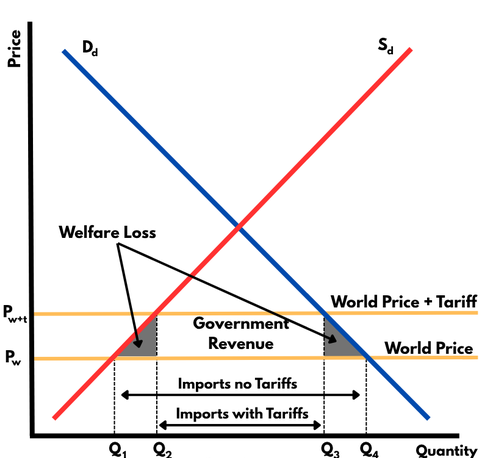
A tariff diagram can show how a tariff raises the domestic price above the world price, reducing imports and increasing domestic production. This illustrates how protection can support domestic producers.
Therefore, trade protection may be justified where it protects strategically important or developing industries and prevents significant employment losses, although the benefits depend on the type and duration of protection.
(b) Answer:
A trading bloc is a group of countries that agree to reduce or remove trade barriers between members. The degree of economic integration can vary from a free trade area to a customs union, common market or monetary union. The consequences therefore depend partly on the type and depth of integration.
One major advantage is greater market access. Removing trade barriers allows domestic firms to sell to a larger market. This can increase export demand and allow firms to expand production. A larger market can also enable firms to exploit economies of scale, reducing average costs and potentially lowering prices.
For example, membership of the European Union gives firms access to a large single market with reduced internal trade barriers. This can increase opportunities for trade and investment among member states.
Trading blocs can also increase competition. Domestic firms face greater competition from firms in other member countries, creating incentives to reduce costs, improve quality and innovate. Consumers may benefit through lower prices, greater choice and improved product quality.
Another benefit is the freedom of movement of labour in deeper forms of integration such as a common market. Workers can move towards countries where employment opportunities are greater, while firms can obtain workers with the skills they require. This can improve the allocation of labour and increase employment opportunities.
Trading blocs can also encourage foreign direct investment (FDI). Firms outside the bloc may establish production facilities within the bloc to gain access to its large integrated market. This can bring capital, technology and management skills to member countries and potentially increase productivity and economic growth.
For example, membership of the EU has helped make some member states attractive locations for multinational firms seeking access to the European single market.
Trading blocs may also increase political stability and cooperation. Greater economic interdependence can encourage member countries to cooperate on trade, investment and other economic issues. A bloc may also provide members with greater bargaining power when negotiating internationally.
However, trading blocs can create significant disadvantages. Increased competition from other member countries may harm industries that are relatively uncompetitive. Firms may reduce output or close, resulting in unemployment in particular regions or sectors.
This can potentially increase regional or national inequality within the trading bloc. More competitive countries or regions may attract greater investment and employment, while less competitive members may lose industries.
Another disadvantage is a possible loss of economic sovereignty. The deeper the integration, the more countries may have to accept common rules and policies. In a monetary union, for example, countries give up control over their national currency and independent monetary policy.
There can also be effects on balance of payments positions. Increased imports from partner countries may benefit consumers but could worsen the current account of a less competitive member state if its exports do not increase sufficiently.
Trading blocs may also create tensions with countries outside the bloc. A customs union, for example, establishes a common external tariff. This may divert trade away from lower-cost producers outside the bloc towards higher-cost producers within the bloc, creating trade diversion.
For example, the EU’s common external trade policies mean that individual member states cannot independently determine all of their external trade protection measures. This can provide collective bargaining strength but reduces individual policy autonomy.
Real-world example: The European Union demonstrates both the benefits and costs of economic integration. The single market has increased opportunities for trade, investment and labour mobility, while the common rules and deeper integration have required member states to accept restrictions on some aspects of national economic policy.
Another example is ASEAN, where greater regional economic integration has encouraged trade and investment among Southeast Asian economies. However, differences in development levels and competitiveness mean that the benefits are not necessarily distributed equally among all members.
Overall evaluation: Trading blocs can generate substantial benefits through larger markets, economies of scale, increased competition, investment, employment opportunities and greater consumer choice. These benefits are likely to be greater when countries have complementary economies and firms can respond effectively to increased market access.
However, the costs depend strongly on the type and depth of integration. A relatively shallow free trade agreement may provide trade benefits while preserving considerable national policy independence, whereas a monetary union involves much greater loss of sovereignty. Less competitive industries may also experience unemployment and structural adjustment problems.
Therefore, the consequences of trading blocs are mixed rather than universally positive or negative. For countries with competitive industries, good infrastructure and the ability to adapt to increased competition, integration can significantly increase economic growth and consumer welfare. However, countries or sectors that are less competitive may experience unemployment and adjustment costs, while deeper integration can involve greater restrictions on national economic policy. The overall outcome therefore depends on the structure of the trading bloc and the economic circumstances of its members.