
IBDP Economics 2.7 Role of government in microeconomic SL Paper 2- New Syllabus
Question
Read the extracts and answer the questions that follow.
Text A — The economy of Argentina
Argentina, the third-largest economy in Latin America, has experienced several cycles of high economic growth and deep recessions over the last 70 years. It has vast natural resources in energy and agriculture and potential for renewable energy. Its leading exports include soybeans and beef products, which contribute significantly to gross domestic product (GDP) and employment and are major sources of foreign currency. However, Argentina faces unfavourable climate conditions that create problems for the agriculture sector. A drought in 2023 caused over 20 billion United States dollars (USD) in losses for soybean farmers.
Argentina faces high relative poverty rates despite redistribution policies such as transfer payments. Argentina is known for extensive government intervention, including price ceilings on rent and strong protection for labour unions and workers.
For many years, Argentina managed its exchange rate by limiting the amount of foreign currency that citizens could purchase as well as by restricting imports. The aim was to protect reserve assets and prevent currency depreciation. This led to the establishment of an informal (unofficial) foreign exchange market and discouraged foreign direct investment (FDI). However, the foreign currency limitations resulted in an overvalued currency and failed to stop the level of reserve assets from decreasing.
In 2018, Argentina requested a loan from the International Monetary Fund (IMF) to help fund its budget deficit and large external debt repayments. However, Argentina defaulted on its debt repayments to the IMF, which led to low consumer and business confidence, causing large FDI and portfolio investment outflows. To receive future loans, the IMF requires Argentina to promote good governance, reduce government spending, increase reserve assets and control inflation.
In 2022, Argentina’s economic challenges continued with high inflation and a persistent budget deficit, leading to unsustainable debt. High inflation has led to declining real wages. Moreover, uncertainty about future prices has contributed to lower business investment.
Text B — Argentina’s new economic reforms
In December 2023, Argentina’s new government initiated reforms to help solve its economic challenges. The new economic reforms included:
- deregulating markets, such as removing price controls and restrictions on buying foreign currency
- privatization of 41 state-owned enterprises to improve efficiency, including the national airline, rail networks, state media, and major oil, water and sewage companies
- increasing labour market flexibility by reducing labour union power and lowering labour costs
- reducing government spending by cancelling infrastructure projects, reducing the size of the public sector and eliminating transport and energy subsidies.
The immediate result of removing restrictions on foreign currency purchases was a large depreciation of the Argentine peso (ARS), Argentina’s currency, as predicted by speculators. Moreover, inflation increased to over 250 %. The new government maintained that while the reforms may cause a short-term recession, the policies would ultimately lead to long-term price stability and economic growth, despite predictions that relative poverty rates could increase to 60 %. However, the government has stated it will continue spending on programmes to decrease poverty.
To address the budget deficit and maintain a trade surplus, the government increased taxes on cigarettes and imposed tariffs on imports such as laptops. Income taxes were increased, but the level of income on which no income tax is paid was raised from ARS 1.35 million to ARS 1.55 million per month.
The IMF supported the reforms and agreed to grant future loans to Argentina. The loans are important to establish international credibility and finance government spending.
Text C — Education and productivity in Argentina
Despite significant investments in education, achievement levels are not improving. Experts recommend that Argentina focus on improving the quality of education to decrease poverty rates and increase the economy’s productive capacity. Additionally, Argentina’s low female labour force participation rate indicates an underutilized resource. An improved education system could increase female participation in the economy and raise household incomes.
Table 1: Argentina’s exchange rates
| Year | Argentine peso (ARS) per US dollar (USD) |
|---|---|
| 2023 (before removing foreign exchange market restrictions) | 350 |
| 2024 (after removing foreign exchange market restrictions) | 820 |
Table 2: Development data for Argentina
| Indicator | 2013 | 2022 |
|---|---|---|
| Gini coefficient | 0.409 | 0.420 |
| Relative poverty rate (%) | 30 | 40 |
| Human Development Index (HDI) | 0.845 | 0.842 |
| Gender Inequality Index (GII) | 0.356 | 0.287 |
Table 3: Economic data for Argentina
| Indicator | 2013 | 2022 |
|---|---|---|
| Real GDP (USD billion) | 593.86 | 598.31 |
| Nominal GDP (USD billion) | 526.32 | 631.31 |
| Gross national income (USD billion) | 540.19 | 619.14 |
| Net trade in goods and services (USD million) | −694 | 5440 |
| Inflation rate (%) | 10.9 | 94.8 |
| Unemployment rate (%) | 7.1 | 6.8 |
| Exports (% of GDP) | 10.7 | 16.3 |
| Female labour force participation rate (%) | 48 | 50 |
| Government (national) debt (% of GDP) | 40.1 | 89.5 |
| Government budget (% of GDP) | −1.9 | −4.2 |
| Government employment (public sector) (% of total employment) | 18.0 | 23.4 |
(a) (i) Define the term reserve assets indicated in bold (Text A, paragraph 3). [2]
Show Answer
Reserve assets are foreign currency and other internationally accepted assets held by a central bank or government. They can be used to intervene in the foreign exchange market and support the value of the domestic currency.
(a) (ii) Define the term inflation indicated in bold (Text A, paragraph 5). [2]
Show Answer
Inflation is a sustained increase in the general price level of goods and services in an economy over time.
(b) (i) Using the data provided in Table 3, calculate the GDP price deflator for 2022. [2]
Show Answer
The GDP price deflator is calculated using:
\(\text{GDP price deflator} = \frac{\text{Nominal GDP}}{\text{Real GDP}} \times 100\)
\(= \frac{631.31}{598.31} \times 100\)
\(= 105.52\)
Answer: The GDP price deflator for 2022 is \(105.52\).
(b) (ii) Using your answer to part (b) (i), determine the percentage change in prices from the base year. [1]
Show Answer
Percentage change in prices:
\(105.52 – 100 = 5.52\%\)
Answer: Prices increased by \(5.52\%\) from the base year.
(b) (iii) Sketch a Lorenz curve to show how the change in the “level of income on which no income tax is paid” may affect Argentina’s income distribution (Text B, paragraph 3). [2]
Show Answer
Raising the income level at which no income tax is paid increases the tax-free threshold. This can increase the disposable income of lower-income households and may improve income equality.
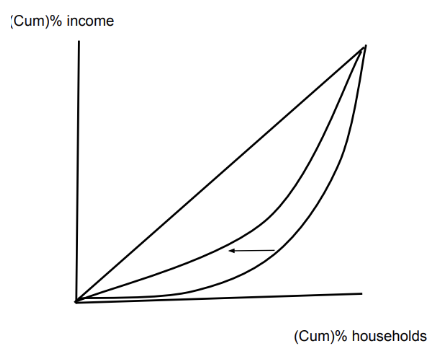
On a Lorenz curve, improved income distribution is shown by the curve shifting towards the line of perfect equality.
(c) Using an AD/AS diagram, explain how privatization might affect inflation (Text B, paragraph 1). [4]
Show Answer
Privatization transfers state-owned enterprises to private ownership. Private firms have a profit incentive to improve efficiency and productivity and reduce production costs.
Lower production costs can increase short-run aggregate supply (SRAS), shifting SRAS to the right. Alternatively, greater productive capacity can shift LRAS to the right.
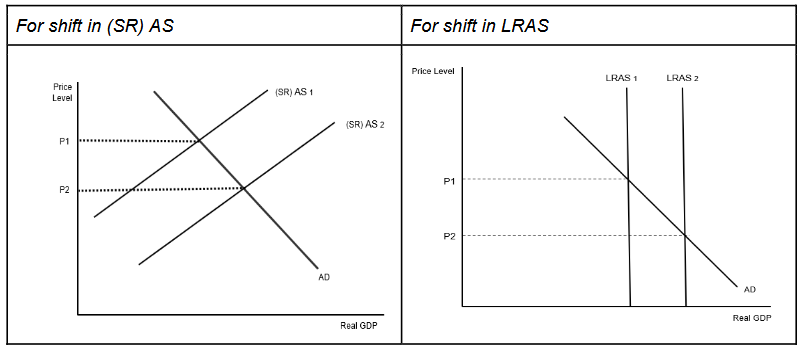
With aggregate demand unchanged, an increase in aggregate supply reduces the general price level. Therefore, privatization may reduce inflationary pressure if efficiency gains are sufficiently large.
(d) Using a demand and supply diagram, explain how eliminating the transport subsidies may impact transport producers’ revenue (which includes payments by the government) (Text B, paragraph 1). [4]
Show Answer
A subsidy is a payment made by the government to producers. It lowers producers’ effective costs and shifts the supply curve to the right.
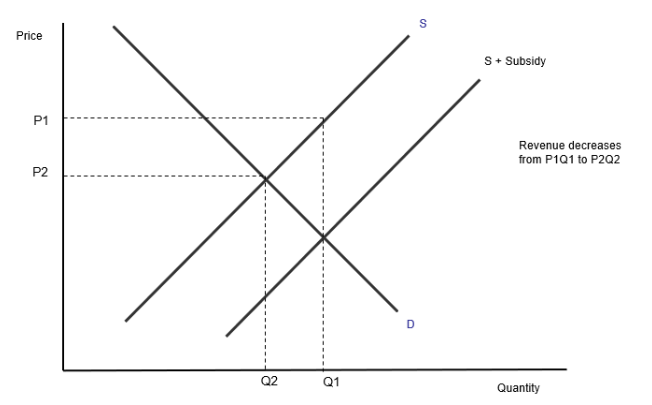
When the transport subsidy is eliminated, producers no longer receive the government payment. Their effective costs increase, causing the supply curve to shift leftwards.
The market price of transport services rises, but the quantity supplied falls. Producers also lose the additional revenue previously received from the government subsidy. Therefore, their total revenue, including government payments, is likely to decrease.
(e) Using an international trade diagram, explain how the quantity of laptops consumed will change due to the introduction of a tariff (Text B, paragraph 3). [4]
Show Answer
A tariff is a tax imposed on imported goods. The tariff raises the domestic price of imported laptops above the world price.
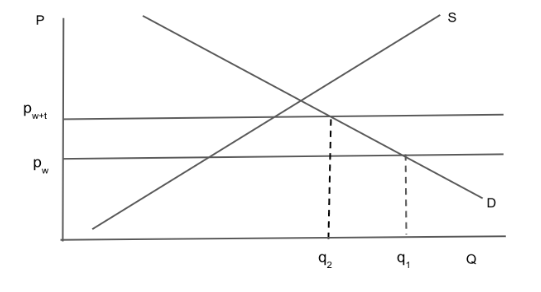
The higher domestic price causes a contraction in quantity demanded, as consumers move upwards along the demand curve.
Therefore, the quantity of laptops consumed decreases following the introduction of the tariff.
(f) Using a production possibilities curve (PPC) diagram, explain how following the experts’ recommendation about education may impact Argentina’s production possibilities (Text C). [4]
Show Answer
Improving the quality of education increases the quality and productivity of labour. It can also increase female labour-force participation by improving skills and employment opportunities.
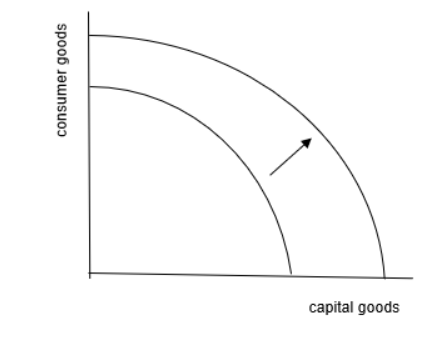
Higher labour productivity increases Argentina’s productive capacity. Therefore, the PPC shifts outwards, showing that the economy can produce a greater combination of goods and services.
This can contribute to long-run economic growth and potentially improve economic development through higher incomes and employment.
(g) Using information from the text/data and your knowledge of economics, discuss the consequences on Argentina’s economy of a depreciation of the Argentine peso (ARS). [15]
Show Answer
Introduction
A depreciation of the Argentine peso means that the value of the peso falls relative to foreign currencies. Its consequences are likely to be mixed, affecting exports, imports, inflation, economic growth, employment, investment and living standards.
Impact on exports and economic growth
A depreciation makes Argentine exports cheaper in foreign-currency terms. Therefore, demand for exports may increase, particularly for important exports such as soybeans and beef. These exports contribute significantly to GDP and employment.
Higher exports increase net exports, which increases aggregate demand. This may increase real GDP and economic growth. Export industries may also experience increased employment and investment.
Higher export earnings may also strengthen Argentina’s external position and increase the availability of foreign currency.
Impact on imports and the balance of payments
A weaker peso makes imported goods and services more expensive in Argentina. Consumers may substitute away from imports towards domestically produced goods.
This may reduce import expenditure and improve net exports and the current account. However, the extent of the improvement depends on the price elasticities of demand for exports and imports and on whether domestic firms can increase production.
Inflationary pressures
A major disadvantage is that depreciation increases the domestic price of imported goods and raw materials. Firms that depend on imported inputs face higher production costs, causing cost-push inflation.
There may also be additional demand-pull inflation if increased exports raise aggregate demand significantly.
This is particularly serious for Argentina because inflation was already very high. The data show that inflation increased from 10.9% in 2013 to 94.8% in 2022. Therefore, further depreciation could worsen an existing inflation problem.
Impact on real wages, poverty and living standards
Higher inflation caused by depreciation may reduce real wages if nominal wages do not rise as quickly as prices. This reduces households’ purchasing power.
The text states that high inflation has already caused declining real wages. A further reduction in real incomes could increase relative poverty and worsen living standards.
It may also increase government pressure to provide transfer payments and poverty-reduction programmes.
Impact on investment and FDI
Depreciation can make Argentine assets and production costs cheaper for foreign investors, potentially encouraging foreign direct investment (FDI). It may also correct the previous problem of an overvalued currency.
However, persistent depreciation and high inflation can increase economic uncertainty. Businesses may postpone investment because future costs, revenues and exchange rates become difficult to predict.
This could reduce business investment and limit long-run economic growth.
Impact on external debt
If Argentina has foreign-currency-denominated debt, depreciation makes the debt more expensive when measured in pesos. This increases the domestic-currency cost of servicing external debt and may put additional pressure on the government budget.
Overall evaluation
The consequences of depreciation depend on the size of the depreciation, the price elasticities of exports and imports, the level of foreign-currency debt and the ability of domestic producers to increase output.
In the short run, depreciation is likely to create significant inflationary and living-standard costs for Argentina because the economy already suffers from very high inflation and relative poverty.
However, in the long run, a more competitive exchange rate could improve export competitiveness, increase employment, strengthen net exports and support economic growth if domestic producers can expand output.
Therefore, depreciation could provide benefits through improved international competitiveness, but these benefits may be outweighed in the short run by higher inflation, falling real wages and increased uncertainty. The overall outcome will depend on Argentina’s ability to restore price stability and business confidence while taking advantage of greater export competitiveness.
Most-appropriate topic codes (CED):