
IBDP Economics 1.1 What is economics? SL Paper 1- New Syllabus
Question
(a) Using a production possibilities curve (PPC), explain the concepts of scarcity and opportunity cost. [10]
(b) Using real-world examples, evaluate the view that the most effective way of increasing the consumption of healthcare is through the provision of subsidies. [15]
Most-appropriate topic code (CED):
▶️ Answer/Explanation
(a) Answer:
Scarcity arises because resources such as land, labour, capital and entrepreneurship are limited, while human wants are unlimited. Therefore, an economy cannot produce everything that people want and must make choices about how its scarce resources are allocated.
A production possibilities curve (PPC) shows the maximum possible combinations of two goods or services that an economy can produce when its resources and technology are fully employed and efficiently used. The PPC therefore illustrates the problem of scarcity because the economy cannot produce combinations beyond the curve with its existing resources and technology.
For example, an economy may have to choose between producing healthcare and education. If all resources are fully employed, producing more healthcare requires some resources to be transferred away from education. This means the economy must make a choice because its resources are scarce.
Opportunity cost is the value of the next best alternative forgone when a choice is made. On a PPC, moving from one point to another along the curve involves reallocating resources between the two goods. The amount of one good that must be sacrificed to produce more of the other represents its opportunity cost.
For example, if an economy moves along its PPC to produce more healthcare, it may have to reduce the production of education. The education output forgone is the opportunity cost of producing additional healthcare.
If resources are fully employed and the economy is operating on the PPC, increasing the production of one good normally requires a reduction in the production of the other good. Therefore, an opportunity cost is incurred.
However, if the economy is operating inside the PPC, resources are not being fully employed or are being used inefficiently. In this situation, production of one good can increase without necessarily reducing production of the other good. Therefore, no opportunity cost needs to be incurred from reallocating fully employed resources.
The PPC assumes, for simplicity, that the available resources and the state of technology remain constant. It also assumes that resources are fully employed and completely mobile when considering production possibilities along the curve.
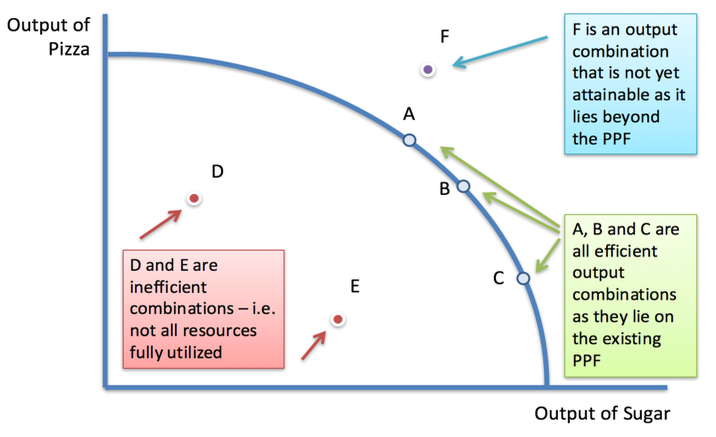
A PPC should show combinations of two goods, such as healthcare and education. Points on the PPC represent efficient use of resources and demonstrate scarcity. A movement from one point on the PPC to another demonstrates choice and the opportunity cost of increasing the production of one good.
Therefore, the PPC illustrates the fundamental economic problem: because resources are scarce, choices must be made, and when resources are fully employed, those choices involve an opportunity cost.
(b) Answer:
Healthcare is generally regarded as a merit good because individuals may under-consume it if it is left entirely to the market. Healthcare can also generate positive externalities because a healthier population can create benefits for other members of society, such as lower transmission of infectious diseases and a more productive workforce.
One way for governments to increase healthcare consumption is through the provision of subsidies. A subsidy is a payment from the government to producers that reduces their effective cost of production. This can shift the supply curve to the right, lowering the market price and increasing the quantity of healthcare consumed.
For example, if the government subsidizes medical treatment or healthcare providers, producers can supply healthcare at a lower cost. Consumers may then face lower prices, increasing their ability and willingness to consume healthcare services.
Subsidies can also improve equity. Lower-income households may be unable to afford sufficient healthcare at market prices. Reducing the price through a subsidy can increase their access to healthcare and potentially improve their health outcomes and living standards.
Subsidies may also benefit producers. Lower production costs can increase producer revenue and allow healthcare providers to expand capacity, employ more workers or invest in improved facilities and technology.
For example, governments in many countries subsidize healthcare through public funding or payments to healthcare providers. This reduces the direct cost faced by patients and increases access to essential medical services.
A subsidy may also help correct positive externalities of consumption. If the social marginal benefit of healthcare is greater than the private marginal benefit, the free-market equilibrium quantity will be below the socially desirable quantity. A subsidy can reduce the price and encourage consumption towards the socially optimal level.
However, subsidies are not necessarily the most effective policy. They involve a significant opportunity cost because government resources used to subsidize healthcare cannot simultaneously be spent on other priorities such as education, infrastructure or poverty reduction.
There may also be government budgetary costs. A large subsidy programme may require higher taxation, increased borrowing or reductions in other government expenditure. This becomes particularly important when the government has limited financial resources.
Subsidies may also create producer inefficiency. If healthcare providers receive substantial government support, they may have less incentive to reduce costs or improve efficiency because part of their costs are effectively covered by the government.
Another limitation is that subsidies may not fully solve the problem of under-consumption caused by imperfect information. Consumers may not understand the long-term benefits of preventative healthcare even if the price is reduced. In such cases, a subsidy alone may not generate the desired increase in consumption.
Education and awareness programmes can therefore complement or sometimes outperform subsidies. Providing information about vaccinations, preventative healthcare, nutrition and regular medical screening can reduce imperfect information and encourage consumers to recognize the benefits of healthcare.
Direct government provision is another alternative. Rather than subsidizing private healthcare providers, the government can directly provide healthcare through publicly funded hospitals and clinics. This may improve access for low-income households and ensure that essential services are available even where private provision would be insufficient.
For example, the United Kingdom’s NHS provides healthcare largely through government funding rather than relying solely on subsidies to private healthcare providers. This can provide broad access to healthcare regardless of an individual’s ability to pay.
Subsidies may nevertheless be preferable where private providers already have the capacity to supply healthcare efficiently. In such circumstances, subsidizing consumption or production can increase access while allowing consumers and producers to retain some choice.
Overall evaluation: Subsidies can be highly effective in increasing healthcare consumption because they reduce prices, lower production costs, improve affordability and can help correct positive externalities. They are particularly useful where high prices are the main barrier preventing consumers from accessing healthcare.
However, the word “most effective” means that subsidies must be compared with alternative policies. Direct government provision may provide more universal access, while education can address imperfect information and encourage greater long-term demand for healthcare. The effectiveness of each policy also depends on the availability of healthcare providers, the size of the subsidy and the government’s fiscal capacity.
Therefore, subsidies are an important and potentially effective method of increasing healthcare consumption, but they are not always the most effective approach. A combination of subsidies, direct government provision and education is likely to be more effective because it can simultaneously address affordability, access and imperfect information while reducing the risk that reliance on subsidies alone creates inefficiency or excessive government expenditure.