Can the Democratic Republic of the Congo achieve its economic potential?
- The Democratic Republic of the Congo (DRC) is a nation of great potential. It has large mineral resources and an abundance of fertile land. The mining and export of cobalt, copper and gold are the main source of government revenue. However, the abundance of natural resources causes devastating conflicts as rebel groups fight for control of the DRC’s resources. With a population of 80 million and gross domestic product (GDP) per capita of only US$457, the DRC is one of the world’s poorest nations. It is ranked 176 in the world in terms of the Human Development Index (HDI).
- The government has been accused of relying too much on tariffs, but to improve living standards, the government needs revenue to spend on agriculture, electricity and roads. Furthermore, business owners in the DRC complain of corruption and increasing “red tape” (excessive regulations).
- The government believes that a strong agricultural sector could boost economic growth but only 10 % of the land is used for farming. Rice, maize and other crops grow well in the tropical climate and yet the government spends US$1 billion per year importing basic foods. According to a government spokesperson, the lack of infrastructure is a major barrier to the processing and transporting of agricultural products. The DRC’s road network is so bad that farmers and traders often make a two-week trip in small boats down the Congo River to sell their produce. The DRC has just 27 877 kilometres (km) of roads. It is estimated that 90 000 km of national roads and 150 000 km of rural roads must be built.
- In addition, the World Bank reports that only 17 % of the DRC’s population has access to electricity, despite the capacity of the Congo River to generate enough electricity to satisfy the needs of the region.
- To make matters worse, the regional conflicts have affected the availability of healthcare services. It is estimated that half of the health centres have been looted*, burnt or destroyed. Government expenditure on healthcare per capita remains one of the lowest in the world. Non-governmental organizations (NGOs) are relied on to protect the health and wellbeing of citizens. NGOs help to achieve this by distributing medicine and teaching families about hygiene and proper sanitation.
Question
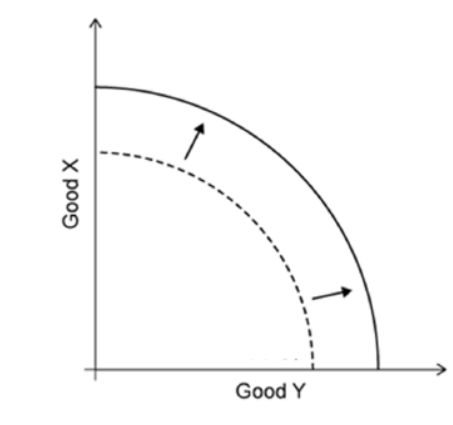
Using a production possibilities curve (PPC) diagram, explain how the production possibilities (potential output) of the DRC might be affected if there were greater access to electricity (paragraph [4]).
▶️Answer/Explanation
For a PPC (outward shift) showing an increase in the potential output in the DRC
AND
for explaining that greater access to electricity may increase efficiency/productivity (increases the quality and/or the quantity of the factors of production) and hence increase potential output (productive capacity).