
▶️ Answer/Explanation
1. According to Source A, what factors encouraged the Norse to search for new territories across the North Atlantic? [3]
Source A identifies several factors:
- Population pressure in existing Norse settlements.
- Political unrest in the Norse homelands.
- Increasing pressure on available land in Iceland.
- A major famine around 975, which encouraged further expansion.
Any three clearly identified factors would provide a strong response.
2. What does Source A suggest about the influence of environmental conditions on Norse settlement in Greenland? [4]
Source A suggests that environmental conditions strongly affected the location and economic character of Norse settlement in Greenland.
The Eastern Settlement became more heavily populated because it offered better conditions for livestock farming.
Greenland was poorly suited to growing grain, so settlers relied heavily on sheep and goats. This demonstrates how the Norse adapted their economy to local environmental conditions.
The limitations of Greenland’s environment also contributed to continued dependence on trade with Europe.
3. Explain the significance of Norse sea-going vessels to the expansion described in Source A. [4]
Source A identifies the knarr as an important vessel used during Norse expansion.
These ships could carry people, livestock and cargo, which was essential for creating new settlements rather than simply conducting voyages of exploration.
Their ability to travel across the North Atlantic enabled Norse settlers to reach Iceland and Greenland and maintain communication with Europe.
Knarrs were therefore important both for expansion and economic survival, particularly because Greenland depended on external trade.
4. What, according to Source B, attracted the Norse to the lands west of Greenland? [3]
Source B indicates that the western lands contained resources that were attractive to the Norse.
- Bjarni saw forested land unlike Greenland.
- Markland was described as flat and wooded.
- Vinland had grassy meadows.
- Its rivers were rich in salmon.
- The area appeared capable of supporting people through the winter.
5. What does Source B reveal about the difference between the voyages of Bjarni Herjólfsson and Leif Erikson? [4]
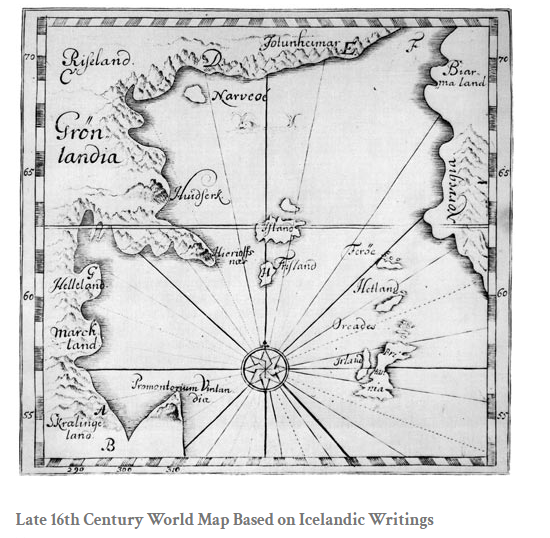
Bjarni’s encounter with western lands was largely accidental. A storm blew him off course while he was travelling from Iceland to Greenland.
Although he saw unfamiliar land, Bjarni did not land or attempt to explore it. He continued towards Greenland.
Leif Erikson, in contrast, deliberately retraced Bjarni’s route and explored several regions.
Leif and his crew also constructed houses and spent time in Vinland, making his expedition a deliberate attempt at exploration and temporary settlement.
6. With reference to its origin and content, analyse the value and limitations of Source B for a historian studying Norse exploration of Vinland. [6]
Source B is based on saga traditions relating to the voyages of Bjarni Herjólfsson and Leif Erikson. This is valuable because the sagas preserve accounts of individuals, routes and places associated with Norse exploration.
The content provides specific information about Bjarni’s accidental voyage and Leif’s later deliberate exploration.
It also describes the environmental characteristics of Helluland, Markland and Vinland, helping historians understand why certain regions may have attracted Norse explorers.
However, saga accounts were preserved and recorded after the events described. Their content may therefore reflect memory, storytelling and later interpretation.
Descriptions of resources and locations cannot automatically be treated as precise contemporary observations.
Source B is therefore valuable for reconstructing how Norse exploration was remembered and for identifying possible motives and routes, but its claims should be compared with archaeological evidence.
7. What archaeological evidence in Source C indicates that L’Anse aux Meadows was an organized Norse settlement? [3]
Source C identifies several forms of archaeological evidence:
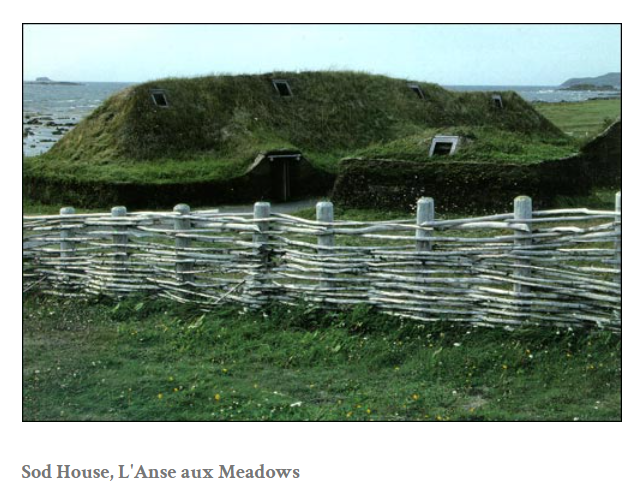
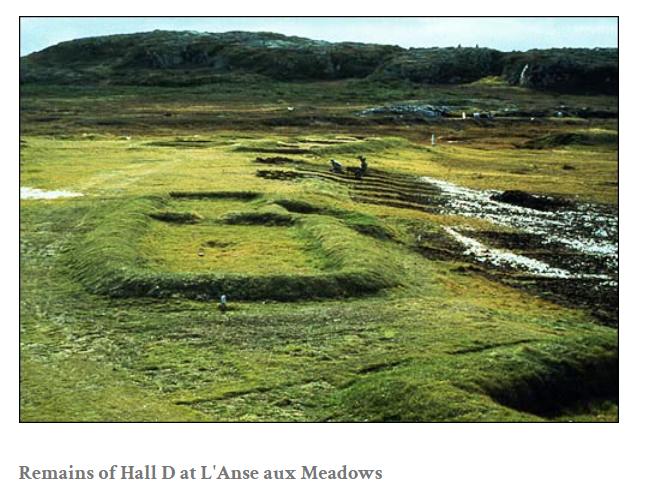
- Approximately eight buildings.
- A bloomery and smithy used for iron working.
- Nails, rivets and other iron objects.
- A spindle whorl, bone needle and whetstone associated with everyday life.
These finds indicate an organized community rather than simply a temporary landing by explorers.
8. What does Source C suggest about the purpose and character of the settlement at L’Anse aux Meadows? [4]
Source C suggests that L’Anse aux Meadows was a small and temporary settlement.
It probably accommodated no more than about 75 people and appears to have been occupied only seasonally for a limited number of years.
The iron-working facilities and the production of nails and rivets suggest that one important function was ship repair and maintenance.
The site probably also served as a base for exploration farther south, rather than becoming a permanent agricultural colony comparable to the Greenland settlements.
9. Analyse how the archaeological and modern historical context of Source C affects its usefulness for studying the successes and limitations of Norse settlement in North America. [6]
Source C is particularly useful because it draws on physical archaeological evidence. Buildings, iron-working facilities and everyday objects provide direct material evidence that Norse people reached and lived in North America.
The archaeological evidence confirms practical achievements such as iron working and ship maintenance, demonstrating that the settlement was more substantial than a brief exploratory landing.
At the same time, the small number of buildings, limited population and short occupation provide evidence of the limitations of Norse settlement.
Modern historians can combine these discoveries with evidence concerning the distance from Greenland, its limited population and conflict with the Skrælingjar to explain why a permanent colony was difficult to sustain.
Archaeological evidence nevertheless has limitations because physical remains cannot directly reveal the motives, intentions or perceptions of individual settlers.
Source C is therefore highly useful for establishing the physical reality, organization and limited scale of Norse settlement, but written evidence is also required to understand motivations and individual experiences.