
▶️ Answer/Explanation
1. According to Source A, what environmental challenges did the Aztecs face when establishing Tenochtitlán? [3]
Source A indicates that the Aztecs settled in an area dominated by marshy and swampy land near Lake Texcoco.
Suitable agricultural land was therefore limited, and the environment required substantial modification before it could support a growing settlement.
The location also created the need for careful management of water and food resources.
2. What does Source A suggest about the ways in which the Aztecs adapted to the environment of the Valley of Mexico? [4]
Source A shows that the Aztecs actively modified their environment rather than simply accepting its limitations.
They drained swampy areas and constructed artificial islands that could be used for cultivation.
They developed intensive agriculture and used irrigation methods to increase food production.
They also supplemented agriculture through fishing and hunting, showing that they exploited several different environmental resources.
3. Explain how Source A demonstrates the relationship between environmental conditions and innovation in the development of the Aztec state. [4]
The difficult environment created a need for technological and agricultural adaptation.
Because much of the land around Lake Texcoco was marshy, the Aztecs developed techniques to drain land and create new areas suitable for cultivation.
Irrigation and intensive agriculture allowed the population to produce enough food to support a larger settlement.
Source A therefore suggests that environmental pressures encouraged innovation in agriculture and water management, which in turn contributed to the growth of Tenochtitlán and the strength of the Aztec state.
4. According to Source B, what was the significance of the Triple Alliance formed in 1428? [3]
The alliance united the Aztecs with Texcoco and Tacuba.
Together they defeated their powerful Tepanec rivals and captured Azcapotzalco.
The alliance then became the political and military foundation for the subsequent expansion of Aztec power.
5. What does Source B suggest about the roles of Itzcoatl and Moctezuma I in the expansion of Aztec power? [4]
Itzcoatl played an important role in establishing the political conditions for imperial expansion. Under his leadership, the Aztecs formed the Triple Alliance and defeated the Tepanecs.
This victory removed a major regional rival and strengthened Tenochtitlán’s position.
Moctezuma I, who succeeded Itzcoatl in 1440, continued the process of expansion and became remembered as an important warrior.
The source therefore presents both rulers as important in transforming Aztec political and military power into an expanding empire.
6. With reference to its origin and content, analyse the value and limitations of Source B for a historian studying the establishment and expansion of the Aztec Empire. [6]
Source B is adapted from a modern article written and regularly updated by HISTORY.com Editors. This gives it value as an accessible secondary account that summarizes major events in the creation of the Aztec Empire.
Its content is particularly useful because it identifies the formation of the Triple Alliance in 1428, the defeat of the Tepanecs, and the importance of Itzcoatl and Moctezuma I.
It also highlights both warfare and commerce as mechanisms through which Aztec influence expanded.
However, the source is a broad modern overview rather than a specialist academic study or contemporary Aztec account.
It provides limited detail about the internal workings of the Triple Alliance, the distribution of power among its members or the experiences of conquered communities.
It is therefore useful for establishing the broad pattern of imperial growth, but a historian would need additional primary and specialist sources for a more detailed investigation.
7. According to Source C, what features supported the growth of Tenochtitlán as a major urban centre? [3]
Source C identifies several important features:
- Large and active markets such as Tlatelolco.
- An extensive system of aqueducts.
- Effective agriculture and water management capable of supporting a large population.
8. What does Source C suggest about the relationship between infrastructure, commerce and urban growth in the Aztec Empire? [4]
Source C suggests that Tenochtitlán’s growth depended on several interconnected systems.
Aqueducts supplied water for irrigation and bathing, helping support both agriculture and everyday urban life.
Markets such as Tlatelolco enabled large-scale exchange of goods and contributed to the city’s economy.
Infrastructure, food production and commerce therefore worked together to sustain a very large urban population.
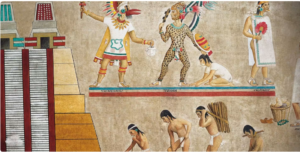
9. Analyse how Source C can be used by a historian investigating the role of innovation and organization in the development of the Aztec Empire. [6]
Source C is useful because it shows that Aztec power depended on more than military conquest.
The development of aqueducts demonstrates technological organization and the ability to manage water resources in a difficult environment.
Large markets reveal a highly developed commercial system capable of supplying and connecting a substantial urban population.
The size of Tenochtitlán also suggests effective planning, agricultural production and administrative organization.
Source C additionally indicates that Aztec society was highly structured, which may have helped organize labour and resources.
Its limitation is that, as a modern overview, it summarizes these developments rather than explaining precisely how individual systems were constructed or administered. It is therefore most useful for identifying the broad relationship between innovation, organization and imperial development.