Focused Study 2: Independence and Identity
Kenyan Independence (1945–1978) — SL & HL Paper 1 Source Practice
Read Sources A to C and answer Questions 1 to 9. The sources relate to the growth of Kenyan nationalism, attempts to create political unity and the contribution of trade unions to the struggle against colonial rule.
Source A
The struggle for independence contributed to the development of Kenyan nationalism and national consciousness. Shared African resentment of colonialism helped create a common political response among people who did not necessarily have identical ethnic or regional interests. Colonialism therefore provided a common stimulus around which nationalist ideas could develop.
Political organization during this period was not completely unified. Some organizations remained ethnically based while others attempted to build broader coalitions. Attempts to organize across ethnic lines did not always succeed immediately. Nevertheless, such experiments were important because they provided experience in building national political movements.
Political activists recognized that ethnic divisions created serious obstacles to nationalism. African leaders were also aware that British colonial policy could benefit from keeping different communities politically separated. The search for unity was therefore both an ideological goal and a practical political strategy.
The independence struggle brought together political associations, trade unions and other forms of organization. Different groups did not necessarily agree on the best method for obtaining independence. Yet their activities contributed collectively to an expanding political consciousness.
The author argues that these experiences helped lay the psychological foundations of nation building. Common opposition to colonial rule created experiences and political memories that could later be interpreted as part of a Kenyan national identity.
Source B
The search for African political unity was not limited to formal political parties. Trade unions also became important vehicles for African political demands. The East Africa Trade Union Congress was associated with leaders including Bildad Kaggia, Fred Kubai and Makhan Singh.
These union leaders rejected the idea that labour issues could be separated completely from politics. Industrial grievances and demands for political rights increasingly became connected. Trade union organizations therefore became a means of expressing broader African opposition to colonial rule.
During the Emergency, the position of trade unions became particularly important. Formal African political activity faced severe restrictions. According to Tom Mboya, trade unions consequently became one of the principal African voices both politically and industrially.
Many trade unionists believed that organized labour had to identify itself with the nationalist cause. Workers’ demands were therefore connected to questions of political representation, racial inequality and colonial authority. The labour movement provided political activists with organizational experience and networks.
Trade unions also demonstrated that nationalist activity did not take place only through established political parties. Industrial organization allowed workers to participate directly in the wider movement for political change.
Source C
British colonial administration had encouraged political organization at local and ethnic levels. African political activity was often restricted to associations representing particular districts or communities. These restrictions helped keep many political demands focused on local interests.
Organizations emerged among several communities, including the Young Kavirondo Association, Kikuyu Central Association and Taita Hills Association. Such organizations responded to genuine local grievances. However, their ethnic character made the construction of a national political movement more difficult.
Even the Kenya African Union, regarded as an early attempt at national political organization, drew much of its support from the Kikuyu. During the State of Emergency, national political parties were banned. Ethnically based district associations, however, were allowed to operate.
This colonial policy encouraged continued political separation. Nationalist leaders therefore faced the difficult task of creating a common Kenyan political identity while working within institutions that had often been organized along ethnic lines.
The struggle for national unity was consequently neither automatic nor complete. It developed through political negotiation and repeated attempts to overcome divisions inherited from colonial rule.
Questions
1. According to Source A, what factors encouraged the development of Kenyan nationalism? [3]
2. What does Source A suggest about the difficulties involved in creating national political unity? [4]
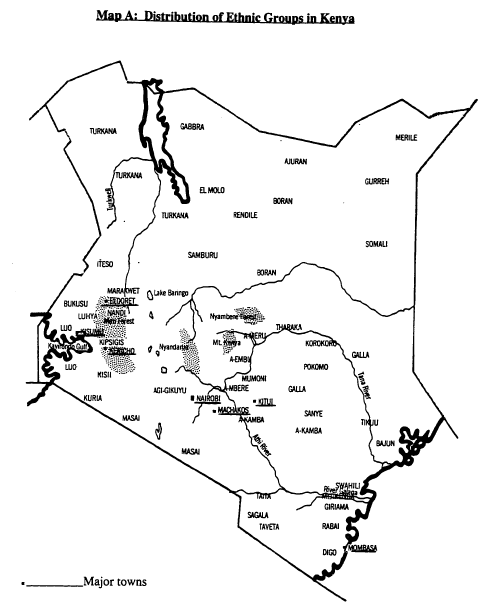
3. Explain how Source A and the map can be used together to investigate the development of Kenyan nationalism. [4]
4. According to Source B, what roles did trade unions play in the nationalist struggle? [3]
5. What does Source B suggest about the relationship between labour activism and political nationalism? [4]
6. With reference to its origin and content, analyse the value and limitations of Source B for studying trade unions in the independence struggle. [6]
7. According to Source C, how did colonial policy influence African political organization? [3]
8. What does Source C suggest about the relationship between ethnicity and nationalism? [4]
9. Analyse how Sources A to C explain the challenges involved in creating a national independence movement in Kenya. [6]
Most-appropriate topic:
• FOCUSED STUDY 2: Independence and Identity — Kenyan Independence (1945–1978)
• Grounding content: development of nationalism; political organizations; ethnic divisions; national unity; trade union movement; African political participation
