Focused Study 3: Political and Economic Transitions
The Meiji Restoration (1853–1894) — SL & HL Paper 1 Source Practice
Read Sources A to C and answer Questions 1 to 9. The sources relate to Commodore Perry’s arrival, economic disruption, samurai opposition and the weakening of the Tokugawa shogunate.
Source A
For more than two hundred years, Tokugawa isolationist policies had limited Western involvement in Japan. By the middle of the nineteenth century, however, the shogunate could no longer prevent foreign pressure. On 8 July 1853, four American naval vessels commanded by Commodore Perry entered Tokyo harbour.
The ships presented Japan with an obvious demonstration of American military power. Campbell characterizes Perry’s message as effectively asking whether Japan would trade peacefully or face conflict. Japan did not possess a navy capable of challenging the American squadron.
The Japanese government therefore chose negotiation rather than military resistance. Perry acted on behalf of United States President Millard Fillmore. American pressure forced Japan to open harbours to United States trade.
This ended the centuries-old prohibition against extensive Western commercial contact. The opening of Japan also increased exposure to European and American ideas. The decision therefore had political, economic and cultural consequences.
The encounter demonstrated the weakness of Tokugawa foreign policy. A system designed to keep Western powers at a distance could not withstand the pressure of industrial naval power.
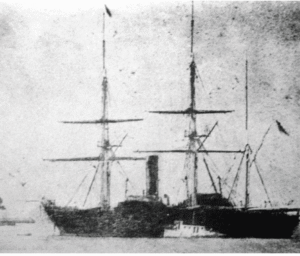
Photograph of one of Commodore Perry’s ‘Black Ships’ that opened up Japanese markets to US trade”
Source B
Adapted from Campbell’s discussion of the economic consequences of opening Japan, PDF page 3.
Opening Japan to foreign trade brought Western ideas and commercial activity into the country. However, economic change occurred very quickly. Foreign money entered Japanese markets at a pace that the existing economy was not prepared to absorb.
Campbell states that this contributed to economic destabilization. The government therefore faced domestic economic difficulties at the same time that it was confronting foreign pressure.
Japanese observers were also aware of what had happened to China. The Opium Wars appeared to demonstrate the dangers that might accompany economic and political involvement with Western states. Japan therefore approached foreign trade with considerable anxiety.
The shogunate’s own domestic policies made matters worse. People increasingly blamed the shogun for the difficulties they were experiencing. Criticism of foreign policy became linked with dissatisfaction over domestic government.
The opening of Japan therefore weakened the shogunate in two ways. It demonstrated the government’s inability to resist foreign pressure and contributed to economic conditions that increased domestic discontent.
Foreign intervention was consequently not simply an external problem. It became a catalyst for internal political opposition.
Source C
Adapted from Campbell’s account of lower-ranking samurai and the sonnō jōi movement, PDF page 3.
Lower-ranking samurai became an important source of opposition to the Tokugawa government. Some were appointed to official positions by the shogun. On the surface, these appointments appeared to represent promotions.
However, Japan’s rigid social hierarchy prevented many of them from gaining the authority they expected. They remained frustrated by the privileges of higher-ranking elites. Their dissatisfaction therefore had an important domestic social dimension.
Foreign policy added to this resentment. Many lower-ranking samurai believed that the shogunate was endangering Japanese sovereignty by allowing Western influence into the country.
They increasingly redirected their political loyalty toward the emperor. The slogan sonnō jōi expressed this position: “Revere the emperor, Expel the barbarian.” The emperor therefore became a symbol around which opposition to the shogunate could organize.
Some rebellious factions attacked foreigners in Japanese ports. They also participated in local uprisings against the shogunate. These attacks did not by themselves overthrow Tokugawa rule.
Nevertheless, they weakened the shogun’s position among political elites. The shogunate therefore faced growing opposition from groups that combined social frustration, nationalism and loyalty to the emperor.
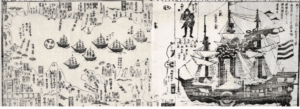
Japanese print from 1854 showing a paddlewheel steamer belonging to Commodore Perry’s squadron”
Questions
1. According to Source A, why did Japan agree to negotiate with Commodore Perry? [3]
2. What does Source A suggest about the effect of Western naval power on Japanese sovereignty? [4]
3. Explain how the Black Ships image can be used alongside Source A to investigate American pressure on Japan. [4]
4. According to Source B, what problems followed the opening of Japan to foreign trade? [3]
5. What does Source B suggest about the relationship between foreign pressure and domestic political instability? [4]
6. With reference to its origin and content, analyse the value and limitations of Source B for studying the fall of the Tokugawa shogunate. [6]
7. According to Source C, why did lower-ranking samurai oppose the shogunate? [3]
8. What does Source C suggest about the significance of sonnō jōi? [4]
9. Analyse how Sources A to C together explain the weakening of Tokugawa rule after 1853. [6]
Most-appropriate topic:
• FOCUSED STUDY 3: Political and Economic Transitions — The Meiji Restoration (1853–1894)
• Grounding content: Commodore Perry; opening of Japan; economic instability; foreign influence; lower-ranking samurai; sonnō jōi; decline of Tokugawa authority
