
▶️ Answer/Explanation
1. According to Source A, what forms did post-war population displacement take? [3]
Source A identifies several forms of movement, including flight, expulsion, organised transfer, repatriation and resettlement. It also includes people displaced when borders changed around them even if they did not initially move. Refugees included Germans, Jews, Poles, Ukrainians, liberated forced labourers, prisoners of war and evacuees. The source therefore presents post-war displacement as a broad European phenomenon rather than one single refugee movement.
2. What does Source A suggest about why the end of the war did not end displacement? [4]
The end of fighting did not remove the political and ethnic conflicts that had produced displacement. New frontiers, expulsions and state-led population transfers continued to force people from homes. Many survivors could not return because communities had been destroyed or because their former homes now lay in another state. Peace therefore ended one form of violence while generating new population movements.
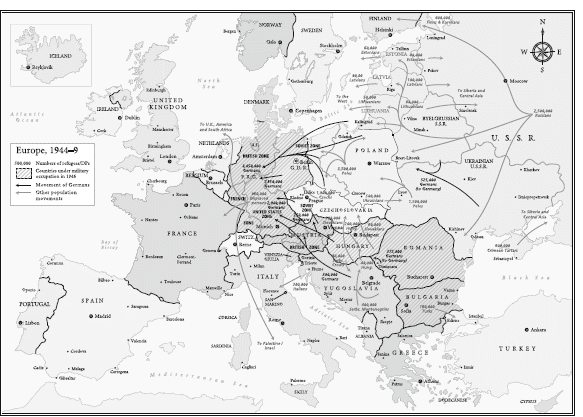
3. Explain how the map can be used alongside Source A to investigate the scale of displacement. [4]
The map shows that movements crossed large parts of Europe and were especially concentrated in Central and Eastern Europe. It helps connect migration routes with changed frontiers and occupation zones. Used with Source A, it makes the transnational scale of displacement much clearer. However, it cannot reveal the individual experience, degree of coercion or motive behind each route, so written evidence remains necessary.
4. According to Source B, why does Gatrell use the term “violent peacetime”? [3]
Gatrell uses “violent peacetime” because coercion and conflict continued after formal hostilities ended. Expulsions of Germans, Polish–Ukrainian transfers and the Kielce pogrom all occurred in the post-war setting. Local wars and political violence also continued elsewhere in Europe. The phrase challenges the assumption that 1945 produced an immediate transition to peaceful stability.
5. What does Source B suggest about the relationship between state policy and displacement? [4]
Source B shows that states actively reshaped populations rather than merely reacting to spontaneous refugee movements. Governments and Allied decision-makers used transfers and expulsions to make populations fit new territorial arrangements. These policies were justified as ways of creating order, security and ethnic homogeneity, although punitive motives also existed. Displacement therefore became part of deliberate post-war state-building.
6. With reference to its origin and content, analyse the value and limitations of Source B for studying post-war displacement. [6]
Source B is valuable because Peter Gatrell is a specialist historian who places individual movements within a broad comparative framework. Its content gives useful figures and identifies both local violence and organised state intervention. The retrospective perspective allows him to compare the aftermaths of the two world wars and develop the concept of “violent peacetime”. However, the broad scope means that individual countries and refugee groups receive less detailed treatment. It is also a secondary interpretation produced decades later rather than a contemporary eyewitness account. The source is therefore very useful for overall patterns and interpretation but should be paired with local records and refugee testimony.
7. According to Source C, what longer-term problems confronted displaced people and relief agencies? [3]
Relief agencies had to move beyond emergency feeding and shelter toward repatriation, resettlement and long-term integration. Some displaced people remained in camps for years because return was impossible or no receiving country would accept them. Citizenship, employment and family reunification became major problems. These issues show that the refugee crisis continued long after the first emergency of 1945.
8. What does Source C suggest about the role of displaced people in reconstruction? [4]
Source C suggests that refugees were not only a burden on scarce resources. They also formed large pools of mobile labour that could help reconstruction and economic growth. Their skills and numbers could support industries and communities when integration policies worked effectively. The source therefore presents displaced people as participants in reconstruction as well as recipients of relief.
9. Analyse how Sources A to C together explain the scale, causes and consequences of post-war displacement. [6]
Source A establishes the enormous variety and geographical scale of post-war movements. Source B explains that these movements arose from continuing violence, territorial revision and deliberate policies of ethnic and national reconstruction. Source C shows that the consequences extended into welfare, employment, citizenship and long-term integration. Together they demonstrate that displacement was both a legacy of wartime destruction and a product of post-war political decisions. They also show that displaced people could shape reconstruction rather than simply suffer from it. The three sources therefore present population movement as a central feature of Europe’s transition from war to a new political order.