Home / IB Mathematics AHL 3.12 Vector applications to kinematics-AI HL Paper 1- Exam Style Questions

IB Mathematics AHL 3.12 Vector applications to kinematics-AI HL Paper 1- Exam Style Questions- New Syllabus

Question

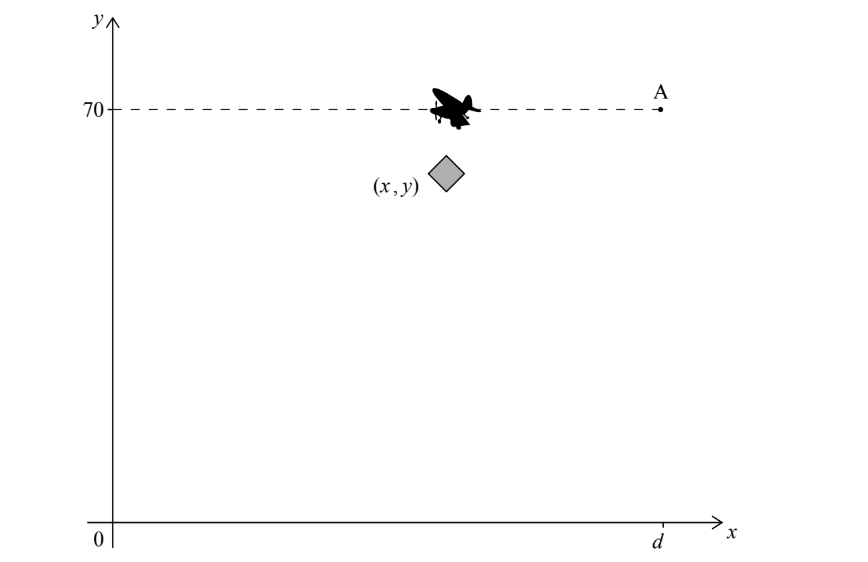
An aircraft traveling at a constant altitude of \(70\) m releases a supply container at point \(A\), which is at a horizontal distance \(d\) from a target marked \(O\).
The acceleration vector of the container during its descent is modeled as \(\begin{pmatrix} 0 \\ -9.8 \end{pmatrix} \, \text{ms}^{-2}\). At the moment of release, the container has an initial velocity vector of \(\begin{pmatrix} -20 \\ 0 \end{pmatrix} \, \text{ms}^{-1}\).
(a) Determine the velocity vector of the container \(\begin{pmatrix} \dot{x} \\ \dot{y} \end{pmatrix}\) as a function of time \(t\).
(b) Calculate the value of the initial horizontal distance \(d\), assuming the container successfully lands at target \(O\).

Most-appropriate topic codes:

AHL 5.13: Kinematic problems involving displacement, velocity and acceleration — part (a)
AHL 3.12: Vector applications to kinematics — part (b)
▶️ Answer/Explanation
Detailed solution

(a)
Integrate the acceleration vector \(\begin{pmatrix} 0 \\ -9.8 \end{pmatrix}\) with respect to time \(t\):
\(\dot{x} = \int 0 \, dt = C_1\)
\(\dot{y} = \int -9.8 \, dt = -9.8t + C_2\)
Using initial velocity at \(t=0\), \(\begin{pmatrix} \dot{x}(0) \\ \dot{y}(0) \end{pmatrix} = \begin{pmatrix} -20 \\ 0 \end{pmatrix}\):
\(C_1 = -20\) and \(C_2 = 0\).
Thus, the velocity vector is \(\begin{pmatrix} \dot{x} \\ \dot{y} \end{pmatrix} = \begin{pmatrix} -20 \\ -9.8t \end{pmatrix}\).

(b)
Find the position vector \(\mathbf{r}(t)\) by integrating the velocity:
\(x(t) = \int -20 \, dt = -20t + K_1\)
\(y(t) = \int -9.8t \, dt = -4.9t^2 + K_2\)
At \(t=0\), the container is at point \(A(d, 70)\), so \(K_1 = d\) and \(K_2 = 70\).
The position equations are: \(x(t) = -20t + d\) and \(y(t) = -4.9t^2 + 70\).
The container lands at \(O(0,0)\) when \(y(t) = 0\):
\(-4.9t^2 + 70 = 0 \Rightarrow t^2 = \frac{70}{4.9} \Rightarrow t \approx 3.7796\dots\) s.
At this time, the horizontal position \(x(t)\) must be \(0\):
\(-20(3.7796\dots) + d = 0 \Rightarrow d = 75.592\dots\)
\(d \approx 75.6\) m.

Scroll to Top