
▶️ Answer/Explanation
(a)(i)
For \(H\),
\(y=\dfrac{1}{x}=x^{-1}\)
\(\dfrac{dy}{dx}=-\dfrac{1}{x^2}\)
At \(x=t\), the gradient of the tangent is \(-\dfrac{1}{t^2}\).
The tangent and normal are perpendicular, so their gradients have a product of \(-1\).
\(\left(-\dfrac{1}{t^2}\right)m_N=-1\)
✅ Hence, the gradient of \(N\) is \(m_N=t^2\).
(a)(ii)
The point of contact is \(\left(t,\dfrac{1}{t}\right)\).
Using the point-gradient form of a straight line:
\(y-\dfrac{1}{t}=t^2(x-t)\)
\(y-\dfrac{1}{t}=t^2x-t^3\)
✅ Hence, \(y=t^2x+\dfrac{1}{t}-t^3\).
(b)(i)
Comparing \(y=t^2x+\dfrac{1}{t}-t^3\) with \(y=mx+c\):
\(m=t^2\)
Therefore:
\(t=\sqrt{m}\) or \(t=-\sqrt{m}\)
Also:
\(c=\dfrac{1}{t}-t^3=\dfrac{1-t^4}{t}\)
When \(t=\sqrt{m}\):
\(c=\dfrac{1-m^2}{\sqrt{m}}=\dfrac{1}{\sqrt{m}}(1-m^2)\)
When \(t=-\sqrt{m}\):
\(c=\dfrac{m^2-1}{\sqrt{m}}=\dfrac{1}{\sqrt{m}}(m^2-1)\)
✅ Hence, \(c=\dfrac{1}{\sqrt{m}}(1-m^2)\) or \(c=\dfrac{1}{\sqrt{m}}(m^2-1)\).
(b)(ii)
Since \(m=t^2\) and \(t\ne0\), the gradient of a normal must be positive.
Conversely, every positive value of \(m\) gives a real value \(t=\pm\sqrt{m}\).
✅ Answer: \(m\in\mathbb{R}^{+}\), or \(m>0\)
(c)(i)
For a fixed positive value of \(m\), the two possible \(y\)-intercepts are opposites:
\(c_1=\dfrac{1-m^2}{\sqrt{m}}\), \(\quad c_2=\dfrac{m^2-1}{\sqrt{m}}=-c_1\)
There is exactly one distinct normal when the two intercepts are equal.
\(c_1=c_2\)
\(1-m^2=m^2-1\)
\(m^2=1\)
Since \(m>0\):
✅ Answer: \(m=1\)
For \(m=1\), both normal points produce the same line \(y=x\).
(c)(ii)
For every other positive value of \(m\), the two intercepts are different, producing two distinct parallel normal lines.
✅ Answer: \(m\in\mathbb{R}^{+}\), \(m\ne1\)
(d)
(i)Sketch the rectangular hyperbola \(y=\dfrac{1}{x}\), with one branch in the first quadrant and the other in the third quadrant.
For example, choose \(m=4\). Then \(t=\pm2\), giving normal points:
\(\left(2,\dfrac12\right)\) and \(\left(-2,-\dfrac12\right)\)
The two normal lines are:
\(y=4x-\dfrac{15}{2}\)
and
\(y=4x+\dfrac{15}{2}\)
(ii) These lines are parallel and are normal to the two different branches of \(H\).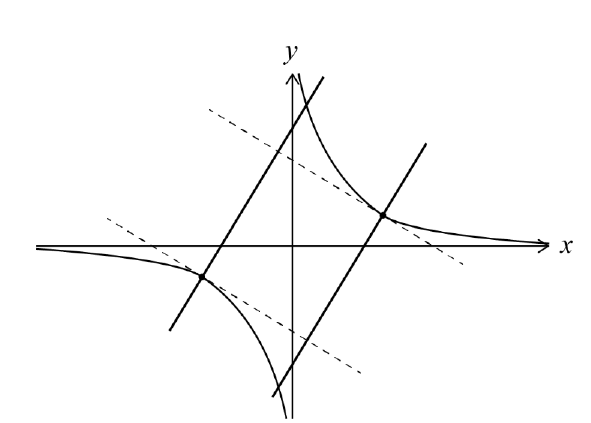
(e)(i)
At an intersection of the normal line and \(F\):
\(\dfrac{k^2}{x}=t^2x-kt^3+\dfrac{k}{t}\)
Multiply throughout by \(x\).
\(k^2=t^2x^2-kt^3x+\dfrac{k}{t}x\)
\(t^2x^2-k\left(t^3-\dfrac{1}{t}\right)x-k^2=0\)
Divide throughout by \(t^2\).
✅ \(x^2-k\left(t-\dfrac{1}{t^3}\right)x-\dfrac{k^2}{t^2}=0\)
(e)(ii)
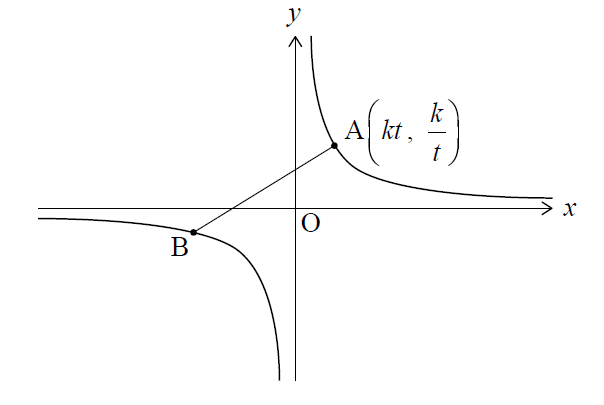
One root is the \(x\)-coordinate of A:
\(x_A=kt\)
Let the other root, corresponding to B, be \(x_B\).
Using the product of the roots:
\((kt)x_B=-\dfrac{k^2}{t^2}\)
\(x_B=-\dfrac{k}{t^3}\)
Since B lies on \(F\):
\(y_B=\dfrac{k^2}{x_B}\)
\(y_B=\dfrac{k^2}{-\frac{k}{t^3}}=-kt^3\)
✅ Answer: \(\mathrm{B}\left(-\dfrac{k}{t^3},-kt^3\right)\)
(f)
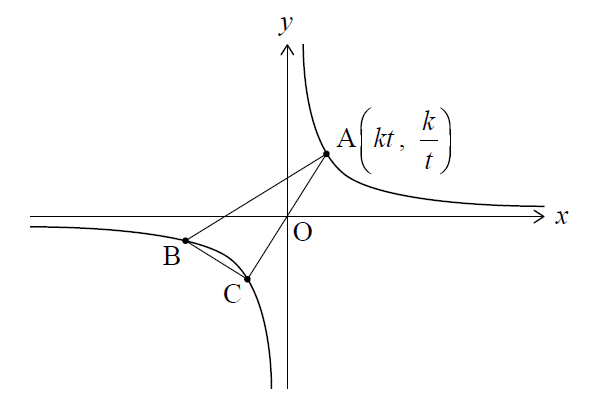
First determine the coordinates of C.
The gradient of the line through O and A is:
\(\dfrac{\frac{k}{t}}{kt}=\dfrac{1}{t^2}\)
Therefore, the equation of line OA is:
\(y=\dfrac{x}{t^2}\)
At its intersections with \(F\):
\(\dfrac{x}{t^2}=\dfrac{k^2}{x}\)
\(x^2=k^2t^2\)
\(x=\pm kt\)
The root \(x=kt\) gives A, so the other intersection is:
\(\mathrm{C}\left(-kt,-\dfrac{k}{t}\right)\)
Now form the vectors from C.
\(\overrightarrow{CA}=\left(2kt,\dfrac{2k}{t}\right)\)
\(\overrightarrow{CB}=\left(-\dfrac{k}{t^3}+kt,-kt^3+\dfrac{k}{t}\right)\)
Their scalar product is:
\(\overrightarrow{CA}\cdot\overrightarrow{CB}=2kt\left(-\dfrac{k}{t^3}+kt\right)+\dfrac{2k}{t}\left(-kt^3+\dfrac{k}{t}\right)\)
\(=2k^2\left(t^2-\dfrac{1}{t^2}\right)+2k^2\left(\dfrac{1}{t^2}-t^2\right)\)
\(=0\)
Therefore, \(\overrightarrow{CA}\) and \(\overrightarrow{CB}\) are perpendicular.
Since \(t\ne\pm1\), the points B and C are distinct.
✅ Hence, \(BC\perp CA\), so \(\angle BCA=90^\circ\).
`