
Question
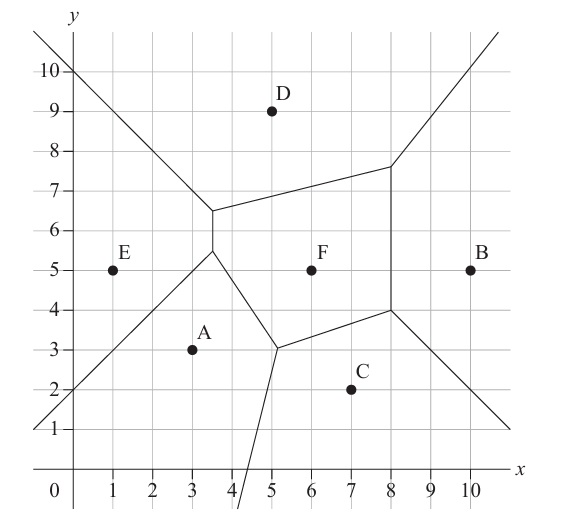
(ii) The distance between site \( B \) and vertex \( X \) is given by \( \sqrt{n} \). State the value of \( n \).
(ii) Calculate the exact value of \( b \).
Most appropriate topic codes (IB Mathematics: applications and interpretation):
• SL 3.5: Equations of perpendicular bisectors — part (a)
• Prior learning: Mid-point of a line segment and distance between two points — parts (b)(ii), (c)(ii)
▶️ Answer/Explanation
(a)
The boundary between two sites is the perpendicular bisector of the line segment joining them. For D(5,9) and E(1,5):
Midpoint = \(\left( \frac{5+1}{2}, \frac{9+5}{2} \right) = (3, 7)\)
Gradient of DE = \(\frac{5-9}{1-5} = \frac{-4}{-4} = 1\)
∴ Gradient of perpendicular bisector = \(-1\)
Equation: \(y – 7 = -1(x – 3)\) → \(y = -x + 10\)
\(\boxed{y = -x + 10}\)
(b)(i)
Vertex X is equidistant from B, C, F. In the diagram (implied by typical Voronoi construction from given coordinates), X is at the intersection of perpendicular bisectors of BC and CF (or BF). From the grid, X is at (8, 4).
\(\boxed{(8, 4)}\)
(b)(ii)
BX = distance between B(10,5) and X(8,4):
\(BX = \sqrt{(10-8)^2 + (5-4)^2} = \sqrt{4 + 1} = \sqrt{5}\)
So \(n = 5\).
\(\boxed{5}\)
(c)(i)
Vertex Y lies on the vertical boundary between B and F, and also on the boundary between D and F. Since F is at (6,5) and B is at (10,5), the perpendicular bisector of BF is vertical at the midpoint x-coordinate:
\(a = \frac{6+10}{2} = 8\)
\(\boxed{8}\)
(c)(ii)
Y is equidistant from B(10,5), D(5,9), and F(6,5). Use distance equality from Y(8, b) to B and D:
\( (8-10)^2 + (b-5)^2 = (8-5)^2 + (b-9)^2 \)
\( 4 + (b-5)^2 = 9 + (b-9)^2 \)
Expand: \(4 + b^2 – 10b + 25 = 9 + b^2 – 18b + 81\)
Simplify: \(b^2 – 10b + 29 = b^2 – 18b + 90\)
\(-10b + 29 = -18b + 90\)
\(8b = 61\)
\(b = \frac{61}{8}\)
\(\boxed{\frac{61}{8}}\) or \(\boxed{7.625}\)