Home / IB Mathematics SL 1.8: Systems of linear equations AI SL Paper 2 – Exam Style Questions

IB Mathematics SL 1.8: Systems of linear equations AI SL Paper 2 - Exam Style Questions - New Syllabus

Question

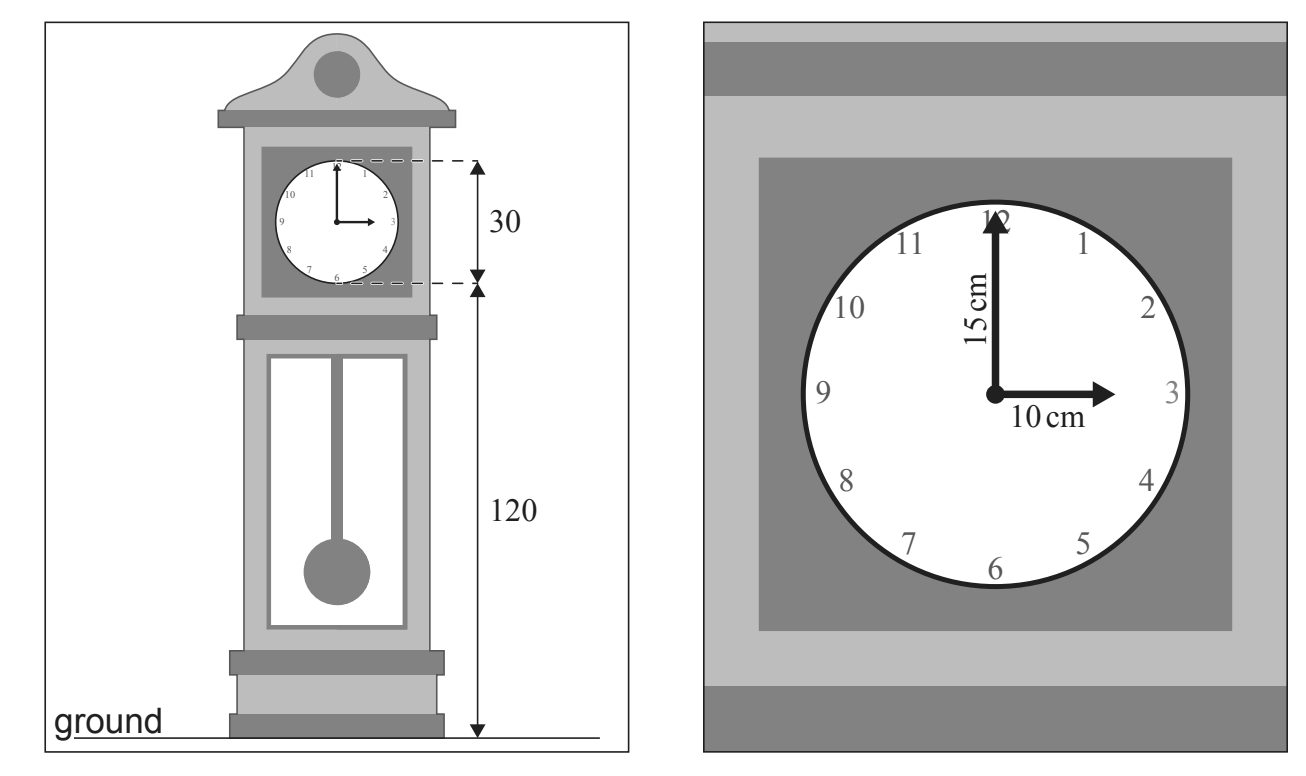
A large grandfather clock features a circular face with a diameter of $30$ cm. The base of this clock face is situated $120$ cm above the floor. The clock’s minute hand measures $15$ cm, while the hour hand measures $10$ cm. The arrangement is illustrated in the provided diagram.
The clock is set in motion at exactly 3:00 pm.
(a) (i) State the magnitude of the angle formed between the hour hand and the minute hand at 3:00 pm.
(ii) Determine the linear distance between the tips of the two hands at this specific time.
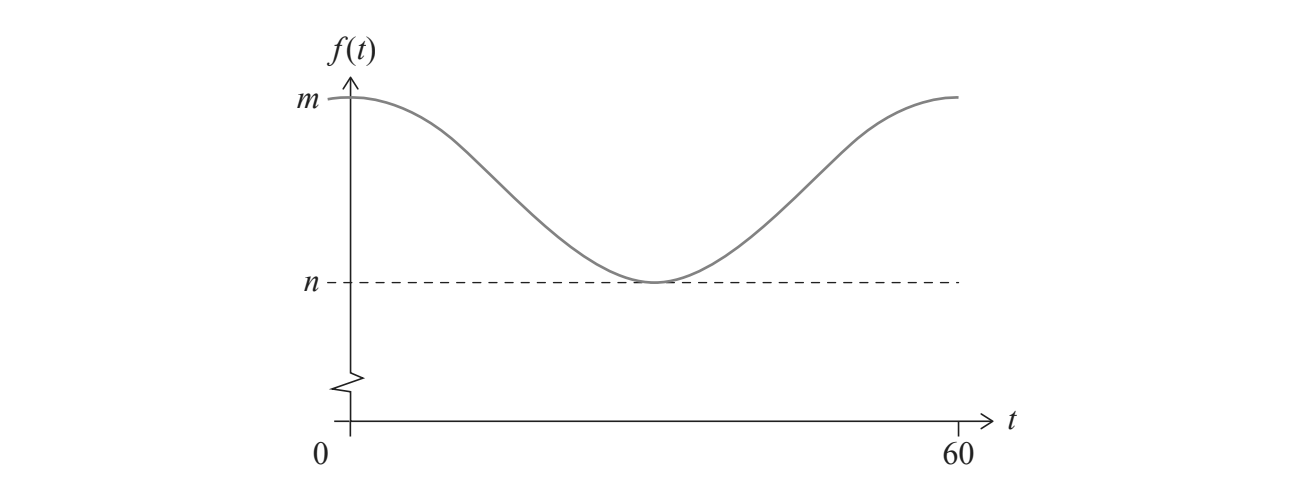
The vertical position of the minute hand’s tip, denoted by $f(t)$ cm above the floor, is modeled by the periodic function $f(t) = a \cos(bt) + d$, where $a, b > 0$. The argument $bt$ is calculated in degrees, and $t$ represents the elapsed time in minutes since 3:00 pm.
A graph representing $y = f(t)$ for the interval from 3:00 pm to 4:00 pm is shown below, where $m$ and $n$ denote the maximum and minimum heights respectively.
(b) Identify the values of: (i) $m$ (ii) $n$.
(c) Based on your previous answers, calculate the values of: (i) $a$ (ii) $b$ (iii) $d$.
The vertical position of the hour hand’s tip, $g(t)$ cm above the floor, is modeled by the function $g(t) = p \sin(qt) + d$, where $qt$ is measured in degrees and $t$ is the time in minutes after 3:00 pm.
(d) (i) Verify that the constant $q = 0.5$.
(ii) Determine the value of the parameter $p$.
(e) Calculate the height of the tip of the hour hand above the floor at 4:00 pm.
(f) Determine the first instance after 3:00 pm when the tips of both hands are at the same vertical height above the floor. Provide your answer rounded to the nearest minute.

Most-appropriate topic codes (IB Mathematics AI SL 2025):

SL 3.2: Applications of right-angled trigonometry and Pythagoras — part (a)
SL 2.5: Modelling with sinusoidal functions — parts (b), (c), (d), (e)
SL 1.8: Technology-aided solution of equations — part (f)
▶️ Answer/Explanation
Detailed solution

(a)
(i) At 3 pm, the angle is 90°.
(ii) Using Pythagoras theorem (since angle is 90°):
Distance \(= \sqrt{10^2 + 15^2} = \sqrt{100 + 225} = \sqrt{325}\).
Distance \(\approx \textbf{18.0 cm}\).

(b)
The lowest point of the clock face is 120 cm. The diameter is 30 cm, so the center is at \(120 + 15 = 135\) cm.
(i) \(m\) (maximum height of minute hand tip) \(= 135 + 15 = \textbf{150}\).
(ii) \(n\) (minimum height of minute hand tip) \(= 135 – 15 = \textbf{120}\).

(c)
(i) \(a\) (amplitude) \(= \frac{150 – 120}{2} = \textbf{15}\).
(ii) Period of minute hand is 60 minutes.
\(b = \frac{360}{60} = \textbf{6}\).
(iii) \(d\) (principal axis) \(= \frac{150 + 120}{2} = \textbf{135}\).

(d)
(i) Period of hour hand is 12 hours = 720 minutes.
\(q = \frac{360}{720} = \mathbf{0.5}\).
(ii) At 3 pm (\(t=0\)), the hour hand is horizontal (height 135). As time moves to 4 pm, the hand moves down. A standard sine wave starts at the principal axis and goes up. Since this goes down, \(p\) must be negative.
Length of hour hand is 10, so amplitude is 10.
\(p = \textbf{-10}\).

(e)
At 4 pm, \(t=60\).
\(g(60) = -10 \sin(0.5 \times 60) + 135 = -10 \sin(30^\circ) + 135\).
\(g(60) = -10(0.5) + 135 = -5 + 135 = \textbf{130 cm}\).

(f)
Set heights equal: \(15 \cos(6t) + 135 = -10 \sin(0.5t) + 135\).
\(15 \cos(6t) = -10 \sin(0.5t)\).
Using GDC to solve for \(t\):
\(t \approx 15.88\).
Time is \(3 \text{ pm} + 16 \text{ minutes}\).
3:16 pm.

Scroll to Top