Home / IB Mathematics SL 2.4: Finding the point of intersection AI SL Paper 2 – Exam Style Questions

IB Mathematics SL 2.4: Finding the point of intersection AI SL Paper 2 - Exam Style Questions - New Syllabus

Question

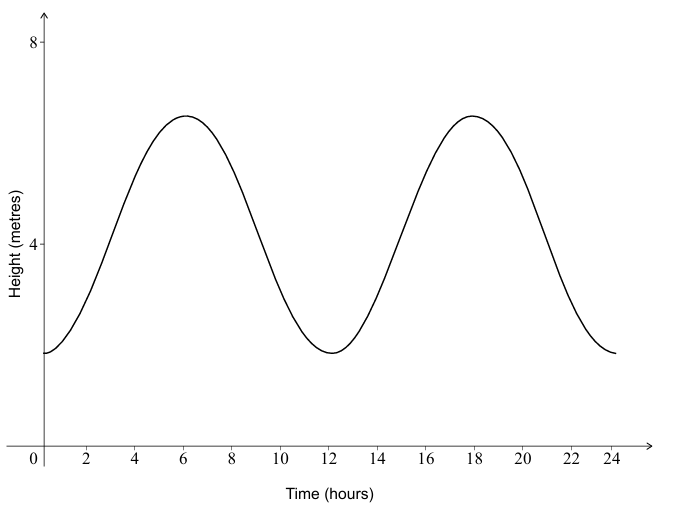
On a certain day, the tidal height, \( h \), measured in metres at Albion harbour, is modeled using the following periodic function:
\( h(t) = -2.5 \cos(bt^\circ) + 4.5, \quad 0 \leq t \leq 24 \),
where \( b \) is a real constant and \( t \) denotes the number of hours passed since midnight.
Tidal height graph
(a) Demonstrate that the value of the parameter \( b \) must be 30.
(b) Calculate the height of the tide exactly 5 hours after midnight.
(c) Identify:
(i) the amplitude of the function \( h \);
(ii) the equation representing the principal axis of the graph.
Safety regulations specify that boats can only enter or depart Albion harbour when the water depth \( h(t) \) is at least 2.65 metres. Robin plans to set out for a fishing trip as soon as possible after 12:00 (noon).
(d) Determine the earliest time Robin can leave the harbour. Provide your answer to the nearest minute.
It takes Robin 15 minutes to navigate from the harbour to his fishing location. He intends to return to the harbour before the end of the same day.
(e) Calculate the maximum duration, in hours, that Robin can spend at the fishing site while ensuring he can safely re-enter the harbour.

Most-appropriate topic codes (IB Mathematics AI SL 2025):

SL 2.5: Modelling with sinusoidal functions (amplitude, period, axis) — parts (a), (b), (c)
SL 1.8: Solution of equations using technology (GDC) — parts (d), (e)
SL 2.4: Key features of graphs; finding points of intersection — part (e)
▶️ Answer/Explanation

(a)
The graph shows a period of 12 hours.
For \( \cos(bt^\circ) \), period = \( \frac{360}{b} \).
Set \( \frac{360}{b} = 12 \) ⇒ \( b = 30 \).
\( \boxed{b = 30} \)

(b)
\( h(5) = -2.5 \cos(30 \times 5) + 4.5 \).
\( = -2.5 \cos 150^\circ + 4.5 \).
\( \cos 150^\circ = -\frac{\sqrt{3}}{2} \approx -0.866025 \).
So \( h(5) \approx -2.5 \times (-0.866025) + 4.5 \approx 2.16506 + 4.5 = 6.66506 \).
\( \boxed{6.67\ \text{m}} \)

(c)
(i) Amplitude = \( 2.5 \) metres.
\( \boxed{2.5} \)
(ii) Principal axis: \( h = 4.5 \).
\( \boxed{h = 4.5} \)

(d)
Solve \( -2.5 \cos(30t) + 4.5 = 2.65 \) for \( t > 12 \).
Using technology: first solution after \( t = 12 \) is \( t \approx 13.4089 \) hours.
Convert: \( 0.4089 \times 60 \approx 25 \) minutes.
Earliest time ≈ 13:25 (1:25 p.m.).
\( \boxed{13:25} \)

(e)
Last time to return: solve \( -2.5 \cos(30t) + 4.5 = 2.65 \) for \( t \) before next low tide.
Next crossing after 13.4089 is at \( t \approx 22.5910 \) hours (by symmetry of cosine).
Travel time each way = 0.25 hours total.
Max time at site = \( 22.5910 – 13.4089 – 0.25 \approx 8.6821 \) hours.
\( \boxed{8.68\ \text{hours}} \)

Scroll to Top