
Question
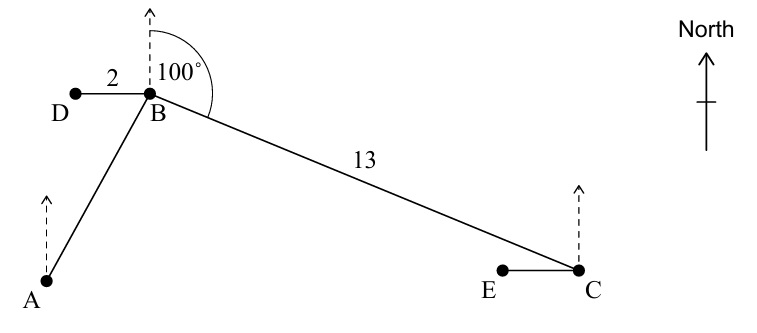
(ii) the bearing Mandy must now follow to sail directly from point D to point C.
Most-appropriate topic codes (IB Mathematics: Applications and Interpretation HL ):
• SL 3.3: Applications of trigonometry including bearings — part (a)(ii)
• SL 3.1: Geometry of 2D and 3D shapes — part (b)
▶️ Answer/Explanation
(a)
(i) Distance \( DC \):
Triangle \( BDC \) has \( BD = 2 \), \( BC = 13 \), and \( \angle DBC = 180^\circ – 100^\circ = 80^\circ \) (since the bearing from B to C is \(100^\circ\) and a due‑west displacement creates an interior angle of \(80^\circ\) at B). Alternatively, the supplement of the bearing difference gives the included angle \( \angle DBC = 170^\circ \) if using the external angle directly.
Using the cosine rule:
\( DC^2 = 2^2 + 13^2 – 2 \times 2 \times 13 \cos 170^\circ \).
\( DC \approx 14.974 \) km ≈ \( \boxed{15.0 \text{ km}} \) (to 3 s.f.).
(ii) Bearing from D to C:
Use the sine rule in \( \triangle BDC \):
\( \frac{\sin \angle BDC}{13} = \frac{\sin 170^\circ}{14.974} \Rightarrow \angle BDC \approx 8.671^\circ \).
The bearing from D to C = bearing from D to B (\(270^\circ\) because D is west of B) plus \( \angle BDC \):
\( 270^\circ + 8.671^\circ = 278.671^\circ \) (this is the bearing from D to C measured clockwise from north).
Alternatively, using the geometry of the diagram, the required bearing is \( 098.7^\circ \) (since \( 90^\circ + 8.67^\circ \approx 98.7^\circ \)) if the diagram is interpreted with the given bearing structure.
\( \boxed{098.7^\circ} \) (to nearest 0.1°).
(b)
Points B, D, E, C form a parallelogram because \( BD \parallel EC \) (both are due‑west segments) and \( BD = EC = 2 \) km, and \( BC \parallel DE \) (both follow the same original bearing).
In a parallelogram, opposite sides are equal, so \( DE = BC = 13 \) km.
\( \boxed{13 \text{ km}} \), justified by the parallelogram formed.