Home / IB Mathematics SL 4.1 Concepts of population, sample AI HL Paper 1- Exam Style Questions

IB Mathematics SL 4.1 Concepts of population, sample AI HL Paper 1- Exam Style Questions- New Syllabus

Question

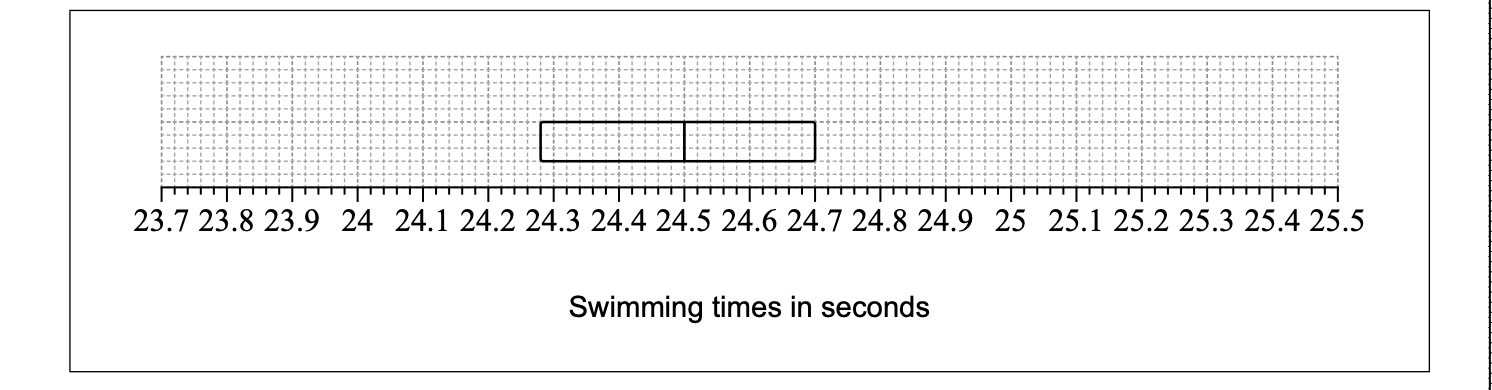
The completion times, measured in seconds, for the \(16\) fastest women in a \(50\) m freestyle swimming championship were documented. Every swimmer achieved a unique time. An incomplete box and whisker diagram for these recorded times is provided below.
(a) State the number of swimmers who recorded a time greater than \(24.70\) seconds.
(b) Determine the interquartile range (\(\text{IQR}\)) for this data set.

An outlier is defined as a value that satisfies one of the following:

  • more than \(1.5 \times \text{IQR}\) below the lower quartile
  • more than \(1.5 \times \text{IQR}\) above the upper quartile.
Among the \(16\) women, the two fastest competitors finished in \(23.96\) and \(24.12\) seconds, while the two slowest competitors finished in \(25.12\) and \(25.40\) seconds.
(c) (i) Show that only one of these four times is an outlier.
(ii) Complete the box and whisker diagram provided above.

Most-appropriate topic codes:

SL 4.2: Box and whisker diagrams — part (a) and (c-ii) 
SL 4.3: Measures of dispersion (interquartile range) — part (b)
SL 4.1: Interpretation of outliers — part (c-i) 
▶️ Answer/Explanation
Detailed solution

(a)
In a box plot, the value \(24.70\) corresponds to the third quartile (\(Q_3\)). Since \(Q_3\) marks the point above which \(25\%\) of the data lies, and there are \(16\) swimmers:
Number of swimmers \(= 0.25 \times 16 = 4\).
\(4\) swimmers.

(b)
From the diagram, the third quartile (\(Q_3\)) is \(24.70\) and the first quartile (\(Q_1\)) is \(24.28\).
\(\text{IQR} = Q_3 – Q_1 = 24.70 – 24.28 = 0.42\).
\(\text{IQR} = 0.42\) seconds.

(c)
(i) Calculate the outlier boundaries:
Upper Boundary \(= Q_3 + 1.5 \times \text{IQR} = 24.70 + 1.5(0.42) = 24.70 + 0.63 = 25.33\).
Lower Boundary \(= Q_1 – 1.5 \times \text{IQR} = 24.28 – 0.63 = 23.65\).

Comparing the given times:
Fastest: \(23.96\) and \(24.12\) (Both \(> 23.65\), so not outliers).
Slowest: \(25.12\) and \(25.40\).
\(25.12 < 25.33\) (Not an outlier).
\(25.40 > 25.33\) (Outlier).
Thus, only \(25.40\) is an outlier.

(ii) To complete the diagram:
– Mark an ‘x’ at \(25.40\) to denote the outlier.
– Extend the upper whisker to the maximum value within the boundary, which is \(25.12\).
– Extend the lower whisker to the minimum value, \(23.96\).

Scroll to Top