

▶️ Answer/Explanation
(a)
For the quadratic equation to have no real roots, its discriminant must be negative.
\( b^2-4ac<0 \)
Here,
\( a=\frac12,\qquad b=k,\qquad c=13. \)
Therefore,
\( k^2-4\left(\frac12\right)(13)<0 \)
\( k^2-26<0 \)
\( k^2<26. \)
Since \(k\) is a positive integer,
\( k<\sqrt{26}\approx5.10. \)
Hence the greatest possible value is
\( \boxed{k=5.} \)
(b)(i)
Using \(k=5\),
\( f(x)=\frac12x^2+5x+13. \)
The axis of symmetry is
\( x=-\frac{b}{2a} =-\frac5{2(\frac12)} =-5. \)
✅ Axis of symmetry:
\( \boxed{x=-5} \)
(b)(ii)
Substitute \(x=-5\) into the function:
\( f(-5) =\frac12(25)+5(-5)+13 =\frac{25}{2}-25+13 =\frac12. \)
Therefore the minimum point is
\( \boxed{\left(-5,\frac12\right)}. \)
The vertex gives the minimum since the coefficient of \(x^2\) is positive, so the parabola opens upwards.
(c)
Differentiate:
\( \frac{dy}{dx}=x+5. \)
At \(x=-3\),
\( \frac{dy}{dx}=2. \)
Hence the normal has gradient
\( -\frac12. \)
The point on the curve is
\( f(-3) =\frac12(9)-15+13 =\frac52. \)
Using point-gradient form,
\( y-\frac52=-\frac12(x+3). \)
Simplifying,
\( \boxed{y=-\frac12x+1.} \)
(d)
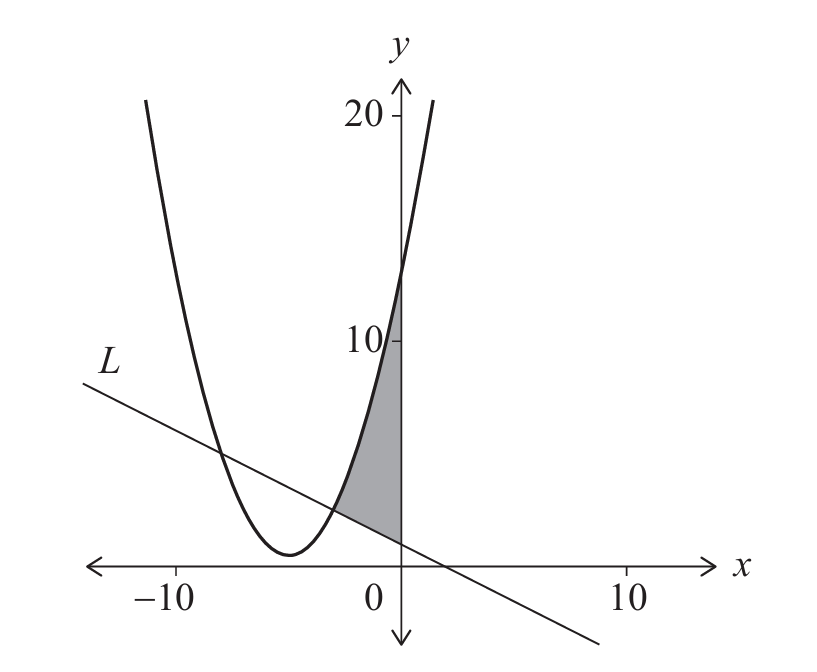
The required area is the area between the curve and the line from \(x=-3\) to \(x=0\).
\( A=\int_{-3}^{0} \left[\left(\frac12x^2+5x+13\right)-\left(-\frac12x+1\right)\right]dx \)
\( =\int_{-3}^{0} \left(\frac12x^2+\frac{11}{2}x+12\right)dx. \)
Integrate:
\( A= \left[ \frac{x^3}{6} +\frac{11x^2}{4} +12x \right]_{-3}^{0}. \)
Evaluating the limits,
\( A = 0- \left( -\frac{27}{6} +\frac{99}{4} -36 \right) = \frac{63}{4}. \)
The shaded area is obtained by integrating the difference between the upper curve and the lower straight line.
✅ Shaded area:
\( \boxed{\frac{63}{4}.} \)