Home / IB DP Maths 2026, 2027 & 2028 / Application and Interpretation HL / IB Mathematics SL 5.8 Approximating areas using the trapezoidal rule AI HL Paper 2- Exam Style Questions

IB Maths SL 5.8 Approximating areas using the trapezoidal rule AI HL Paper 2- Exam Style Questions- New Syllabus

Question

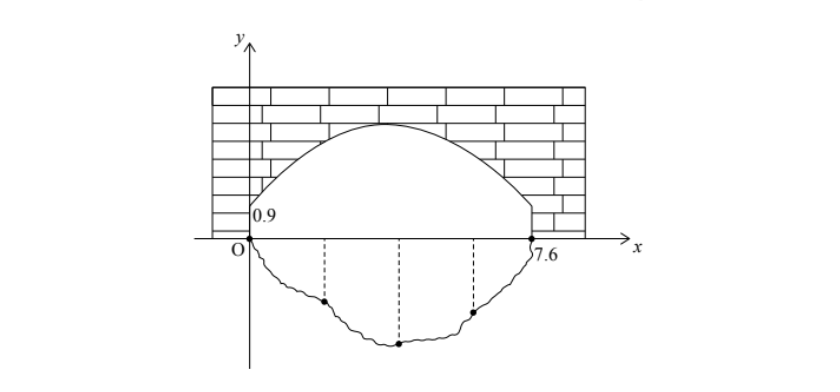
The following illustration depicts the cross-section of a bridge spanning a river. A Cartesian coordinate system is applied, with the origin, \(O\), situated at the intersection of the bridge support and the water surface on the left bank. All dimensions are provided in metres.
A field worker records the depth of the river at regular intervals of 1.9 m starting from \(O\). These recorded depths are presented in the table below.
Horizontal distance from \(O\) (m)01.93.85.77.6
Vertical depth (m)01.682.812.320
(a) Apply the trapezoidal rule to estimate the total cross-sectional area of the river channel beneath the bridge.
The velocity of the water current under the bridge is constant at \(0.3 \text{ ms}^{-1}\).
(b) Calculate the volume of water moving through this cross-section per second.
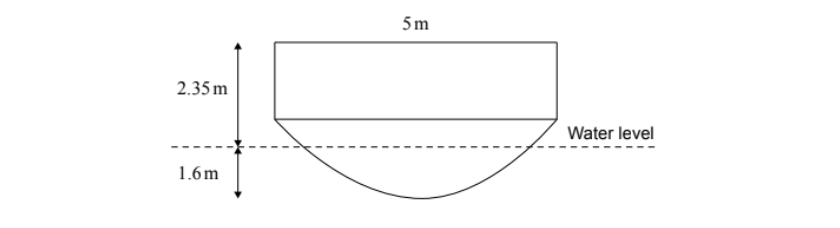
A vessel is navigating the river. The deck of the boat is flat, parallel to the water, and measures 5 m in width. The boat stands 2.35 m high above the waterline, while its hull extends 1.6 m below the waterline. The vessel maintains a course directly down the center of the river.
(c) Compute the clearance (vertical distance) between the lowest point of the hull and the riverbed as the vessel passes under the bridge.
The profile of the bridge’s arch is modelled by the quadratic function \(y = -0.15x^2 + 1.14x + 0.9\), for \(0 \le x \le 7.6\).
(d) Determine the maximum height reached by the bridge arch above the surface of the water.
(e) Establish whether the upper deck of the boat is able to clear the bridge structure during transit.

Most-appropriate topic codes:

TOPIC SL 5.8: Trapezoidal rule — part (a)
TOPIC SL 3.1: Volume and surface area of 3D solids — part (b)
TOPIC SL 2.5: Quadratic models (Maximum/Optimization) — part (d)
TOPIC SL 2.5: Modeling with linear/piecewise functions — part (e)
▶️ Answer/Explanation
Detailed solution

(a)
Trapezoidal rule formula: \(A \approx \frac{h}{2} (y_0 + y_n + 2(y_1 + \dots + y_{n-1}))\).
Here \(h = 1.9\). Values: 0, 1.68, 2.81, 2.32, 0.
\(A \approx \frac{1.9}{2} (0 + 0 + 2(1.68 + 2.81 + 2.32))\).
\(A \approx 0.95 \times 2(6.81) = 1.9 \times 6.81 = \mathbf{12.9 \text{ m}^2}\) (12.939).

(b)
Volume rate = Cross-sectional area \(\times\) speed.
\(V = 12.939 \times 0.3 = \mathbf{3.88 \text{ m}^3}\) (3.8817).

(c)
The boat travels down the centre. The bridge width is 7.6m. Centre is at \(x = 3.8\).
Depth of river at \(x=3.8\) is 2.81m (from table).
Depth of boat is 1.6m.
Distance = \(2.81 – 1.6 = \mathbf{1.21 \text{ m}}\).

(d)
Find max of \(y = -0.15x^2 + 1.14x + 0.9\).
Axis of symmetry \(x = \frac{-b}{2a} = \frac{-1.14}{2(-0.15)} = \frac{-1.14}{-0.3} = 3.8\).
Substitute \(x=3.8\):
\(y = -0.15(3.8)^2 + 1.14(3.8) + 0.9\).
\(y \approx \mathbf{3.07 \text{ m}}\) (3.066).

(e)
Boat width is 5m. It is centered at \(x=3.8\).
The boat extends from \(3.8 – 2.5 = 1.3\)m to \(3.8 + 2.5 = 6.3\)m.
Height of boat is 2.35m.
We need to check the height of the arch at the corners of the boat (\(x=1.3\) and \(x=6.3\)).
\(y(1.3) = -0.15(1.3)^2 + 1.14(1.3) + 0.9 = \mathbf{2.13 \text{ m}}\) (2.1285).
Since \(2.13 \text{ m} < 2.35 \text{ m}\) (height of boat), the boat cannot pass under the bridge.

Scroll to Top