
Question
Most-appropriate topic codes (IB Mathematics Applications and Interpretation HL):
• AHL 3.7: Radian measure — parts (b)(ii), (d)
• AHL 3.10: Vectors — parts (b), (c), (e), (f)
• SL 3.3: Applications of trigonometry — part (a)
• SL 3.2: Sine and cosine rules — part (a)
▶️ Answer/Explanation
(a)(i)
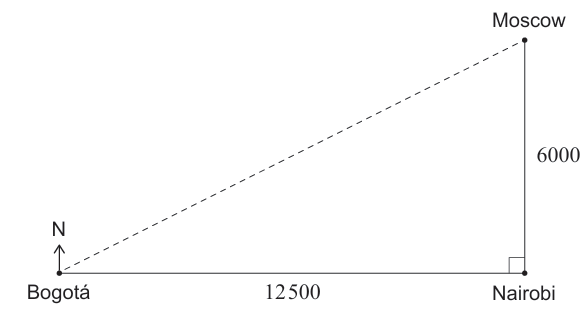
Method: Using Pythagoras’ theorem in the right-angled triangle with sides 6000 km and 12500 km.
Distance = \(\sqrt{6000^2 + 12500^2} = \sqrt{36000000 + 156250000} = \sqrt{192250000} = 13865.24…\)
\(\boxed{13900 \text{ km}}\) (to 3 significant figures)
(a)(ii)
Method 1: Using trigonometry \(\tan(\text{angle}) = \frac{\text{opposite}}{\text{adjacent}} = \frac{12500}{6000}\)
Angle = \(\arctan\left(\frac{12500}{6000}\right) = \arctan(2.0833…) = 64.4^\circ\)
Bearing is measured clockwise from north, so bearing = \(064^\circ\)
\(\boxed{064^\circ}\) or \(\boxed{64.4^\circ}\)
(b)(i)
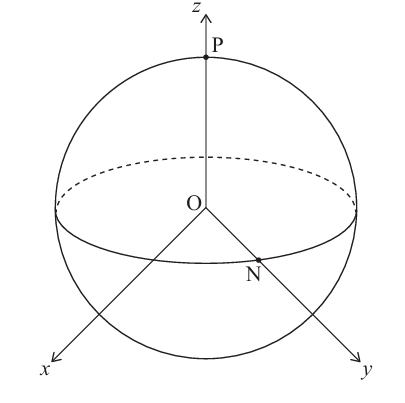
Method: Using scalar product formula \(p \cdot n = |p||n|\cos\theta\)
\(p \cdot n = (0)(0) + (0)(6) + (6)(0) = 0\)
\(|p| = \sqrt{0^2 + 0^2 + 6^2} = 6\), \(|n| = \sqrt{0^2 + 6^2 + 0^2} = 6\)
\(\cos\theta = \frac{p \cdot n}{|p||n|} = \frac{0}{6 \times 6} = 0\)
∴ \(\theta = 90^\circ\) or \(\frac{\pi}{2}\) radians
\(\boxed{90^\circ}\)
(b)(ii)
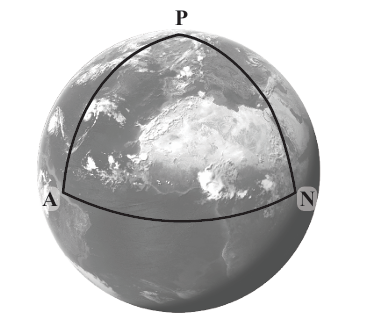
Method: Using arc length formula \(s = r\theta\) with \(\theta\) in radians
From part (b)(i), angle = \(90^\circ = \frac{\pi}{2}\) radians
Arc length = \(6000 \times \frac{\pi}{2} = 3000\pi\) km
\(\boxed{3000\pi \text{ km}}\)
(c)(i)
Method: Using cross product formula \(a \times p = \begin{vmatrix} i & j & k \\ 6 & 0 & 0 \\ 0 & 0 & 6 \end{vmatrix}\)
\(a \times p = (0 \times 6 – 0 \times 0)i – (6 \times 6 – 0 \times 0)j + (6 \times 0 – 0 \times 0)k\)
\(= 0i – 36j + 0k = \begin{pmatrix} 0 \\ -36 \\ 0 \end{pmatrix}\)
\(\boxed{\begin{pmatrix} 0 \\ -36 \\ 0 \end{pmatrix}}\)
(c)(ii)
Method 1 (Scalar product):
First find \(a \times n = \begin{vmatrix} i & j & k \\ 6 & 0 & 0 \\ 0 & 6 & 0 \end{vmatrix} = (0 \times 0 – 0 \times 6)i – (6 \times 0 – 0 \times 0)j + (6 \times 6 – 0 \times 0)k = \begin{pmatrix} 0 \\ 0 \\ 36 \end{pmatrix}\)
\((a \times p) \cdot (a \times n) = (0)(0) + (-36)(0) + (0)(36) = 0\)
Since scalar product = 0, the vectors are perpendicular, so angle = \(90^\circ\)
Method 2 (Cross product magnitude):
\(|a \times p| = \sqrt{0^2 + (-36)^2 + 0^2} = 36\)
\(|a \times n| = \sqrt{0^2 + 0^2 + 36^2} = 36\)
\((a \times p) \times (a \times n) = \begin{pmatrix} (-36)(36) – (0)(0) \\ (0)(0) – (0)(36) \\ (0)(0) – (-36)(0) \end{pmatrix} = \begin{pmatrix} -1296 \\ 0 \\ 0 \end{pmatrix}\)
\(|(a \times p) \times (a \times n)| = 1296\)
\(\sin\theta = \frac{|(a \times p) \times (a \times n)|}{|a \times p||a \times n|} = \frac{1296}{36 \times 36} = 1\)
∴ \(\theta = 90^\circ\)
\(\boxed{90^\circ}\)
(d)
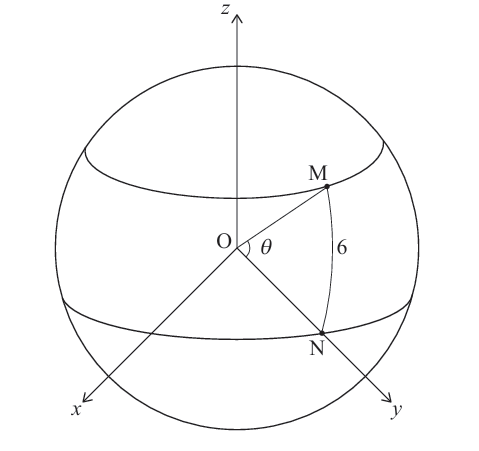
Method: Using arc length formula \(s = r\theta\) with \(s = 6000\) km, \(r = 6000\) km
\(6000 = 6000 \times \theta\) ⇒ \(\theta = 1\) radian
Convert to degrees: \(1 \times \frac{180}{\pi} = 57.2957…^\circ\)
\(\boxed{57.3^\circ}\) (to 3 significant figures)
(e)
Method 1 (Scalar product):
First find angle BÔM using scalar product:
\(b = \begin{pmatrix} 6\sin120^\circ \\ 6\cos120^\circ \\ 0 \end{pmatrix} = \begin{pmatrix} 6 \times \frac{\sqrt{3}}{2} \\ 6 \times (-\frac{1}{2}) \\ 0 \end{pmatrix} = \begin{pmatrix} 3\sqrt{3} \\ -3 \\ 0 \end{pmatrix}\)
\(m = \begin{pmatrix} 0 \\ 6\cos57.3^\circ \\ 6\sin57.3^\circ \end{pmatrix}\)
\(b \cdot m = (3\sqrt{3})(0) + (-3)(6\cos57.3^\circ) + (0)(6\sin57.3^\circ) = -18\cos57.3^\circ\)
\(|b| = \sqrt{(3\sqrt{3})^2 + (-3)^2 + 0^2} = \sqrt{27 + 9} = \sqrt{36} = 6\)
\(|m| = \sqrt{0^2 + (6\cos57.3^\circ)^2 + (6\sin57.3^\circ)^2} = \sqrt{36(\cos^2 57.3^\circ + \sin^2 57.3^\circ)} = 6\)
\(\cos(\text{BÔM}) = \frac{b \cdot m}{|b||m|} = \frac{-18\cos57.3^\circ}{36} = -\frac{\cos57.3^\circ}{2}\)
\(\text{BÔM} = \arccos\left(-\frac{\cos57.3^\circ}{2}\right) = 105.673…^\circ\)
Shortest distance = \(\frac{105.673}{360} \times 2\pi \times 6000 = 11066.0… \text{ km}\)
\(\boxed{11100 \text{ km}}\) (to 3 significant figures)
(f)
Method: Using method from part (c) – find angle between \(b \times m\) and \(b \times p\)
First find \(b \times m\):
\(b \times m = \begin{pmatrix} 36\cos120^\circ\sin57.3^\circ \\ -36\sin120^\circ\sin57.3^\circ \\ 36\sin120^\circ\cos57.3^\circ \end{pmatrix}\)
Using technology with \(\sin57.3^\circ \approx 0.8415\), \(\cos57.3^\circ \approx 0.5403\), \(\sin120^\circ = \frac{\sqrt{3}}{2} \approx 0.8660\), \(\cos120^\circ = -0.5\):
\(b \times m \approx \begin{pmatrix} 36 \times (-0.5) \times 0.8415 \\ -36 \times 0.8660 \times 0.8415 \\ 36 \times 0.8660 \times 0.5403 \end{pmatrix} = \begin{pmatrix} -15.147 \\ -26.234 \\ 16.845 \end{pmatrix}\)
Given \(b \times p = \begin{pmatrix} 36\cos120^\circ \\ -36\sin120^\circ \\ 0 \end{pmatrix} = \begin{pmatrix} -18 \\ -31.176 \\ 0 \end{pmatrix}\)
Scalar product: \((b \times m) \cdot (b \times p) \approx (-15.147)(-18) + (-26.234)(-31.176) + (16.845)(0) = 272.646 + 817.896 = 1090.542\)
\(|b \times m| \approx \sqrt{(-15.147)^2 + (-26.234)^2 + (16.845)^2} = \sqrt{229.43 + 688.22 + 283.75} = \sqrt{1201.40} = 34.661\)
\(|b \times p| = \sqrt{(-18)^2 + (-31.176)^2 + 0^2} = \sqrt{324 + 972.0} = \sqrt{1296} = 36\)
\(\cos\phi = \frac{1090.542}{34.661 \times 36} = \frac{1090.542}{1247.796} = 0.8740\)
\(\phi = \arccos(0.8740) = 29.1^\circ\)
\(\boxed{29.1^\circ}\) or \(\boxed{029^\circ}\)