
Question
Most-appropriate topic codes (IB Mathematics Applications and Interpretation HL):
• AHL 4.14: Unbiased estimates of population parameters ($s_{n-1}$) — parts (b), (c)
• AHL 4.13: Least squares regression analysis and predictions — part (g)
• SL 4.10: Spearman’s rank correlation coefficient — part (f)(ii)
• SL 4.4: Linear correlation and regression — part (f)(i)
• SL 4.1: Concepts of sampling and reliability — part (a)
▶️ Answer/Explanation
(a)(i)
Answer: The sample will be more reliable / more representative of the population / the sample mean is likely to be closer to the population mean. [cite: 1276]
(a)(ii)
Answer: More time consuming / expensive / more open to human error. [cite: 1411]
(b)
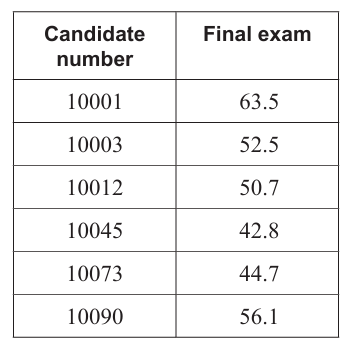
Method: Using GDC with data: $63.5, 52.5, 50.7, 42.8, 44.7, 56.1$
$\boxed{7.60}$ ($7.597537…$) [cite: 1431]
(c)
Answer: The population standard deviation may be different from the sample / these $s_{n-1}$ values are only estimates and the values are too close together / standard deviation is not the only measure of spread. [cite: 1431]
(d)(i)
Answer: The population variances are the same/equal. [cite: 1389]
(d)(ii)
Method: Compare sample standard deviations or variances
Sample $A$: $s_{n-1} = 7.60$, Sample $B$: $s_{n-1} = 7.66$
These are similar, so assumption of equal variances is plausible.
Yes, Aayush should use a pooled $t$-test. [cite: 1389]
(e)(i)
Answer: $H_0: \mu_A = \mu_B$, $H_1: \mu_A < \mu_B$ [cite: 1385]
(e)(ii)
Method: Using GDC with pooled $t$-test
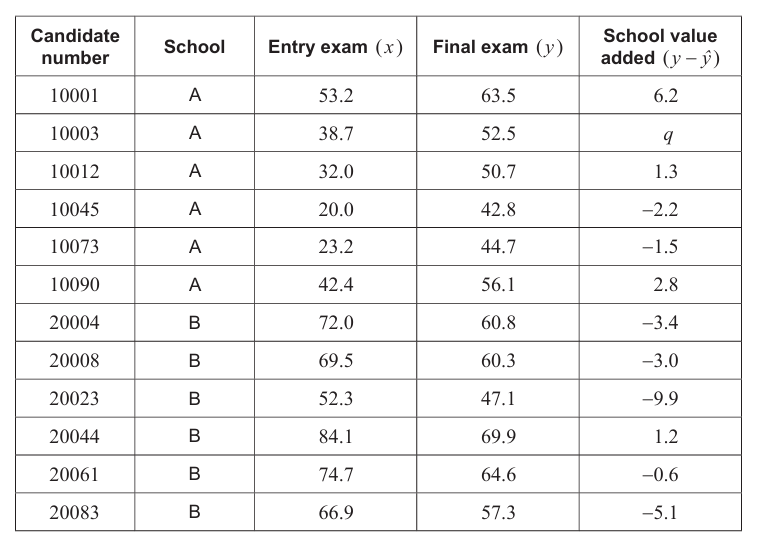
Sample $A$: $n=6, \bar{x}=51.7, s=7.60$
Sample $B$: $n=6, \bar{x}=60, s=7.66$
$\boxed{0.0445}$ ($0.0444586…$) [cite: 1389]
(e)(iii)
Method: Compare $p$-value with significance level $\alpha = 0.05$
$0.0445 < 0.05$ $\Rightarrow$ Reject $H_0$
There is significant evidence that the population mean of School $B$ is higher than the population mean of School $A$ / Aayush’s belief is supported. [cite: 1385]
(f)(i)
Method: Correlation hypothesis test
$H_0: \rho = 0, H_1: \rho \neq 0$
Test statistic: $r = 0.876$
Critical value: $0.576$ (at $5\%$ significance level for $n=12$)
$0.876 > 0.576$ $\Rightarrow$ Reject $H_0$
There is significant evidence of correlation between entry exam and final exam results. [cite: 1465]
(f)(ii)
$\boxed{\text{Spearman’s rank correlation coefficient}}$ [cite: 1372]
(g)
As entry exam result increases by $1$ percentage point, the final exam result increases by $0.37$ percentage points.
(h)(i)
Method: For candidate $10003$: $x = 38.7$
Predicted: $\hat{y} = 0.37 \times 38.7 + 37.6 = 14.319 + 37.6 = 51.919$
School value added: $y – \hat{y} = 52.5 – 51.919 = 0.581$
Rounded to $1$ decimal place: $0.6$
$\boxed{0.6}$
(h)(ii)
Method: Pooled $t$-test on school value added data
$H_0: \mu_A = \mu_B$ (mean school value added equal)
$H_1: \mu_A > \mu_B$ (mean school value added higher in School $A$)
Using GDC with pooled $t$-test:
$p$-value $= 0.0213$ ($0.0212715…$)
$0.0213 < 0.05$ $\Rightarrow$ Reject $H_0$
There is evidence of higher school value added in School $A$. [cite: 1389, 1465]
(i)
Answer: School $B$ outperforms School $A$ is supported by the test in part (e) / higher mean. School $A$ outperforms School $B$ is supported by the test in part (h) / better added value.