
IBDP Physics- B.1 Thermal energy transfers- IB Style Questions For HL Paper 1A -FA 2025
Question
(B) \( \frac{mLT}{c} \)
(C) \( \frac{McT}{L} \)
(D) \( \frac{MLT}{c} \)
▶️ Answer/Explanation
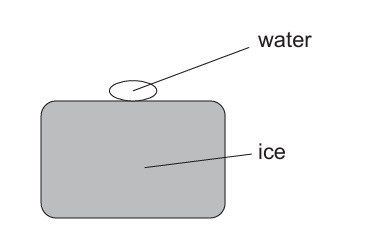
The warm water cools from \( T^\circ C \) to 0°C, releasing heat: \( Q = mcT \)
This heat is used to melt ice: \( Q = m_{melt}L \)
Equating: \( mcT = m_{melt}L \) ⇒ \( m_{melt} = \frac{mcT}{L} \)
✅ Answer: (A)
Question
The temperature of an object changes from \( \theta_1\,^{\circ}\text{C} \) to \( \theta_2\,^{\circ}\text{C} \).
What is the change in temperature measured in kelvin?
(B) \( (\theta_2 – \theta_1) + 273 \)
(C) \( (\theta_2 – \theta_1) – 273 \)
(D) \( 273 – (\theta_2 – \theta_1) \)
▶️ Answer/Explanation
The kelvin scale has the same size degree as the Celsius scale; the only difference between the two scales is the zero point.
Therefore, a change in temperature has the same numerical value in kelvin as in degrees Celsius.
Hence, the change in temperature is \( \theta_2 – \theta_1 \).
✅ Answer: (A)
Question
A metal cube \(X\) of side length \(L\) is heated and gains thermal energy \(Q\). Its temperature increases by \(\Delta T\).
A second cube \(Y\), made of the same material and having side length \(2L\), gains thermal energy \(2Q\).
(B) \( \dfrac{\Delta T}{4} \)
(C) \( \Delta T \)
(D) \( 2\Delta T \)
▶️ Answer/Explanation
The thermal energy gained by a body is given by \( Q = mc\Delta T \), where \(m\) is the mass and \(c\) is the specific heat capacity.
Since both cubes are made of the same material, \(c\) is the same for both. The mass of each cube is proportional to its volume.
For cube \(X\): volume \(= L^3\).
For cube \(Y\): volume \(= (2L)^3 = 8L^3\).
Hence, \( m_Y = 8m_X \).
For cube \(X\): \( Q = m_X c \Delta T \).
For cube \(Y\): \( 2Q = m_Y c \Delta T_Y \).
Substituting \( m_Y = 8m_X \):
\( 2(m_X c \Delta T) = 8m_X c \Delta T_Y \).
Cancelling common terms gives \( 2\Delta T = 8\Delta T_Y \), so \( \Delta T_Y = \dfrac{\Delta T}{4} \).
✅ Answer: (B)