
▶️ Answer/Explanation
(a)
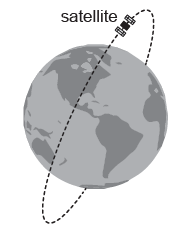
For a circular orbit, \[ \frac{mv^2}{r}=\frac{GMm}{r^2} \] which gives \[ T^2=\frac{4\pi^2 r^3}{GM} \] Substituting \(r=6.6\times10^{6}\,\text{m}\) and \(M=6.0\times10^{24}\,\text{kg}\), \[ T \approx 5.3\times10^{3}\,\text{s} \]
(b)(i)
Using Wien’s displacement law, \[ \lambda_{\max}T=2.90\times10^{-3} \] \[ T=\frac{2.90\times10^{-3}}{10.1\times10^{-6}}\approx2.87\times10^{2}\,\text{K} \] Mean temperature of the Earth \(\approx 287\,\text{K}\) (about \(14^\circ\text{C}\)).
(b)(ii)
Radiation from the Sun has a much shorter wavelength and passes largely through the atmosphere. The Earth emits longer-wavelength infrared radiation, which is absorbed by greenhouse gases. This radiation is re-emitted in all directions, including back towards the Earth, reducing energy loss and increasing the surface temperature.
(c)
Scientists use peer review, repeat experiments, publish methods and results in detail, and collaborate internationally so findings can be checked and verified.