
IBDP Physics- B.3 Gas laws- IB Style Questions For HL Paper 1A -FA 2025
Question
A rigid vessel of volume \(V\) contains \(N\) molecules of an ideal monatomic gas. The average kinetic energy of the molecules is \(E_k\). What is the pressure in the vessel?
(B) \(\dfrac{2NE_k}{3V}\)
(C) \(\dfrac{3N}{2VE_k}\)
(D) \(\dfrac{3NE_k}{2V}\)
▶️ Answer/Explanation
Correct Answer: \( \boxed{\mathrm{B}} \)
For an ideal gas, the kinetic theory relationship between pressure and the total translational kinetic energy is
\(PV=\dfrac{2}{3}E_{\mathrm{total}}\)
The average kinetic energy of one molecule is \(E_k\), so for \(N\) molecules the total kinetic energy is
\(E_{\mathrm{total}}=NE_k\)
Therefore,
\(PV=\dfrac{2}{3}NE_k\)
Rearranging for pressure gives
\(P=\dfrac{2NE_k}{3V}\)
Hence, the correct answer is \( \boxed{\mathrm{B}} \).
Question
A sample of \(n\) moles of an ideal gas is kept at a constant volume. The graph shows how the pressure \(P\) of the gas varies with absolute temperature \(T\).
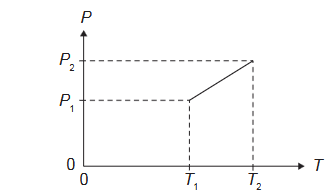
What is the volume of the gas?
(B) \(nR\frac{P_2-P_1}{T_2-T_1}\)
(C) \(nR\left(\frac{T_2}{P_2}-\frac{T_1}{P_1}\right)\)
(D) \(nR\left(\frac{P_2}{T_2}-\frac{P_1}{T_1}\right)\)
▶️ Answer/Explanation
Correct Answer: \( \boxed{\mathrm{A}} \)
For an ideal gas, the ideal gas equation is
\(PV=nRT\)
Since the volume \(V\) and number of moles \(n\) are constant,
\(P=\frac{nR}{V}T\)
The gradient of the graph of \(P\) against \(T\) is therefore
\(\frac{P_2-P_1}{T_2-T_1}=\frac{nR}{V}\)
Rearranging for \(V\),
\(V=nR\frac{T_2-T_1}{P_2-P_1}\)
Thus, the volume of the gas is
\( \boxed{V=nR\frac{T_2-T_1}{P_2-P_1}} \)
Hence, the correct answer is \( \boxed{\mathrm{A}} \).
Question
Three statements about the gas molecules during the expansion are:
II. They travel further on average between each collision.
III. Their average kinetic energy decreases as the gas expands.
(B) I and III only
(C) II and III only
(D) I, II and III
▶️ Answer/Explanation
During a slow expansion at constant temperature, the average kinetic energy of gas molecules depends only on temperature and therefore remains constant.
I. As the gas expands, the number density of molecules decreases. This leads to fewer collisions with the container walls per unit time, so the collision rate is reduced.
II. With increased volume, the average distance between molecules increases. Hence, the mean free path becomes longer and molecules travel further between collisions.
III. This statement is incorrect because the temperature remains constant. Since average kinetic energy is proportional to temperature, it does not decrease.
Therefore, statements I and II are correct.
✅ Answer: (A)