Home / IBDP Physics- B.4 Thermodynamics- IB Style Questions For HL Paper 2

IBDP Physics- B.4 Thermodynamics- IB Style Questions For HL Paper 2 -FA 2025

Question

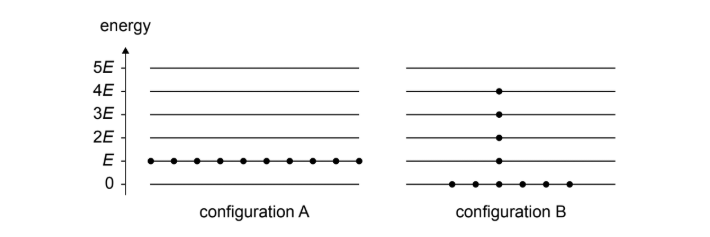
A system is made up of ten distinguishable particles that are able to exchange energy in whole-number multiples of a fixed amount \(E\). The total energy of the system is \(10E\). The diagram shows two possible energy arrangements of the system. In configuration A, each particle has an energy of \(E\). In configuration B, the particles possess a spread of energies ranging from \(0\) to \(4E\).
(a) State which of the two configurations has the larger number of microstates.
The ten-particle system is isolated. Two possible processes describing the overall change of the system are considered.
Process 1: the system starts in configuration A and changes to configuration B.
Process 2: the system starts in configuration B and changes to configuration A.
(b) Explain why process 1 is more likely to take place.

Most-appropriate topic codes (IB Physics):

Topic B.4: Thermodynamics (entropy, microstates, second law) — parts (a) and (b)
▶️ Answer/Explanation
Detailed solution

(a)
Configuration B has the greater number of microstates. In configuration A all particles have exactly the same energy \(E\), so there is only one possible microscopic arrangement. In configuration B, the total energy can be distributed among the particles in many different ways while giving the same overall appearance, resulting in a much larger number of microstates.

(b)
Process 1 is more likely because, for an isolated system, the entropy tends to increase in accordance with the second law of thermodynamics. Entropy is related to the number of microstates by \(S \propto \ln \Omega\). Since configuration B corresponds to a larger number of microstates and therefore higher entropy, the system is more likely to evolve from configuration A to configuration B than in the reverse direction.

Scroll to Top