
▶️ Answer/Explanation
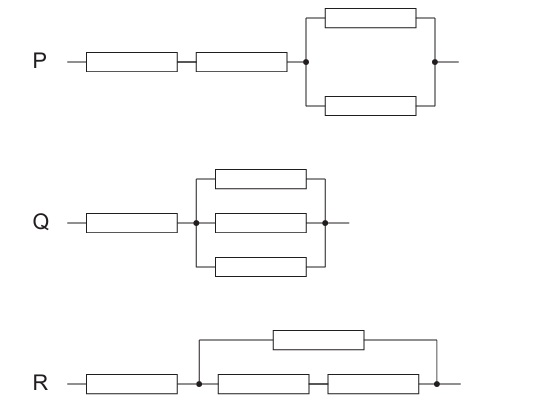
Assuming each resistor has resistance R:
• Q: Two parallel pairs in series – equivalent resistance = R/2 + R/2 = R
• R: Two series pairs in parallel – equivalent resistance = (2R × 2R)/(2R + 2R) = R
• P: All resistors in parallel – equivalent resistance = R/4
Order of increasing resistance: P (R/4) → Q (R) = R (R) → but since Q and R have equal resistance, the order depends on specific arrangement. Given the answer is D (Q R P), this suggests:
– Q has the lowest resistance
– R has medium resistance
– P has the highest resistance
✅ Answer: (D)

▶️ Answer/Explanation
The drift speed \(v_d\) of charge carriers in a conductor is given by \( v_d = \dfrac{I}{nqA} \), where \(I\) is the current, \(n\) is the number density of charge carriers, \(q\) is the charge of an electron, and \(A\) is the cross-sectional area.
Since conductors \(P\) and \(Q\) are connected in series, the same current \(I\) flows through both conductors. They are made of the same material, so \(n\) and \(q\) are the same for both.
Therefore, the drift speed is inversely proportional to the cross-sectional area: \( v_d \propto \dfrac{1}{A} \).
The cross-sectional area of a conductor is proportional to the square of its diameter. If the diameter of \(Q\) is twice that of \(P\), then
\( A_Q = (2)^2 A_P = 4A_P \).
Hence,
\( \dfrac{v_P}{v_Q} = \dfrac{A_Q}{A_P} = \dfrac{4A_P}{A_P} = 4 \).
✅ Answer: (A)


▶️ Answer/Explanation
Total power supplied by the cell is the sum of the powers in the three lamps:
\( P_{\text{total}} = 10 + 20 + 20 = 50\,\text{W} \).
Since the internal resistance is negligible, the terminal voltage is \(20\,\text{V}\). The total current from the cell is
\( P_{\text{total}} = VI \Rightarrow 50 = 20I \Rightarrow I = 2.5\,\text{A} \).
Lamp \(X\) is in series with the rest of the circuit, so it carries the same current \(I=2.5\,\text{A}\). Using \(P = VI\) for lamp \(X\):
\( 10 = V_X(2.5) \Rightarrow V_X = 4\,\text{V} \).
Therefore the remaining voltage across the parallel branch containing \(Y\) and \(Z\) is
\( 20 – 4 = 16\,\text{V} \).
Lamps \(Y\) and \(Z\) are in parallel, so they each have the same potential difference:
\( V_Y = 16\,\text{V} \).
✅ Answer: (B)