IBDP Physics- C.2 Wave model- IB Style Questions For HL Paper 1A -FA 2025
Question
(B) Frequency: 250 Hz, Amplitude: 5.0 nm
(C) Frequency: 4.0 × 10⁻³ Hz, Amplitude: 10.0 nm
(D) Frequency: 250 Hz, Amplitude: 10.0 nm
▶️ Answer/Explanation
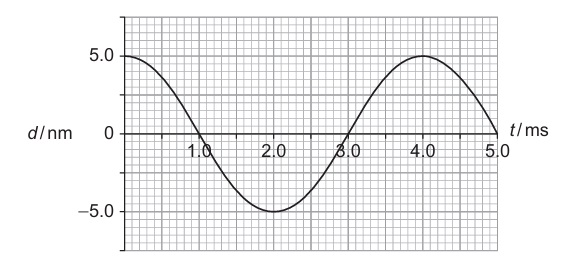
From the graph:
• Amplitude = maximum displacement = 5.0 nm
• Time period T = 4.0 ms = 4.0 × 10⁻³ s
• Frequency f = 1/T = 1/(4.0 × 10⁻³) = 250 Hz
✅ Answer: (B)
Question
It is a…
(B) longitudinal wave
(C) standing wave
(D) travelling wave
▶️ Answer/Explanation
Polarization refers to restricting the direction of oscillation of a wave. This is only possible if the oscillations are perpendicular to the direction of wave propagation.
Transverse waves have oscillations perpendicular to the direction of travel and therefore can be polarized. Longitudinal waves oscillate parallel to the direction of travel and cannot be polarized.
Whether a wave is standing or travelling does not determine whether it can be polarized.
✅ Answer: (A)
Question
Which point is at the centre of a compression?
▶️ Answer/Explanation
In a longitudinal wave, compressions occur where particles of the medium are closest together, corresponding to regions of maximum pressure and density.
On a displacement–distance graph, the centre of a compression is located where the gradient of the displacement is most negative, indicating particles on either side are moving towards each other.
From the diagram:
Point A corresponds to a compression,
Point B is a normal pressure point,
Point C corresponds to a rarefaction,
Point D is another normal pressure point.
✅ Answer: (A)
