
▶️ Answer/Explanation
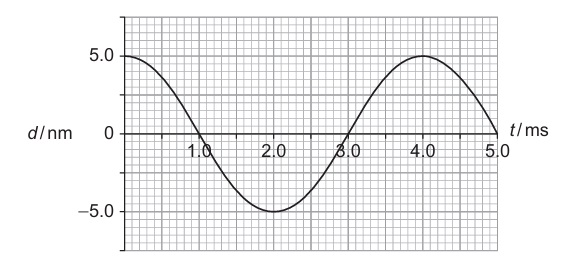
1. Determine Amplitude:
The maximum displacement from the equilibrium position (\(d = 0\)) is 5.0 nm.
2. Determine Period (T):
The graph shows one complete cycle from \(t = 0\) to \(t = 4.0\) ms.
\(T = 4.0 \text{ ms} = 4.0 \times 10^{-3} \text{ s}\).
3. Calculate Frequency (f):
\(f = \frac{1}{T} = \frac{1}{4.0 \times 10^{-3}} = 250 \text{ Hz}\).
4. Match Options:
Frequency = 250 Hz, Amplitude = 5.0 nm.
✅ Answer: (B)

▶️ Answer/Explanation
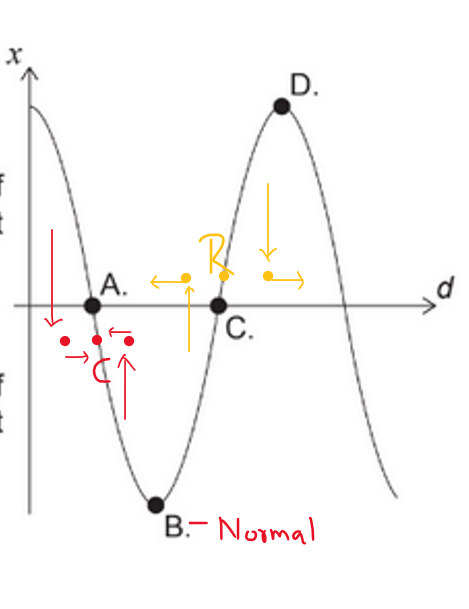
For a longitudinal wave, a compression occurs where neighbouring particles are closest together.
This corresponds to a region where the displacement changes from positive to negative with distance (the curve has a steep negative slope), meaning particles on either side have moved towards the same region.
From the graph, point A is at the centre of a compression.
So:
A — compression
B — normal pressure point
C — rarefaction
D — normal pressure point
✅ Answer: (A)