
▶️ Answer/Explanation
Detailed solution
1. Doppler Effect Formula:
\(\frac{\Delta f}{f_0} \approx \frac{v}{c}\) where \(v\) is the source velocity and \(c\) is the speed of sound.
Because the source is approaching, the observed frequency is increased (\(\Delta f > 0\)).
2. Analyze Motion:
The source slows down until it comes to rest.
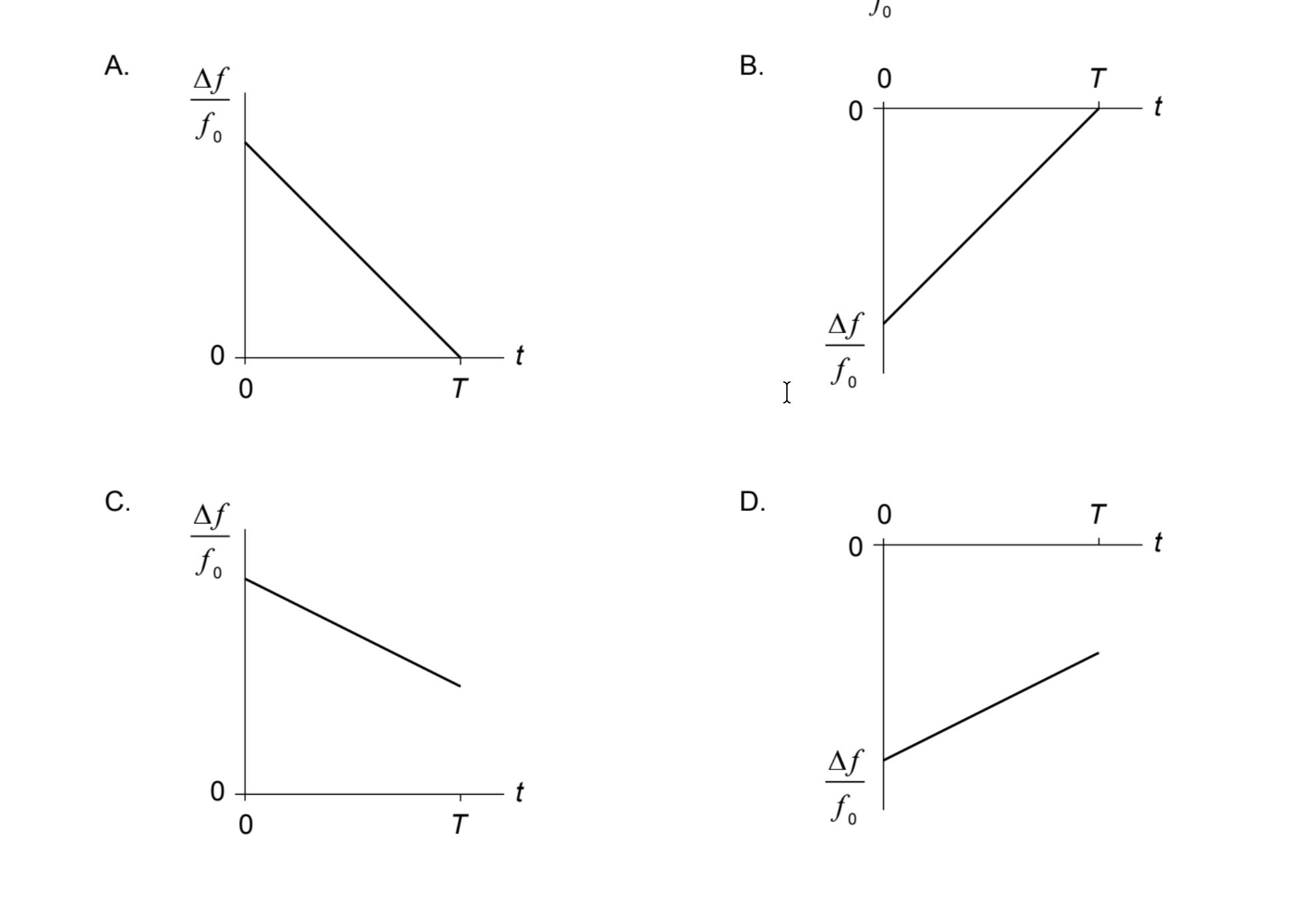
At \(t=0\), the velocity \(v\) is greatest, so \(\frac{\Delta f}{f_0}\) is at its maximum positive value.
At \(t=T\), the velocity is zero, so \(\frac{\Delta f}{f_0} = 0\).
With uniform deceleration, the velocity — and hence \(\frac{\Delta f}{f_0}\) — decreases linearly with time.
3. Match Graph:
The correct graph begins at a positive value and decreases linearly to zero at \(t=T\).
Graph A satisfies these conditions.
✅ Answer: (A)

▶️ Answer/Explanation
Detailed solution
First Doppler shift (car as moving observer):
Frequency received by the car:
\(f’ \approx f\left(1+\dfrac{v}{c}\right)\)
Frequency received by the car:
\(f’ \approx f\left(1+\dfrac{v}{c}\right)\)
Second Doppler shift (reflected wave back to detector):
The reflected wave is Doppler shifted again on the return trip, so the detector receives:
\(f” \approx f’\left(1+\dfrac{v}{c}\right)\)
The reflected wave is Doppler shifted again on the return trip, so the detector receives:
\(f” \approx f’\left(1+\dfrac{v}{c}\right)\)
Hence,
\(f” \approx f\left(1+\dfrac{v}{c}\right)\left(1+\dfrac{v}{c}\right) = f\left(1+\dfrac{v}{c}\right)^2\)
\(f” \approx f\left(1+\dfrac{v}{c}\right)\left(1+\dfrac{v}{c}\right) = f\left(1+\dfrac{v}{c}\right)^2\)
For \(v \ll c\), use \((1+x)^2 \approx 1+2x\):
\(f” \approx f\left(1+\dfrac{2v}{c}\right)\)
\(f” \approx f\left(1+\dfrac{2v}{c}\right)\)
Therefore the change in frequency is
\(\Delta f = f”-f \approx f\dfrac{2v}{c} = \dfrac{2vf}{c}\)
\(\Delta f = f”-f \approx f\dfrac{2v}{c} = \dfrac{2vf}{c}\)


✅ Answer: (D)