
▶️ Answer/Explanation
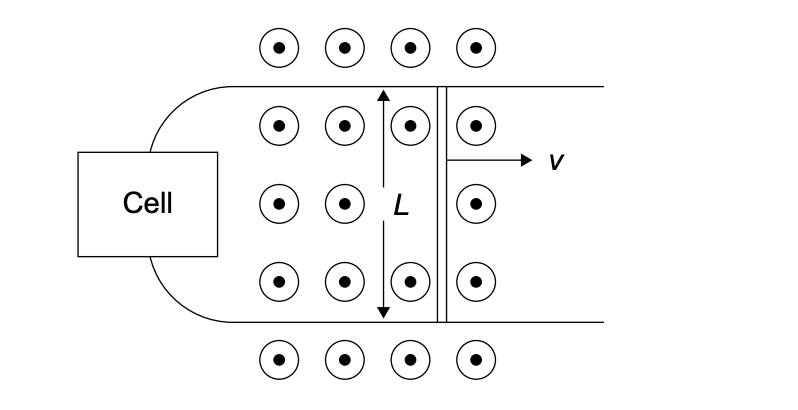
The magnetic force on the rod is \(F = BIL\sin\theta\). Here the rod (current direction) is perpendicular to \(B\) (out of the page), so \(\theta=90^\circ\) and \(F = BIL\sin(90^\circ)\).
For the rod to be pushed to the right by \(\vec{F}=I\vec{L}\times\vec{B}\) with \(\vec{B}\) out of the page, the current in the rod must be upward, which corresponds to an anti-clockwise current around the circuit.
✅ Answer: (A)


▶️ Answer/Explanation
When a straight conductor of length \(L\) moves with speed \(v\) perpendicular to a uniform magnetic field \(B\), an emf is induced given by:
\[ \varepsilon = B L v \]
Hence, the induced emf is directly proportional to the velocity of the wire.
The given graph is a displacement–time graph. The velocity of the wire at any instant is equal to the gradient of this graph.
From \(0\) to \(t_1\), the gradient increases, so the velocity increases and the induced emf increases.
From \(t_1\) to \(t_2\), the gradient is constant, so the velocity and emf are constant.
After \(t_2\), the gradient decreases to zero, so the velocity and emf decrease to zero.

The direction of motion does not reverse, so the emf does not change sign. The correct emf–time graph therefore rises, remains constant, and then falls to zero.
✅ Answer: (C)