
IBDP Computer Science A2.4 Network security SL Paper 2 - New Syllabus
Question
MYP students at One2Seven Academy used a search engine to find information about their school.
Figure 9 shows the outcome of their search.
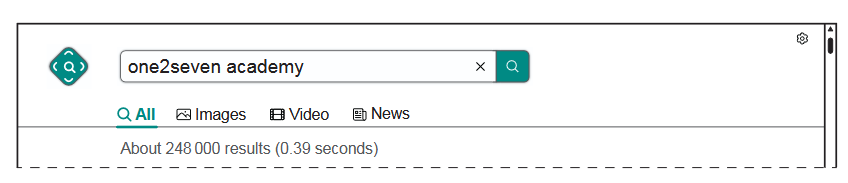
(a) Outline why Figure 9 shows there are 248 000 results when there are actually fewer web pages about One2Seven Academy. [2]
(b) Describe one principle used by the PageRank algorithm as it searches for web pages about One2Seven Academy. [3]
The webmaster at One2Seven Academy is considering increasing the number of meta tags included in the website.
(c) Identify two other ways in which the webmaster could improve the ranking of the One2Seven Academy website. [2]
(d) Explain the relationship between the data in a meta tag and how it is accessed by a web crawler. [3]
(e) Discuss whether the webmaster of One2Seven Academy should use white hat search engine optimization techniques or black hat search engine optimization techniques. [5]
(f) Identify two challenges that search engines face as the web continues to evolve. [2]
Most-appropriate topic codes (IB Computer Science HL):
▶️ Answer/Explanation
(a)
Award [2 max]
- There are no quotation marks around
"One2Seven Academy", so the search engine can return pages containing either word, or both words in any order or location. - The results may therefore include pages containing similar or related words, partial matches, cached pages, duplicates or automatically generated content.
- Unrelated pages may also contain the academy’s name in meta tags, sometimes as a black hat SEO technique to increase popularity.
(b)
Award [3 max: 1 + 1 + 1]
Link analysis: more important pages are likely to receive links from many different sources. Pages about One2Seven Academy that are linked by numerous reputable websites are therefore more likely to be presented prominently.
Quality of links: links from high-ranking websites contribute more to a page’s ranking. High-quality links to One2Seven Academy can therefore increase its visibility in search results.
Damping factor: this accounts for the likelihood that a user starts a new search instead of following links indefinitely, influencing how prominently pages appear based on typical navigation behaviour.
Random surfer model: this models a user randomly clicking on links and starting new searches. Pages with more relevant links may therefore have a higher probability of appearing in searches.
(c)
Award [2 max]
Any two suitable methods, for example:
- Improve website performance and page-loading speed.
- Arrange quality backlinks.
- Optimize website content.
- Optimize the website for mobile devices.
- Use structured data such as Schema Markup.
- Improve user experience (UX).
- Use keyword research and analysis.
- Regularly update the website with new content.
- Use image optimization.
- Use local SEO.
(d)
Award [3 max]
Meta tags provide metadata about a webpage, such as descriptions, keywords or author information. Web crawlers access this metadata while crawling and indexing the webpage to help understand its content and relevance.
The information in a meta tag can influence how the webpage is indexed and its relevance in search results. However, different search engines may interpret the same meta-tag information differently, and its effect can change as search algorithms evolve.
(e)
Award [5 max]
White hat SEO follows search-engine guidelines and focuses on improving content quality, usability and the overall website. It can provide steady, long-term growth in rankings and reduces the risk of penalties or bans. However, results are usually slower and require continuous effort and investment.
Black hat SEO attempts to exploit weaknesses in search-engine algorithms and can produce rapid improvements in rankings. However, these improvements may only be temporary. If detected, the website could receive penalties, be blacklisted or suffer reputational damage.
Conclusion: White hat SEO is the more suitable approach for One2Seven Academy because it provides sustainable rankings and avoids the significant long-term risks associated with black hat techniques.
(f)
Award [2 max]
- Indexing the growing volume of online content.
- Refining algorithms to maintain relevance and accuracy.
- Filtering out false or misleading information.
- Adapting to new content types such as augmented reality (AR).
- Improving algorithms to maintain a good user experience.
- Balancing search efficiency with user privacy.