
IBDP Computer Science B1.1 Approaches to computational thinking SL Paper 2 - New Syllabus
Question
The global increase in mean temperatures is causing concern, and governments are using computer models to determine potential future changes.
Many islands in the Pacific Ocean are close to or below sea level and have observed an increased incidence of coastal flooding. This suggests there is a relationship between the increase in mean temperatures and the increase in mean sea levels.
Figure 4 shows the mean sea level of Nauru from 1994 to 2015.
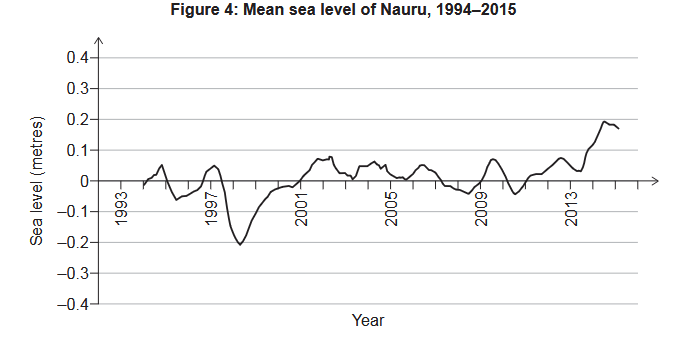
If the mean sea level rises, the probability of coastal flooding will also increase. This will put many of the inhabitants of Nauru at risk.
It has been proposed that a simulation be developed to show the effects of rising temperatures on the extent and frequency of coastal flooding.
Most-appropriate topic code
▶️ Answer/Explanation
(a)
- A model is a mathematical representation or abstraction of a real-life situation or system.
- A simulation is the running of a mathematical model over time, usually on a computer, to represent how the real-life system may behave.
Explanation: The model represents the relationships within the system, while the simulation uses that model to investigate how the system changes over time.
(b)
- Collect and analyse data for pairs of temperature, sea level and flooding measurements.
- Use the data to suggest rules describing the relationships between temperature, sea level and flooding.
- Check the suggested rules against actual observed data and refine them where necessary.
Explanation: The rules should be based on observed relationships in the available data rather than simply being assumed. The proposed rules can then be checked against known data to determine whether they represent the real system sufficiently well.
(c)
- Find suitable historical data for which the actual results are already known.
- Use data that is consistent with the conditions represented by the model and is not significantly affected by unrelated external factors.
- Input the historical data into the proposed simulation.
- Compare the simulation’s predicted results with the known real-world results.
- If the results differ significantly, modify the algorithms or model.
- Repeat the testing process using further historical data to determine whether the modified simulation produces more accurate results.
Evaluation: Using test cases based on known historical data provides evidence about how accurately the simulation represents the real system. Repeated testing and modification can improve the model and therefore increase the accuracy of the simulation.
(d)
Advantages:
- A simulation is a simplified representation of a much more complex real-world system.
- It can be developed and run with less time and cost than repeatedly investigating the real-world situation.
- It can produce measurable and visual results showing possible future effects.
- It can help predict the extent and frequency of coastal flooding and allow governments to prepare for potential risks.
Disadvantages:
- The simulation is a simplified or crude representation and may only consider one or two factors.
- It may not consider important social or cultural factors affecting communities.
- If the input data or rules are inaccurate or have not been adequately validated, the simulation may produce inaccurate predictions.
Evaluation: A simulation can support decision-making by allowing possible future scenarios to be investigated without directly experimenting with the real environment. However, decisions should not rely entirely on the simulation because its accuracy depends on the quality of the model, data, assumptions, and rules used.