
IBDP Computer Science B2.2 Data structures HL Paper 2 - New Syllabus
Question
A lawyer’s rank depends on the number of cases they have won.
The information about the number of cases won by each lawyer in the last four years is stored in a 2D array, casesWon, as shown in Figure 11. Rows represent the number of cases won by a lawyer, and columns represent the year.
Figure 11: An excerpt from the 2D array, casesWon
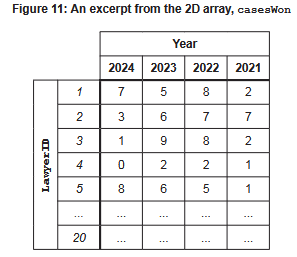
A lawyer’s rank is set to 1 only if the number of cases won by the lawyer in any two consecutive years is greater than 6.
For example: the rank for lawyer 1 will remain 0, whereas the rank for lawyer 2 will be set to 1 as the number of cases they won is greater than 6 in both 2022 and 2021.
updateLawyerRank(int[][] casesWon) to update lawyerRank for all the lawyers in the firm. The method should output a suitable message if no lawyer’s rank changes to 1. [7]The law firm can have more than one criminal lawyer. A criminal lawyer gets only criminal cases.
ArrayList of criminal cases that the law firm currently has and store all criminal cases to this array list. [3]Most-appropriate topic code
▶️ Answer/Explanation
(a)
Award [7 max]
The method should use a flag to determine whether at least one lawyer’s rank has been changed. It must compare each pair of consecutive years and set the lawyer’s rank to 1 if both values are greater than 6.
public static void updateLawyerRank(int[][] casesWon)
{
    boolean flag = false;

    for(int i = 0; i < 20; i++)
    {
        for(int j = 0; j < 3; j++)
        {
            if(casesWon[i][j] > 6 && casesWon[i][j + 1] > 6)
            {
                allLawyers[i].setLawyerRank(1);
                flag = true;
            }
        }
    }

    if(flag == false)
    {
        System.out.println("No lawyer rank was changed to 1");
    }
}
The inner loop stops at j < 3 because j + 1 must remain within the four year columns.
(b)
Award [3 max]
- Declare an
ArrayListofCaseobjects, for examplecriminalCases, to store all criminal cases. - Loop through the
allLawyers[]array from the first lawyer to the last lawyer. - For each lawyer whose
lawyerTypeis"criminal", loop through theirlawyerCases[]array. - Check each element for
nullbefore accessing the case. - Add each valid criminal case to the
ArrayList.
ArrayList<Case> criminalCases = new ArrayList<Case>();

for(int i = 0; i < allLawyers.length; i++)
{
    if(allLawyers[i].getLawyerType().equals("criminal"))
    {
        for(int j = 0; j < allLawyers[i].getLawyerCases().length; j++)
        {
            if(allLawyers[i].getLawyerCases()[j] != null)
            {
                criminalCases.add(allLawyers[i].getLawyerCases()[j]);
            }
        }
    }
}