
Electric Potential Energy \( E_p \) and Work Done from Infinite Separation
The electric potential energy \( E_p \) of a system of charges is defined as the work done by an external agent in assembling the system from infinite separation, where the electric potential energy is taken to be zero.
At infinite separation, electric forces between charges are negligible, so no work is required to keep the charges apart. This makes infinity a convenient reference point.
\( E_p = W_{\text{external}} \)
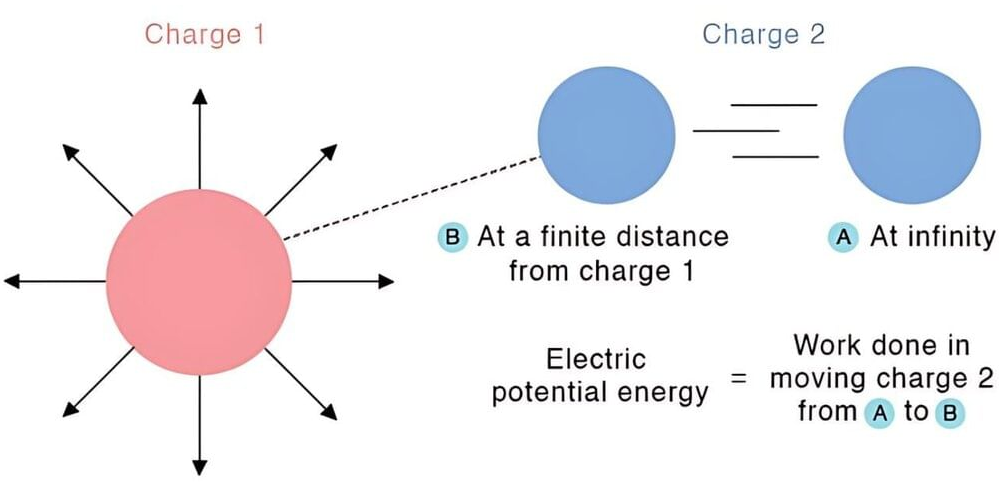
Where:
- \( E_p \): Electric potential energy of the system (in joules)
- \( W_{\text{external}} \): Work done by an external force in assembling the charges
If work is done against the electric force, the electric potential energy of the system increases. If work is done by the electric force, the electric potential energy decreases.
Important points:
- Electric potential energy is a property of the system of charges, not an individual charge.
- \( E_p = 0 \) is defined at infinity.
- Attractive interactions give negative \( E_p \); repulsive interactions give positive \( E_p \).
Example:
An external agent slowly brings a positive test charge from infinity to a point near another charge, keeping it at rest throughout. Explain the meaning of the work done in terms of electric potential energy.
▶️ Answer / Explanation
As the charge is brought in from infinity, the external agent does work against the electric force.
This work done is stored as electric potential energy in the system of charges.
\( E_p = W_{\text{external}} \)
Since the charge starts from infinity where \( E_p = 0 \), the final electric potential energy is equal to the work done in assembling the system.
Electric Potential Energy of a System of Two Charged Bodies
For a system of two point charges, the electric potential energy \( E_p \) is equal to the work done by an external agent in bringing one charge from infinite separation to a distance \( r \) from the other charge.
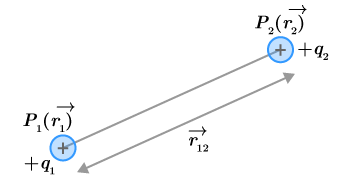
\( E_p = k \dfrac{q_1 q_2}{r} \)
Where:
- \( E_p \): Electric potential energy of the system (in joules)
- \( k \): Coulomb constant \( (9.0 \times 10^9 \, \text{N m}^2 \text{C}^{-2}) \)
- \( q_1, q_2 \): Magnitudes of the two charges (in coulombs)
- \( r \): Separation between the charges (in meters)
The value of \( E_p \) depends on both the magnitudes of the charges and the distance between them.
Sign of the electric potential energy:
- If \( q_1 q_2 > 0 \) (like charges), \( E_p \) is positive → work must be done against repulsion.
- If \( q_1 q_2 < 0 \) (opposite charges), \( E_p \) is negative → energy is released as charges attract.
Key physical interpretation:
A positive value of \( E_p \) indicates an unstable configuration, while a negative value indicates a bound and stable system.
Example:
Two point charges of \( +4.0 \, \text{nC} \) and \( +2.0 \, \text{nC} \) are separated by a distance of \( 0.30 \, \text{m} \). Calculate the electric potential energy of the system.
▶️ Answer / Explanation
Step 1: Identify the values
\( q_1 = 4.0 \times 10^{-9} \, \text{C} \)
\( q_2 = 2.0 \times 10^{-9} \, \text{C} \)
\( r = 0.30 \, \text{m} \)
Step 2: Substitute into the formula
\( E_p = (9.0 \times 10^9)\dfrac{(4.0 \times 10^{-9})(2.0 \times 10^{-9})}{0.30} \)
Step 3: Calculate
\( E_p = \boxed{2.4 \times 10^{-7} \, \text{J}} \)
Interpretation:
The electric potential energy is positive, indicating that work must be done to assemble the system against the repulsive force between the two like charges.
Electric Potential as a Scalar Quantity (Zero at Infinity)
Electric potential \( V \) at a point is a scalar quantity, meaning it has magnitude only and no direction. It is defined as the electric potential energy per unit charge at that point.
\( V = \dfrac{E_p}{q} \)
Reference level:
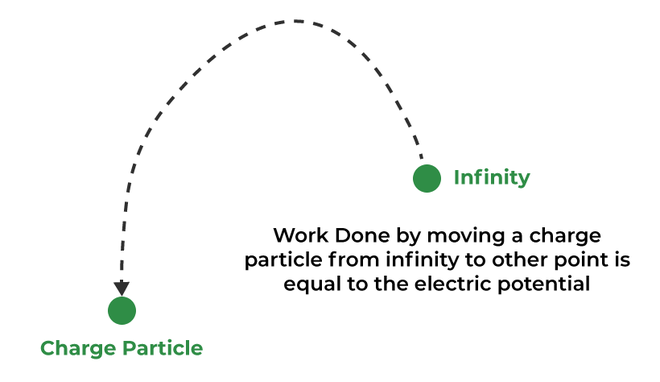
The electric potential is defined to be zero at infinity. At infinite separation from all charges, no work is required to bring a test charge further away, so the electric potential energy and electric potential are both taken as zero.
Why electric potential is scalar:
- It is defined using work and energy, which are scalar quantities.
- No direction is associated with electric potential.
- Positive and negative values indicate higher or lower potential relative to infinity.
Physical meaning:
A positive electric potential indicates work must be done to bring a positive test charge from infinity to that point. A negative electric potential indicates energy is released when bringing the charge from infinity.
Important IB points:
- Electric potential depends only on position, not direction.
- The chosen reference point (infinity) must always be stated in explanations.
- Electric potential can be positive, negative, or zero.
Example:
Explain why the electric potential due to an isolated positive point charge is taken to be zero at infinity.
▶️ Answer / Explanation
At infinity, the electric field due to the charge becomes negligible, so no work is required to move a test charge further away.
Since electric potential is defined as work done per unit charge, the electric potential at infinity is defined as zero.
This provides a convenient and consistent reference point for measuring electric potential elsewhere.
Electric Potential \( V_e \) as Work Done per Unit Charge
The electric potential \( V_e \) at a point is defined as the work done per unit charge in bringing a small positive test charge from infinity to that point, without changing its kinetic energy.

\( V_e = \dfrac{W}{q} \)
For a point charge \( Q \), the electric potential at a distance \( r \) from the charge is given by:
\( V_e = k \dfrac{Q}{r} \)
Where:
- \( V_e \): Electric potential at the point (in volts)
- \( W \): Work done in moving the test charge (in joules)
- \( q \): Test charge (in coulombs)
- \( k \): Coulomb constant \( (9.0 \times 10^9 \, \text{N m}^2 \text{C}^{-2}) \)
- \( Q \): Source charge producing the field (in coulombs)
- \( r \): Distance from the charge (in meters)
Important features:
- Electric potential depends only on position, not on the path taken.
- The test charge must be small so it does not disturb the electric field.
- The electric potential is defined relative to infinity where \( V_e = 0 \).
Sign of electric potential:
- If \( Q > 0 \), \( V_e \) is positive.
- If \( Q < 0 \), \( V_e \) is negative.
Example:
Calculate the electric potential at a point \( 0.50 \, \text{m} \) from an isolated charge of \( +6.0 \, \text{nC} \).
▶️ Answer / Explanation
Step 1: Identify the values
\( Q = 6.0 \times 10^{-9} \, \text{C} \)
\( r = 0.50 \, \text{m} \)
Step 2: Use the formula
\( V_e = k \dfrac{Q}{r} \)
Step 3: Calculate
\( V_e = \dfrac{(9.0 \times 10^9)(6.0 \times 10^{-9})}{0.50} = \boxed{108 \, \text{V}} \)
Interpretation:
A positive electric potential means work must be done to bring a positive test charge from infinity to this point.
Electric Field Strength \( E \) as the Electric Potential Gradient
The electric field strength \( E \) at a point is defined as the rate of change of electric potential with distance. It describes how quickly the electric potential changes as you move through an electric field.
\( E = – \dfrac{\Delta V_e}{\Delta r} \)
Where:
- \( E \): Electric field strength (in N C\(^{-1}\) or V m\(^{-1}\))
- \( \Delta V_e \): Change in electric potential (in volts)
- \( \Delta r \): Distance moved in the field (in meters)
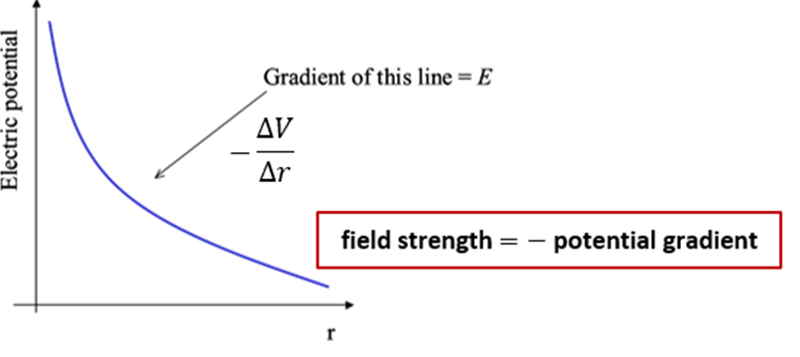
The negative sign indicates that the electric field points in the direction of decreasing electric potential.
Physical interpretation:
- The electric field shows how strongly a charge would be pushed or pulled at a point.
- A steep potential gradient corresponds to a strong electric field.
- A uniform electric field has a constant potential gradient.
IB exam points:
- State that the electric field acts in the direction of maximum decrease in potential.
- Mention that electric field strength is a vector, while electric potential is a scalar.
- Include the negative sign when writing the definition.
Example:
The electric potential between two parallel plates decreases uniformly from \( 600 \, \text{V} \) to \( 200 \, \text{V} \) over a distance of \( 0.20 \, \text{m} \). Calculate the electric field strength between the plates.
▶️ Answer / Explanation
Step 1: Identify the change in potential
\( \Delta V_e = 200 – 600 = -400 \, \text{V} \)
Step 2: Use the formula
\( E = – \dfrac{\Delta V_e}{\Delta r} \)
Step 3: Calculate
\( E = – \dfrac{-400}{0.20} = \boxed{2.0 \times 10^3 \, \text{V m}^{-1}} \)
Interpretation:
The electric field is uniform and directed from higher potential to lower potential.
Work Done in Moving a Charge \( q \) in an Electric Field
The work done \( W \) in moving a charge \( q \) between two points in an electric field is equal to the product of the charge and the change in electric potential between those points.
\( W = q \Delta V_e \)
Where:
- \( W \): Work done (in joules)
- \( q \): Charge moved (in coulombs)
- \( \Delta V_e \): Change in electric potential between the two points (in volts)
Physical meaning:
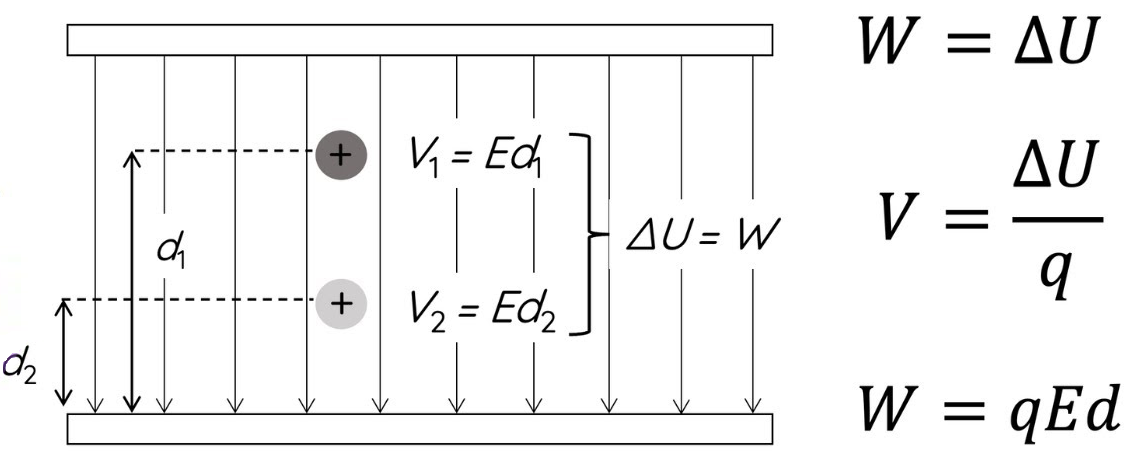
This equation shows that electric potential difference represents the energy transferred per unit charge when a charge moves in an electric field.
Important points:
- A positive value of \( W \) means energy is transferred to the charge.
- A negative value of \( W \) means energy is transferred from the charge to the field.
- The work done depends only on the initial and final positions, not the path taken.
Relation to electric potential energy:
The work done in moving a charge is equal to the change in electric potential energy of the charge:
\( \Delta E_p = q \Delta V_e \)
Example:
A charge of \( 2.0 \, \text{nC} \) moves between two points in an electric field where the electric potential increases by \( 300 \, \text{V} \). Calculate the work done.
▶️ Answer / Explanation
Step 1: Identify the values
\( q = 2.0 \times 10^{-9} \, \text{C} \)
\( \Delta V_e = 300 \, \text{V} \)
Step 2: Use the formula
\( W = q \Delta V_e \)
Step 3: Calculate
\( W = (2.0 \times 10^{-9})(300) = \boxed{6.0 \times 10^{-7} \, \text{J}} \)
Interpretation:
The charge gains electric potential energy as it moves to a higher electric potential.
Equipotential Surfaces in Electric Fields
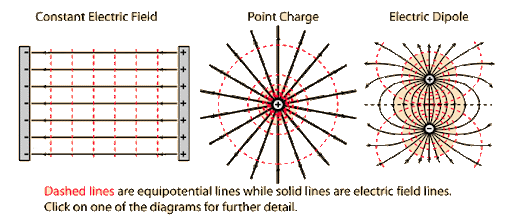
An equipotential surface is a surface on which the electric potential \( V \) is the same at every point.
This means that the change in electric potential \( \Delta V \) between any two points on the surface is zero.
\( \Delta V = 0 \)
Key properties of equipotential surfaces:
- No work is done when a charge moves along an equipotential surface.
- Equipotential surfaces never intersect.
- Closely spaced equipotentials indicate a strong electric field.
- Widely spaced equipotentials indicate a weak electric field.
Work done on a charge:
Since \( \Delta V = 0 \) on an equipotential surface, the work done in moving a charge \( q \) along the surface is:
\( W = q \Delta V = 0 \)
Common examples:
- For a point charge, equipotential surfaces are concentric spheres.
- For a uniform electric field, equipotential surfaces are parallel planes.
Example:
Explain why no work is done when a charged particle moves along an equipotential surface.
▶️ Answer / Explanation
Work done is given by \( W = q \Delta V \).
Along an equipotential surface, the electric potential is constant, so \( \Delta V = 0 \).
Therefore, \( W = 0 \), meaning no energy is transferred to or from the charge.
Relationship Between Equipotential Surfaces and Electric Field Lines
Equipotential surfaces and electric field lines are closely related representations of an electric field.
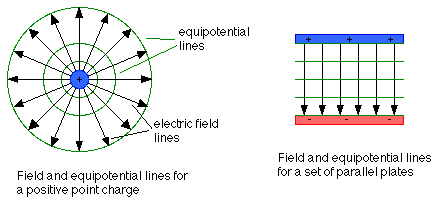
At every point in an electric field, electric field lines intersect equipotential surfaces at right angles.
Electric field lines are perpendicular to equipotential surfaces
Reason for perpendicularity:
The electric field points in the direction of the greatest decrease in electric potential. Since there is no change in potential along an equipotential surface, the field must act at right angles to it.
Key relationships:
- Electric field lines show the direction of the force on a positive test charge.
- Equipotential surfaces show regions of constant electric potential.
- The electric field is strongest where equipotential surfaces are closest together.
Connection to potential gradient:
The electric field strength is related to the spacing of equipotential surfaces by:
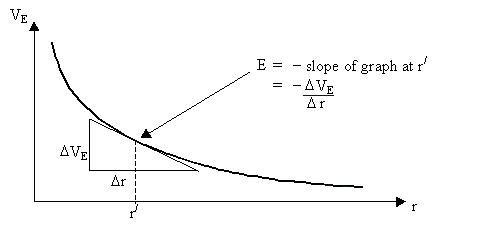
\( E = – \dfrac{\Delta V_e}{\Delta r} \)
Closely spaced equipotential surfaces correspond to a large potential gradient and therefore a strong electric field.
IB exam points:
- State clearly that electric field lines are perpendicular to equipotential surfaces.
- Mention that no work is done moving along an equipotential surface.
- Relate field strength to spacing of equipotentials.
Example:
Explain why electric field lines cannot be parallel to equipotential surfaces.
▶️ Answer / Explanation
If electric field lines were parallel to equipotential surfaces, a charge moving along the field line would experience no change in electric potential.
This would imply no work is done by the field, which contradicts the definition of electric field.
Therefore, electric field lines must be perpendicular to equipotential surfaces.
Electric field – between parallel plate
If we take two parallel plates of metal and give them equal and opposite charge, what does the electric field look like between the plates?
SOLUTION:
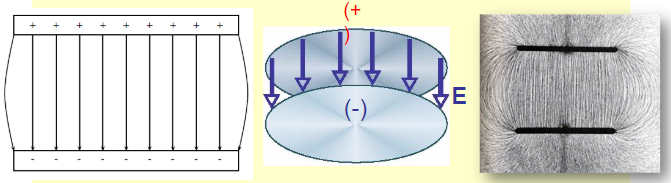
Just remember: Field lines point away from (+) charge and toward (-) charge.
PRACTICE: Justify the statement “the electric field strength is uniform between two parallel plates.”
SOLUTION:
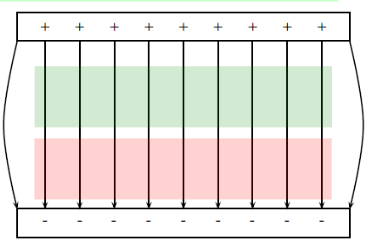
∙Sketch the electric field lines between two parallel plates.
∙Now demonstrate that the electric field lines have equal density everywhere between the plates.
Potential difference
∙Because electric charges experience the electric force, when one charge is moved in the vicinity of another, work W is done (recall that work is a force times a displacement).
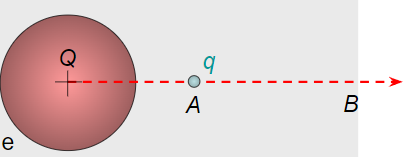
∙We define the potential difference V between two points A and B as the amount of work W done per unit charge in moving a point charge from A to B.

Note that the units of V are JC-1 which are volts V
Potential difference – the electronvolt
When speaking of energies of individual charges (like electrons in atoms), rather than large groups of charges (like currents through wire), Joules are too large and awkward.
We define the electronvolt eV as the work done when an elementary charge e is moved through a potential difference V.
From W = qV we see that
1 eV = eV = (1.60 x 10⁻¹⁹ C)(1V) = 1.60 x 10⁻¹⁹ J.

FYI – We will use electronvolts exclusively in Topic E when we study atomic physics.
Potential difference – path independence
EXAMPLE:
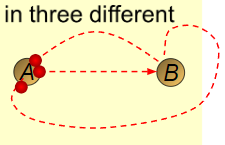
A charge of q = +15.0 µC is moved from point A, having a voltage (potential) of 25.0 V to point B, having a voltage (potential) of 18.0 V, in three different ways. What is the work done in each case?
▶️Answer/Explanation
SOLUTION:
The work is independent of the path because the electric force is a conservative force. W = qV = (15.0×10⁻⁶)(-7.0) = -1.1×10⁻⁴ J. (Same for all)
FYI
We also found out in Topic D.1 that gravity is also a conservative force.
Question
A sphere of mass m and positive charge q is at rest midway between two horizontal parallel plates separated by a distance s. The potential difference across the plates is V.
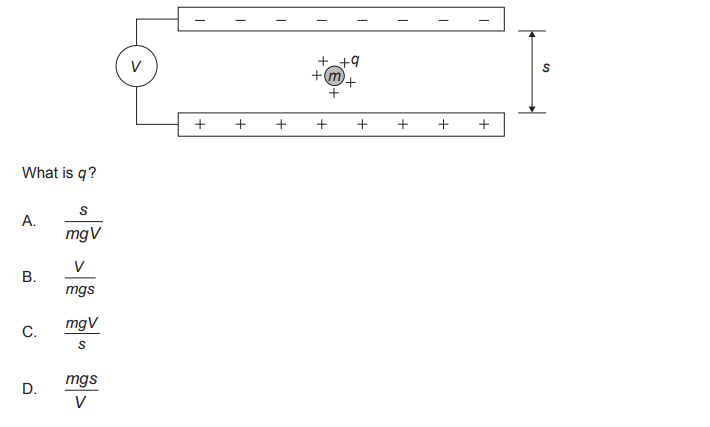
▶️Answer/Explanation
Ans D
Question
Two positive and two negative charges are located at the corners of a square as shown. Point $X$ is the centre of the square. What is the value of the electric field $E$ and the electric potential $V$ at $X$ due to the four charges?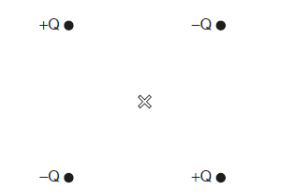
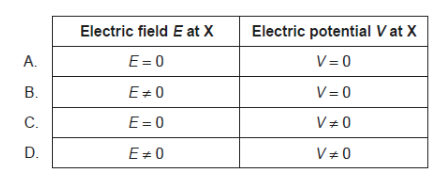
▶️Answer/Explanation
Ans:A