
Question
▶️ Answer/Explanation
(a)(i)
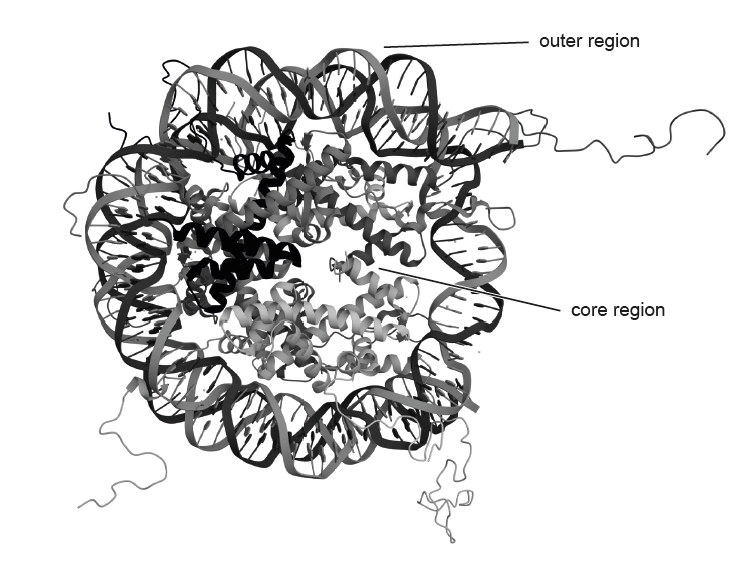
The molecule in the outer region is DNA, because the double helix structure with visible base-pair patterns is clearly shown wrapping around the core.
(a)(ii)
The core region is made of:
• proteins / polypeptides forming the histone octamer
• alpha-helical regions of these proteins are visible in the model
A complete nucleosome core typically contains **eight histone molecules** (H2A, H2B, H3, H4 × two).
(b)
Bacteria lack nucleosomes because they do not possess histone proteins and have only a single circular DNA molecule with minimal folding or supercoiling.
In other words, they have “naked DNA” rather than chromatin.
(c)
DNA can be used in cladistics in the following ways:
• Cladistics groups organisms based on evolutionary ancestry
• DNA base-sequence data provides objective molecular evidence
• Sequences of the same gene are compared across species
• The more similar the base sequences, the more closely related the species are
• Organisms with a shared evolutionary ancestor are placed in the same clade
• Gradual accumulation of mutations helps estimate when lineages diverged from a common ancestor
Thus, DNA gives measurable, heritable differences that reflect true evolutionary relationships.