Home / IB DP / IB DP Biology 2026, 2027 & 2028 / IB DP Biology Mock Exam HL Paper 1B Set 4

IB DP Biology Mock Exam HL Paper 1B Set 4 - 2025 Syllabus

IB DP Biology Mock Exam HL Paper 1B Set 4

Prepare for the IB DP Biology Exam with our comprehensive IB DP Biology Exam Mock Exam HL Paper 1B Set 4. Test your knowledge and understanding of key concepts with challenging questions covering all essential topics. Identify areas for improvement and boost your confidence for the real exam

IB DP Biology Mock Tests -All Sets

Question 

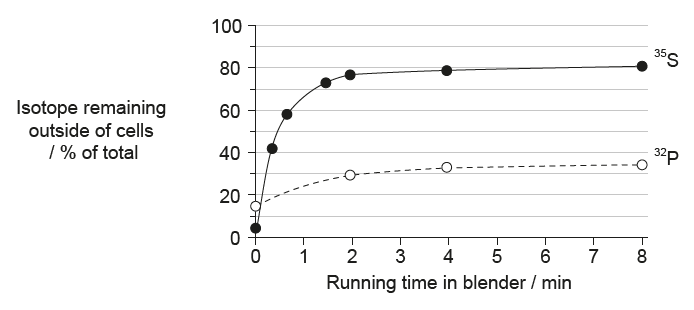
The graph shows the results of Hershey and Chase’s 1952 experiment. Bacteria were exposed to virus particles labelled with radioactive 32P or 35S. After agitation in a blender, samples were centrifuged to measure the percentage of isotope remaining outside the bacterial cells.
(a) Calculate the difference between the amounts of 35S and 32P remaining outside the bacteria at 2 minutes. [1]
(b) Explain how these data support the conclusion that DNA is the genetic material of cells. [3]
(c)
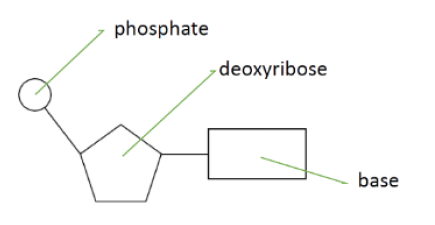
(i) Draw and label a diagram to show the structure of a DNA nucleotide. [3]
(ii) List the DNA nucleotides that are purines and those that are pyrimidines. [1]

▶️ Answer/Explanation

(a)
At 2 minutes: • 35S ≈ 80% outside the cells • 32P ≈ 32% outside the cells

Difference: \[ 80\% – 32\% = \boxed{48\%} \] (Accept values 46–50%.)

(b)
• Phosphorus (P) is found in DNA, while sulphur (S) is found in proteins.
• Only a small percentage of radioactive 32P remains outside the cells, meaning the labelled DNA entered the bacteria.
• A large percentage of 35S stays outside the cells, showing viral proteins did not enter.
• Since the material that enters the cell is the material that directs viral replication, this demonstrates that DNA—not protein—is the genetic material.

(c)(i)
A correctly labelled DNA nucleotide must include:
• A pentose sugar (deoxyribose), drawn as a five-sided ring and labelled
• A nitrogenous base attached to carbon 1′ of deoxyribose
• A phosphate group attached to carbon 5′ of deoxyribose
(c)(ii)
Purines: Adenine (A), Guanine (G)
Pyrimidines: Thymine (T), Cytosine (C)
(All four bases must be correctly listed.)

Scroll to Top