
Question
▶️ Answer/Explanation
(a)
A correct plan diagram should include the following labelled tissues (no individual cells shown):
• vascular bundle
• xylem
• phloem
• epidermis
• cortex 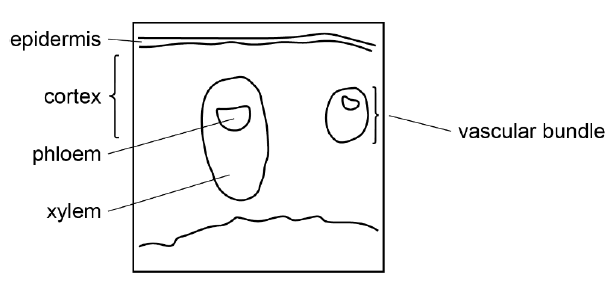
The vascular bundles should be positioned near the outer edge, with the cortex outside them and the epidermis forming the outermost layer.
(b)(i)
To find the real thickness:
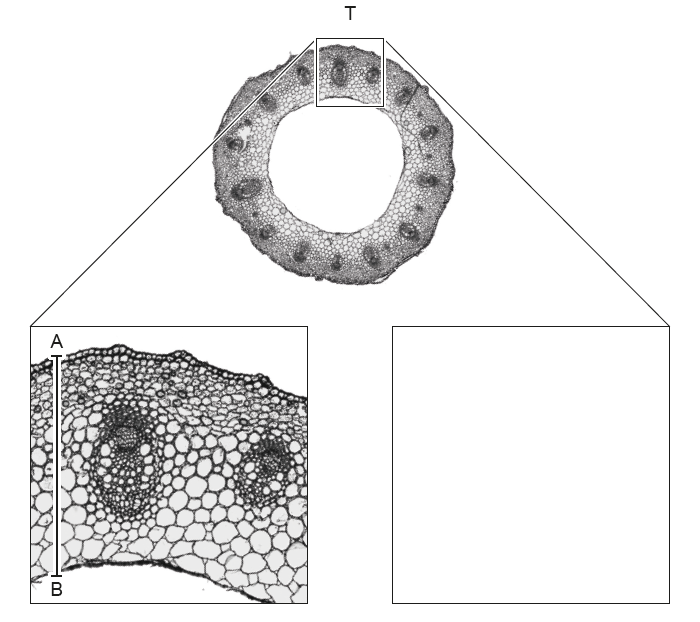
• Measure AB on the printed image (for example, suppose AB = 45 mm).
• Divide by the magnification (100×).
Example calculation:
If measured AB = 45 mm:
Actual thickness = \( \frac{45\ \text{mm}}{100} = 0.45\ \text{mm} \)
Which is also:
0.045 cm or 450 μm.
Any value in the acceptable range of 0.42–0.47 mm (420–470 μm) gains credit.
(b)(ii)
• Count how many eyepiece graticule divisions span the stem’s thickness.
• Use the calibrated value of one division (from the stage micrometer).
• Multiply the number of divisions by the micrometre value per division.
Alternatively: determine the true length of one graticule unit, then multiply by the number of units covering the stem.
(c)
One valid defence strategy:
• sharp structures such as spines or thorns
OR • chemical defences (toxins, secondary compounds, irritants)
(d)
Two correct adaptations with explanation may include:
• a thick waxy cuticle — reduces evaporation and water loss
• small leaves or spines — decreases surface area for transpiration
• sunken stomata or hairy surfaces — trap moist air and lower water loss
• rolled leaves — keep humidity close to the surface
• succulent tissues — store water for drought periods
• CAM photosynthesis — stomata open at night to reduce water loss