
Question
▶️ Answer/Explanation
(a)
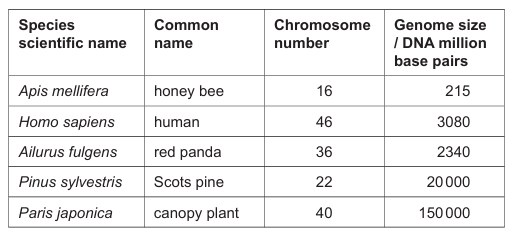
Somatic cells. This is because all the chromosome numbers listed are even, which is characteristic of the diploid (2n) number found in somatic cells. For example, humans have a diploid number of 46.
(b)
Chromosomes are classified by their length / size / position of the centromere / banding pattern.
(c)
Histones are involved in the coiling/condensing of DNA to form chromosomes (for cell division/mitosis/meiosis).
(d)
The data does not show a clear positive correlation between genome size and organism complexity.
Argument for a correlation: Among the animal species, the honey bee (likely the least complex) has the smallest genome, and humans (likely the most complex) have the largest animal genome.
Argument against a correlation: The plant species (Pinus sylvestris and Paris japonica) have genome sizes that are much larger than those of the animal species, yet they are generally considered less complex organisms than humans. This is known as the C-value paradox. Furthermore, “complexity” is subjective and not clearly defined by the data in the table.