
Question
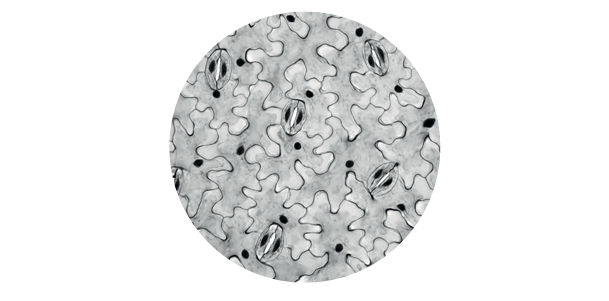
▶️ Answer/Explanation
(a)
A guard cell should be clearly labelled on the image. The label line must touch part of a guard cell; do not circle the entire stoma.
Example: Label one of the two kidney-shaped cells surrounding a pore.
(b)
Total magnification = magnification of eyepiece lens × magnification of objective lens.
Example: Eyepiece = 10×, objective = 60× → total magnification = 10 × 60 = 600×.
(c)
(i) Count the number of stomata visible within the field of view and divide by the area of that field.
Example: If 18 stomata are counted in a field of 0.3 mm², density = 18 ÷ 0.3 = 60 stomata/mm².
(ii) Repeat the count across multiple fields of view (or different leaves) and calculate the mean value.
Example: Count stomata in 5 different fields, calculate mean to minimize local variation.
(d)
Choose one adaptation and explain its functional significance:
Pneumatophores (aerial roots): Grow vertically above the waterlogged soil to facilitate oxygen uptake for root respiration in anaerobic conditions.
Salt exclusion: Specialized root membranes prevent salt entry, maintaining osmotic balance and reducing dehydration risk.
Buttress roots: Provide structural stability in soft, unstable mud, preventing tree collapse.
Example (Pneumatophores): “Mangrove trees develop pneumatophores that project above the mud, enabling oxygen diffusion to submerged roots for aerobic respiration in oxygen-depleted waterlogged sediments.”