
Question
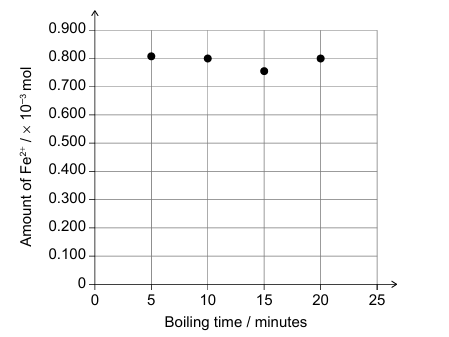
(b) The mean values from part (a) were plotted on a graph of amount of \(\text{Fe}^{2+}\) released (\(\times 10^{-3}\ \text{mol}\)) against boiling time (\(\text{minutes}\)).
▶️ Answer/Explanation
(a)(i)
Independent variable: boiling time of the spinach in water (for example \(5\), \(10\), \(15\), \(20\ \text{minutes}\)).
Dependent variable: volume (titre) of \(\text{KMnO}_{4}(\text{aq})\) added in the titration.
(a)(ii)
Any two appropriate controlled conditions, e.g.:
• Keep the final volume of solution the same for each trial by adding water after filtration to a fixed volume.
• Use spinach leaves of the same freshness/colour/size or surface area (similar samples).
• Boil the water before adding spinach and ensure the temperature while boiling is the same for every trial.
• Use distilled or deionized water instead of tap water.
• Store all solutions in the refrigerator for the same length of time before titration.
• Use the same size storage bottles for all samples.
• Ensure all samples are titrated at the same temperature (allow to reach room temperature).
• Maintain the same acidic conditions of the titration solution (constant \(\text{pH}\)).
• Protect \(\text{KMnO}_{4}(\text{aq})\) from light because it is photosensitive.
(Any two suitable controls gain credit.)
(a)(iii)
Perform a trial using boiled water with no spinach leaves (a blank).
This measures how much \(\text{Fe}^{2+}\), if any, is contributed by the water or equipment, so the amount from the spinach alone can be found by comparison.
(a)(iv)
Any two valid difficulties, e.g.:
• \(\text{KMnO}_{4}(\text{aq})\) is dark purple, so it can be hard to read the burette scale accurately; the reading must be taken from the top of the meniscus.
• The spinach solutions are green/coloured, so the colour change at the end point can be difficult to judge.
• The end point is a mixture of green and faint pink, so the exact moment of the first permanent pink colour can be subjective.
• The reaction may be slow, so the colour takes a long time to disappear, but titration must be done quickly to prevent organic substances reducing \(\text{Fe}^{3+}\) back to \(\text{Fe}^{2+}\).
(Any two suitable points gain credit.)
(b)(i)
The amount (or concentration) of \(\text{Fe}^{2+}\) extracted from the spinach does not show a clear increase as boiling time rises from \(5\) to \(20\ \text{minutes}\); the points are roughly constant (or show no consistent trend).
So there is essentially no obvious relationship/correlation shown in the graph.
(b)(ii)
Range:
• The boiling times (from \(5\) to \(20\ \text{minutes}\)) are realistic cooking times, but the overall range is quite narrow and may not be sufficient to reveal a clear trend. It is likely most \(\text{Fe}^{2+}\) was already extracted before \(5\ \text{minutes}\). More boiling times, including values below \(5\ \text{minutes}\), are needed to see a pattern.
Quantity of measurements:
• There are several measurements for each boiling time (replicates), which is good; however, more replicates would allow calculation of a standard deviation and give better information about variation between trials.
• A measurement at \(t = 0\ \text{minutes}\) (no boiling) is missing, so it is hard to judge whether boiling actually changes the amount of \(\text{Fe}^{2+}\).
• There is only one interval between \(0\) and \(5\ \text{minutes}\); this is not enough to see how fast \(\text{Fe}^{2+}\) is extracted at the beginning.
(c)(i)
The hypothesis is not supported by the data.
Reason: the results do not show an increase in the amount of \(\text{Fe}^{2+}\) with longer boiling times; in fact, the amount at \(5\ \text{minutes}\) is similar to or even slightly higher than at later times. Because no measurement at \(t = 0\ \text{minutes}\) was taken, we also cannot say whether boiling makes any difference compared with no boiling.
(c)(ii)
One suitable modification is to repeat the investigation using a wider and more detailed set of boiling times, for example at \(1\), \(2\), \(3\), \(4\), and \(5\ \text{minutes}\) (or over a much longer range, depending on focus).
Other acceptable changes include: repeating the investigation without boiling (to provide a \(0\ \text{minute}\) point), using a spectrophotometer/atomic absorption spectrophotometer to measure \(\text{Fe}^{2+}\) more precisely, or using a larger mass of spinach to produce more measurable amounts of \(\text{Fe}^{2+}\).