Home / IB DP / Chemistry / IB DP Chemistry Mock Exam SL Paper 1B Set 3

IB DP Chemistry Mock Exam SL Paper 1B Set 3 - 2025 Syllabus

IB DP Chemistry Mock Exam SL Paper 1B Set 3

Prepare for the IB DP Chemistry Exam with our comprehensive IB DP Chemistry Exam Mock Exam SL Paper 1B Set 3. Test your knowledge and understanding of key concepts with challenging questions covering all essential topics. Identify areas for improvement and boost your confidence for the real exam

IB DP Chemistry Mock Tests -All Sets

Question 

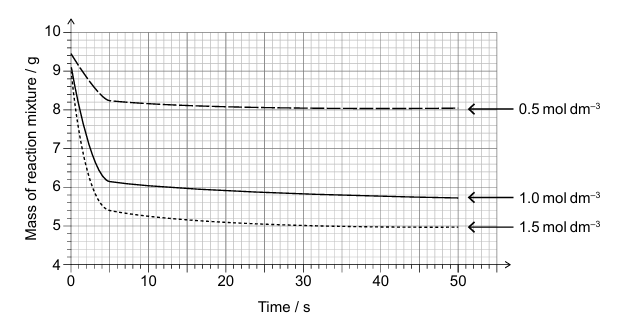
The reaction between solid sodium hydrogencarbonate, \( \text{NaHCO}_{3}(s) \), and aqueous hydrochloric acid, \( \text{HCl(aq)} \), was examined using the same mass of the solid and a constant volume of acid at different concentrations. A data logger measured the mass of the reaction mixture every \( 5 \) seconds, and the results were then plotted as a graph.


(a) Determine, by annotating the graph, the initial rate of release of CO₂(g), in g s⁻¹, with the 1.5 mol dm⁻³ HCl(aq).
(b) Suggest, with a reason, whether NaHCO₃(s) or HCl(aq) was the limiting reagent in the reactions using 0.5 and 1.0 mol dm⁻³ HCl(aq).
(c) The expected (theoretical) mass of CO₂(g) produced in a complete reaction with 1.0 mol dm⁻³ HCl(aq) is 4.40 g.
(i) Determine from the graph the actual mass, in g, of CO₂(g) produced.
(ii) Calculate the percentage difference between the theoretical and actual mass of CO₂(g) produced.
(iii) Although the same mass of NaHCO₃(s) and volume of HCl(aq) were used each time, the graphs begin from different points. Suggest an error in the method that may have caused this.
▶️ Answer/Explanation

(a)
• Tangent drawn at t = 0 for 1.5 mol dm⁻³ solution ✓
• Gradient calculated AND positive value for rate: ≈2.3 g s⁻¹ ✓
\(\boxed{2.3}\) g s⁻¹

(b)
• Limiting reagent: HCl ✓
• Reason: Same initial mass of solid produces different mass of CO₂/carbon dioxide ✓
HCl is limiting because different acid concentrations produce different CO₂ masses.

(c)(i)
Actual mass of CO₂ produced = 9.1 – 5.8 = 3.3 g ✓
\(\boxed{3.3}\) g

(c)(ii)
Percentage difference = [(4.40 – 3.3)/4.40] × 100 = 25% ✓
\(\boxed{25\%}\)

(c)(iii)
Any one of:
• Recording of mass started after reaction began ✓
• Button on data-logger was pressed too late ✓
• Balance not tared/zeroed ✓
• Use of different beakers/flasks/glassware with slightly different masses ✓
• Glassware was not dried/cleaned from previous trial ✓
Any one valid source of error.

Scroll to Top