Home / IB DP / Chemistry / SL / Exam Style Questions / R 1.1 Measuring enthalpy changes SL Paper 2

IBDP Chemistry -Reactivity 1.1 Measuring enthalpy changes - IB Style Questions For SL Paper 2 -FA 2025

Question

Methanol is made in large quantities as it is used in the production of polymers and as a fuel. The enthalpy of combustion of methanol can be determined theoretically or experimentally.
\[ \mathrm{CH_3OH(l) + \tfrac{3}{2}O_2(g) \rightarrow CO_2(g) + 2H_2O(g)} \]
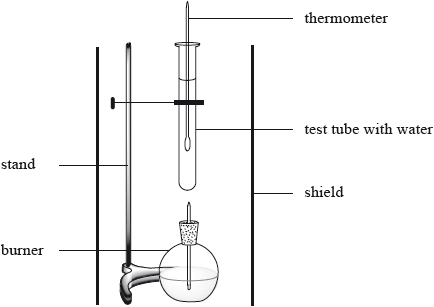
The enthalpy of combustion of methanol can also be determined experimentally in a school laboratory. A burner containing methanol was weighed and used to heat water in a test tube as illustrated.
 
The following data were collected.
MeasurementValue
Initial mass of burner and methanol / g80.557
Final mass of burner and methanol / g80.034
Mass of water / g20.000
Initial temperature of water / °C21.5
Final temperature of water / °C26.4
The Data Booklet value for the enthalpy of combustion of methanol is \(-726 \text{ kJ mol}^{-1}\). Suggest why this value differs from the values calculated in parts (a) and (b).
Using bond enthalpy data from the Data Booklet, determine the theoretical enthalpy of combustion of methanol.
(a) Calculate the amount, in moles, of methanol burned.
(b)(i) Calculate the heat absorbed, in kJ, by the water.
(b)(ii) Determine the enthalpy change, in kJ mol\(^{-1}\), for the combustion of methanol.
(b)(iii) Explain why this experimental value differs from the Data Booklet value.

Most-appropriate topic codes (IB Chemistry 2025):

Reactivity 1.1: Measuring enthalpy changes

▶️ Answer/Explanation
Detailed solution

(a)
Mass of methanol burned: \[ 80.557 – 80.034 = 0.523 \text{ g} \] \[ n(\text{CH}_3\text{OH}) = \frac{0.523}{32.05} = 0.0163 \text{ mol} \]

(b)(i)
Temperature change: \[ \Delta T = 26.4 – 21.5 = 4.9 \text{ K} \] \[ q = mc\Delta T = 20.000 \times 4.18 \times 4.9 = 4.10 \times 10^2 \text{ J} = 0.41 \text{ kJ} \]

(b)(ii)
\[ \Delta H_c = \frac{-0.41}{0.0163} = -25 \text{ kJ mol}^{-1} \]

(b)(iii)
The experimental value is less exothermic because:
• heat is lost to the surroundings,
• combustion may be incomplete,
• methanol is liquid rather than gaseous,
• bond enthalpies are average values.

Theoretical enthalpy (bond enthalpies)
Energy required to break bonds: \[ 3(\text{C–H}) + (\text{C–O}) + (\text{O–H}) + \tfrac{3}{2}(\text{O=O}) = 2808 \text{ kJ mol}^{-1} \] Energy released forming bonds: \[ 4(\text{C=O}) + 2(\text{O–H}) = 3348 \text{ kJ mol}^{-1} \] \[ \Delta H = 2808 – 3348 = -540 \text{ kJ mol}^{-1} \]

Scroll to Top