Home / IB DP / Chemistry / SL / Exam Style Questions / R 2.2 How fast? The rate of chemical change SL Paper 1

IBDP Chemistry - Reactivity 2.2 How fast? The rate of chemical change- IB Style Questions For SL Paper 1A - FA 2025

Question

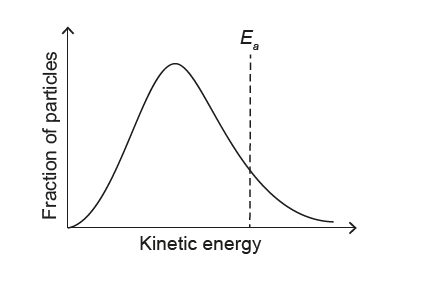
The graph shows a Maxwell–Boltzmann distribution of molecular kinetic energies for a gas at a certain temperature, with the activation energy labelled \(E_{a}\).
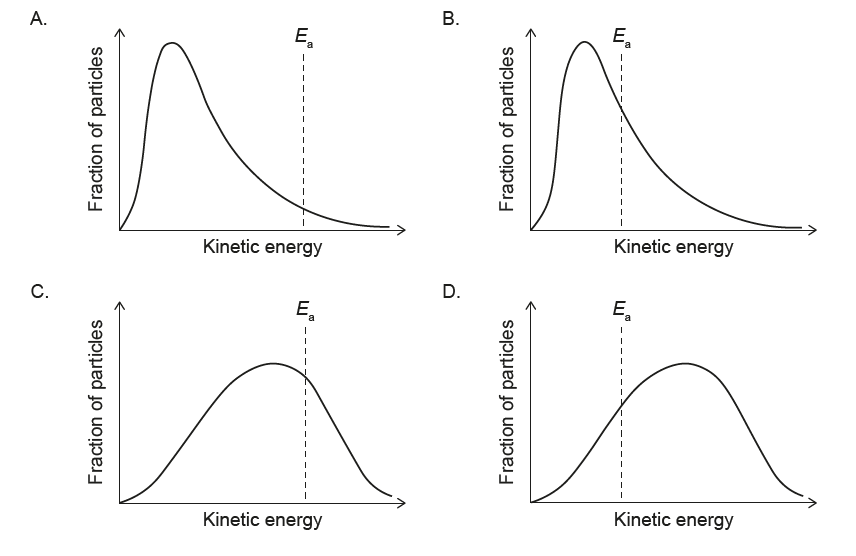
Which option best represents the energy distribution and the position of the activation energy \(E_{a}\) when the gas is at a lower temperature?
▶️ Answer/Explanation
Detailed solution

1. Effect of lowering temperature on the Maxwell–Boltzmann distribution:
When the temperature decreases, the average kinetic energy of the particles decreases.
The Maxwell–Boltzmann curve becomes:
– shifted to the left (towards lower kinetic energy), and
– higher and narrower (more particles with energies close to the new, lower mean).

2. Effect on the activation energy \(E_{a}\):
The activation energy \(E_{a}\) is a fixed property of the reaction and does not change with temperature. Therefore, the vertical line representing \(E_{a}\) must stay at the same kinetic energy value on the horizontal axis.

The only option that shows a narrower, taller curve shifted to lower kinetic energy while keeping the \(E_{a}\) line in the same position is diagram A.

Answer: (A)

Question

The following graph shows the concentration of \( C_{4}H_{9}Cl \) versus time.

What is the average rate of reaction over the first \( 800 \) seconds?
A. \( 1 \times 10^{-3} \text{ mol dm}^{-3}\text{ s}^{-1} \)
B. \( 1 \times 10^{-4} \text{ mol dm}^{-3}\text{ s}^{-1} \)
C. \( 2 \times 10^{-3} \text{ mol dm}^{-3}\text{ s}^{-1} \)
D. \( 2 \times 10^{-4} \text{ mol dm}^{-3}\text{ s}^{-1} \)
▶️ Answer/Explanation

The rate is calculated using:

\[ \text{rate} = -\frac{[\text{reactant at } t_2] – [\text{reactant at } t_1]}{t_2 – t_1} \] Over the first \( 800 \) seconds:

\[ \text{rate} = -\frac{0.10 – 0.02}{0 – 800} \Rightarrow 1 \times 10^{-4} \]
Correct answer: B

Question

Consider the reaction between gaseous iodine and gaseous hydrogen.

\( \mathrm{I_2(g) + H_2(g) \rightleftharpoons 2HI(g)} \quad \Delta H^{\circ} = -9 \text{ kJ} \)

Why do some collisions between iodine and hydrogen not result in the formation of the product?

A. The \( \mathrm{I_2} \) and \( \mathrm{H_2} \) molecules do not have sufficient energy.
B. The system is in equilibrium.
C. The temperature of the system is too high.
D. The activation energy for this reaction is very low.
▶️ Answer/Explanation

For a successful collision, reacting particles must collide with sufficient energy to overcome the activation energy barrier. Many \( \mathrm{I_2} \) and \( \mathrm{H_2} \) molecules collide with less than this minimum energy, so they simply bounce off each other without forming \( \mathrm{HI} \).

Correct answer: A

Scroll to Top