Home / IB DP / Chemistry / SL / Exam Style Questions / R 3.1 Proton transfer reactions SL Paper 1

IBDP Chemistry - Reactivity 3.1 Proton transfer reactions- IB Style Questions For SL Paper 1A - FA 2025

Question

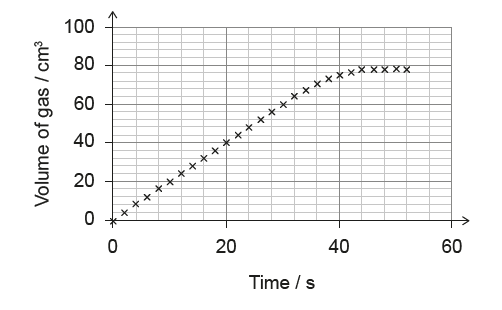
The volume of gas generated in a kinetics experiment is plotted against time. What is the average rate of gas formation during the first 20 seconds?
(A) \(2.0\) cm\(^3\) s\(^{-1}\)
(B) \(1.5\) cm\(^3\) s\(^{-1}\)
(C) \(1.0\) cm\(^3\) s\(^{-1}\)
(D) \(0.5\) cm\(^3\) s\(^{-1}\)
▶️ Answer/Explanation
Detailed solution

1. Define Average Rate:
\(\text{Average Rate} = \frac{\Delta \text{Volume}}{\Delta \text{Time}}\)

2. Read Graph Points:

  • At \(t = 0\) s, \(V = 0\) cm\(^3\).
  • At \(t = 20\) s, read the y-value. The graph passes through exactly \(40\) cm\(^3\) (check the grid lines: 20, 40, 60). Yes, at \(t=20\), \(V=40\).

3. Calculate Rate:
Rate = \(\frac{40 – 0}{20 – 0} = \frac{40}{20} = 2.0\) cm\(^3\) s\(^{-1}\).
Answer: (A)

Question

Which combination describes a strong Brønsted–Lowry acid?

 Proton donorConjugate base
A.goodstrong
B.goodweak
C.poorstrong
D.poorweak

▶️ Answer/Explanation
A strong Brønsted–Lowry acid donates protons easily, so it is a good proton donor. Its conjugate base must be reluctant to accept a proton, so it is a weak base.
Therefore, the correct combination is:
Answer: B — good proton donor, weak conjugate base.

Question

Which reaction represents the neutralization of a Brønsted–Lowry acid and base?
(A) \(2\text{HCl}(\text{aq}) + \text{Zn}(\text{s}) \rightarrow \text{ZnCl}_{2}(\text{aq}) + \text{H}_{2}(\text{g})\)
(B) \(2\text{HCl}(\text{aq}) + \text{ZnO}(\text{s}) \rightarrow \text{ZnCl}_{2}(\text{aq}) + \text{H}_{2}\text{O}(\ell)\)
(C) \(4\text{NH}_{3}(\text{g}) + 5\text{O}_{2}(\text{g}) \rightarrow 4\text{NO}(\text{g}) + 6\text{H}_{2}\text{O}(\ell)\)
(D) \(\text{C}_{2}\text{H}_{4}(\text{g}) + \text{H}_{2}(\text{g}) \rightarrow \text{C}_{2}\text{H}_{6}(\text{g})\)
▶️ Answer/Explanation
Detailed solution

1. Recall Brønsted–Lowry neutralization:
A Brønsted–Lowry acid is a proton (\(\text{H}^{+}\)) donor and a Brønsted–Lowry base is a proton acceptor.
Neutralization occurs when an acid reacts with a base to form a salt and water.

2. Check each option:
(A) \(2\text{HCl}(\text{aq}) + \text{Zn}(\text{s})\): acid reacting with a metal → redox reaction producing \(\text{H}_{2}(\text{g})\), not neutralization.
(B) \(2\text{HCl}(\text{aq}) + \text{ZnO}(\text{s})\): \(\text{HCl}\) (acid) reacts with basic oxide \(\text{ZnO}\) (base) to give the salt \(\text{ZnCl}_{2}(\text{aq})\) and water \(\text{H}_{2}\text{O}(\ell)\) → this is acid–base neutralization.
(C) \(4\text{NH}_{3}(\text{g}) + 5\text{O}_{2}(\text{g})\): combustion/oxidation reaction, not neutralization.
(D) \(\text{C}_{2}\text{H}_{4}(\text{g}) + \text{H}_{2}(\text{g})\): hydrogenation (addition) reaction, not acid–base.

3. Select the correct reaction:
Only option (B) shows an acid reacting with a base to form a salt and water.
Answer: (B)

Scroll to Top