IB DP Chemistry -Structure 1.2 The nuclear atom- IB Style Questions For SL Paper 1A -FA 2025
Question
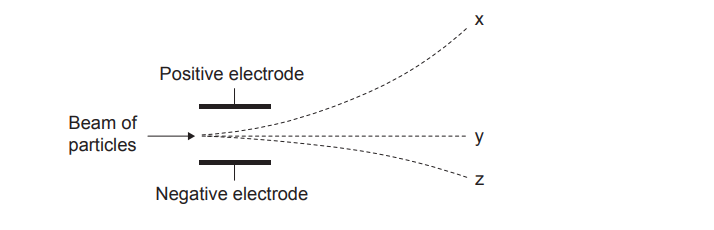
The diagram below illustrates how protons, neutrons and electrons behave in an electric field. Which option correctly identifies each of these particles?
| Protons | Electrons | Neutrons | |
| A | y | z | x |
| B | x | y | z |
| C | x | z | y |
| D | z | x | y |
▶️ Answer/Explanation
Detailed solution
1. Analyze Deflection:
Charged particles are deflected in an electric field.
- Positive Electrode: Attracts negatively charged particles. Path ‘x’ bends toward the positive plate, so ‘x’ must be electrons. Note: Electrons are also lighter than protons, so they deflect more sharply.
- Negative Electrode: Attracts positively charged particles. Path ‘z’ bends toward the negative plate, so ‘z’ must be protons.
- Straight Path: Neutral particles are not affected. Path ‘y’ is straight, so ‘y’ must be neutrons.
✅ Answer: (C)
Question
Which allotrope, oxygen or ozone, possesses the stronger \(\text{O–O}\) bond, and which one absorbs higher-frequency UV radiation in the atmosphere?
| Stronger bond between \(\text{O}\) atoms | Absorbs higher-frequency UV | |
| A | ozone | ozone |
| B | ozone | oxygen |
| C | oxygen | oxygen |
| D | oxygen | ozone |
▶️ Answer/Explanation
Detailed solution
Bond Strength:
The \(\text{O=O}\) double bond in \(\text{O}_2\) is stronger than the delocalized \(\text{O–O}\) bonds in \(\text{O}_3\). Therefore oxygen has the stronger bond between O atoms.
UV Absorption:
Oxygen (\(\text{O}_2\)) absorbs higher-frequency (shorter-wavelength) UV radiation than ozone. Ozone primarily absorbs lower-frequency UV-B and UV-C, whereas oxygen absorbs even higher-energy UV (including UV-C).
Thus the correct combination is oxygen for both categories.
✅ Answer: (C)
