
▶️ Answer/Explanation
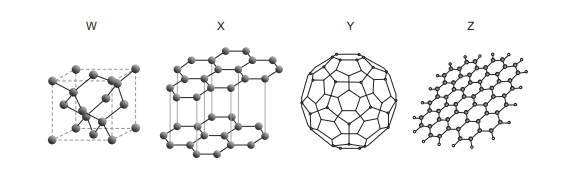
1. Identify each allotrope from its structure:
– \(W\): three-dimensional tetrahedral lattice of carbon atoms \(\Rightarrow\) diamond (\(\text{sp}^3\) hybridization).
– \(X\): stacked layers of hexagonal sheets with weak forces between layers \(\Rightarrow\) graphite (\(\text{sp}^2\) hybridization).
– \(Y\): roughly spherical cage of carbon atoms (e.g. \(\text{C}_{60}\)) \(\Rightarrow\) a fullerene.
– \(Z\): single extended hexagonal sheet of carbon atoms \(\Rightarrow\) graphene.
2. Match to the table:
Graphene \(\Rightarrow Z\)
Fullerene \(\Rightarrow Y\)
Graphite \(\Rightarrow X\)
Diamond \(\Rightarrow W\)
This pattern appears in row A.
✅ Answer: (A)
▶️ Answer/Explanation
In \(\text{SO}_2\), sulfur is the central atom. It is bonded to two oxygen atoms and has one lone pair of electrons.
The electron domains around sulfur are therefore:
- Two bonding domains (the two \(\text{S–O}\) bonds).
- One non-bonding domain (one lone pair).
That gives a total of \(3\) electron domains around sulfur. According to VSEPR theory, \(3\) electron domains arrange themselves in a trigonal planar electron domain geometry.
(Note: the molecular shape of \(\text{SO}_2\) is bent, but the electron domain geometry is trigonal planar.)
✅ Answer: (D)