IB DP Chemistry -Structure 2.4 From models to materials- IB Style Questions For SL Paper 1A -FA 2025
▶️ Answer/Explanation
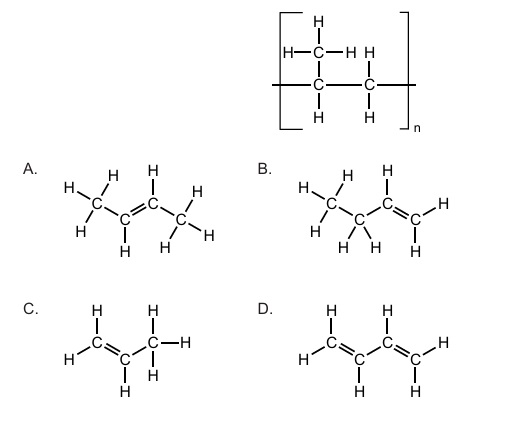
Addition polymers form when monomers with carbon-carbon double bonds undergo chain-growth polymerization. The repeating unit of the polymer reveals the structure of the original monomer. By examining the polymer’s backbone and side groups, it can be determined that the monomer must be the alkene shown in option C, as it would produce the exact repeating pattern seen in the polymer chain when its double bond opens up.
✅ Answer: (C)
Question
| Spectrum A | Spectrum B | |
|---|---|---|
| A. | Absorption | Emission |
| B. | Emission | Absorption |
| C. | Absorption | Absorption |
| D. | Emission | Emission |
▶️ Answer/Explanation
When light from a continuous source passes through a cold gas cloud, atoms in the gas absorb specific wavelengths corresponding to electronic transitions. The spectrum observed is a continuous spectrum with dark lines at those wavelengths, i.e. an absorption spectrum. This is Spectrum A.
A hot gas cloud on its own emits light only at particular wavelengths when excited electrons fall back to lower energy levels. The spectrum seen is a set of bright lines on a dark background, i.e. an emission spectrum. This is Spectrum B.
Therefore:
• Spectrum A: Absorption
• Spectrum B: Emission
✅ Answer: A
Question
| Melting point / \( ^\circ\text{C} \) | Electrical conductivity Molten | Electrical conductivity Solid |
|---|---|---|
| 1414 | poor | poor |
▶️ Answer/Explanation
The substance has a very high melting point of \(1414 \ ^\circ\text{C}\), which suggests extremely strong bonds throughout the structure. Additionally, it conducts electricity poorly in both the molten and solid states.
These characteristics match those of a network covalent structure, such as silicon dioxide \((\text{SiO}_2)\) or diamond. Network covalent substances have: • Very high melting points (due to strong covalent bonds in a giant lattice) • No electrical conductivity in any state (no free ions or electrons)
Why the others are incorrect:
• B. Polar covalent molecule: These have low melting points and do not match \(1414 \ ^\circ\text{C}\). • C. Ionic lattice: Ionic compounds conduct when molten due to mobile ions—this substance does not. • D. Metallic lattice: Metals conduct electricity in the solid state because of delocalized electrons.
✅ Answer: A
