Home / IB DP / Chemistry / SL / Exam Style Questions / S 2.4 From models to materials SL Paper 2

IBDP Chemistry -Structure 2.4 From models to materials - IB Style Questions For SL Paper 2 -FA 2025

Question

The reaction rate between aqueous iron(III) nitrate and sodium thiosulfate can be monitored by recording the time taken for a visible colour change to occur.
(a) In the initial stage of the reaction, an unstable dark violet ion is formed.
\[ \text{Fe}^{3+}(aq) + 2\text{S}_2\text{O}_3^{2-}(aq) \rightarrow \text{Fe}(\text{S}_2\text{O}_3)_2^-(aq) \]
(i) Solid \(\text{CoCl}_2\) is added as a catalyst. Explain how the presence of the catalyst increases the rate of reaction.
(ii) The reaction proceeds until the violet colour disappears. During this process, the thiosulfate ion, \(\text{S}_2\text{O}_3^{2-}\), is oxidized to \(\text{SO}_2\), while \(\text{Fe}^{3+}\) is reduced to \(\text{Fe}^{2+}\). Deduce the oxidation half-equation and the overall redox equation for this second stage of the reaction.
(b) Iron(III) nitrate contains both ionic and covalent types of bonding.
(i) Describe each of these two types of bonding.
(ii) Deduce a Lewis (electron-dot) formula for the nitrate ion.
(iii) State the molecular shape of the nitrate ion.

Most-appropriate topic codes (Chemistry):

TOPIC R1.1: Rate of reaction — part (a-i)
TOPIC R2.1: Electron transfer reactions — part (a-ii)
TOPIC S2.1: Ionic bonding — part (b-i)
TOPIC S2.2: Covalent bonding — parts (b-i), (b-ii)
TOPIC S2.4: From shape to function — part (b-iii)
▶️ Answer/Explanation
Detailed solution

(a)
(i) The catalyst provides an alternative pathway with a lower activation energy (\(E_a\)), allowing more particles to react upon collision.
(ii)
Oxidation: \(\text{S}_2\text{O}_3^{2-} + \text{H}_2\text{O} \rightarrow 2\text{SO}_2 + 2\text{H}^+ + 4\text{e}^-\)
Overall: \(\text{S}_2\text{O}_3^{2-} + 4\text{Fe}^{3+} + \text{H}_2\text{O} \rightarrow 2\text{SO}_2 + 4\text{Fe}^{2+} + 2\text{H}^+\)

(b)
(i)
Ionic: Electrostatic attraction between oppositely charged ions (cations and anions).
Covalent: Electrostatic attraction between shared pairs of electrons and the nuclei of bonded atoms.
(ii) Nitrogen double-bonded to one oxygen atom and single-bonded to two others, enclosed in square brackets with an overall \(1-\) charge (resonance structures apply).
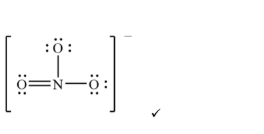
(iii) Trigonal planar.

Scroll to Top