Home / IB DP / Chemistry / SL / Exam Style Questions / S 3.1 The periodic table: Classification of elements SL Paper 2

IBDP Chemistry -Structure 3.1 The periodic table: Classification of elements - IB Style Questions For SL Paper 2 -FA 2025

Question

Thallium is a dense metallic element located in group 13 of the periodic table.
(a) \(30\%\) of naturally occurring thallium atoms contain \(122\) neutrons, while the remaining atoms contain \(124\) neutrons.
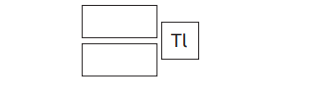
(i) Deduce the nuclear symbol of the thallium isotope that contains \(122\) neutrons. Use section 7 of the data booklet.
(From section 7: thallium has atomic number \(81\) and relative atomic mass \(204.38\).)

(ii) Calculate the relative atomic mass of thallium, giving your answer to two decimal places.
(iii) Explain why the first ionization energy of thallium is lower than that of lead, with reference to nuclear charge and shielding of the outer electrons.
(b) Thallium(I) sulfate has the formula \(\text{Tl}_2\text{SO}_4\).
(i) This compound contains both ionic and covalent bonding. Identify which particles are connected by covalent bonds and which are connected by ionic bonds.
(ii) Compare covalent and ionic bonding in terms of interactions involving valence electrons.
(iii) Write a balanced equation for the preparation of aqueous thallium(I) sulfate by reacting solid thallium(I) hydroxide with sulfuric acid.
(iv) Calculate the volume of \(2.00\ \text{mol dm}^{-3}\) sulfuric acid needed to completely react with \(10.0\ \text{g}\) of thallium(I) hydroxide.
(v) Using the position of thallium in the periodic table, predict whether thallium(I) hydroxide is amphoteric.
(vi) Describe how an experiment using the metals copper and thallium, together with aqueous solutions of their sulfates, could be used to compare their relative reactivities.

Most-appropriate topic codes (Chemistry):

TOPIC S1.2: The nuclear atom — parts (a-i), (a-ii)
TOPIC S1.3: Electron configurations — part (a-iii)
TOPIC S2.2: Covalent bonding — parts (b-i), (b-ii)
TOPIC S2.1: Ionic bonding — parts (b-i), (b-ii)
TOPIC S1.4: Counting particles by mass: The mole — parts (b-iii), (b-iv)
TOPIC S3.1: The periodic table: Classification of elements — part (b-v)
TOPIC R2.2: Electrolytic cells (Reactivity) — part (b-vi)
▶️ Answer/Explanation
Detailed solution

(a)
(i)
From section 7, thallium has atomic number \(81\).
Isotope has \(122\) neutrons, so mass number \(A = 81 + 122 = 203\).
Nuclear symbol: \(\boxed{{}^{203}\text{Tl}}\)

(ii)
Two isotopes: \({}^{203}\text{Tl}\) (30%) and \({}^{205}\text{Tl}\) (70%) since \(81+124=205\).
\[ A_r = (0.30 \times 203) + (0.70 \times 205) \] \[ A_r = 60.9 + 143.5 = \boxed{204.40} \]

(iii)
Lead has a higher nuclear charge (\(Z=82\)) than thallium (\(Z=81\)).
The shielding of the outer electron is similar (both are period 6 with many inner shells), so the effective nuclear attraction is slightly lower in thallium.
Therefore, the outer electron in thallium is held less strongly, so its first ionization energy is lower than that of lead.

(b)
(i)
Covalent bonds: within the sulfate ion, between \(\text{S}\) and \(\text{O}\) atoms in \(\text{SO}_4^{2-}\).
Ionic bonds: between \(\text{Tl}^+\) ions and \(\text{SO}_4^{2-}\) ions.

(ii)
Covalent bonding: atoms share pairs of valence electrons.
Ionic bonding: electrons are transferred (forming cations and anions), then ions are held by electrostatic attraction.

(iii)
\[ 2\text{TlOH}(s) + \text{H}_2\text{SO}_4(aq) \rightarrow \text{Tl}_2\text{SO}_4(aq) + 2\text{H}_2\text{O}(l) \]

(iv)
From section 7: \(\text{Tl} = 204.38\), \(\text{O} = 16.00\), \(\text{H} = 1.01\). 
\[ M_r(\text{TlOH}) = 204.38 + 16.00 + 1.01 = 221.39\ \text{g mol}^{-1} \] \[ n(\text{TlOH}) = \frac{10.0}{221.39} = 0.0452\ \text{mol} \] From the equation, \(2\ \text{mol TlOH}\) react with \(1\ \text{mol H}_2\text{SO}_4\):
\[ n(\text{H}_2\text{SO}_4) = \frac{0.0452}{2} = 0.0226\ \text{mol} \] \[ V = \frac{n}{c} = \frac{0.0226}{2.00} = 0.0113\ \text{dm}^3 = \boxed{11.3\ \text{cm}^3} \]

(v)
No. Thallium is a metal (group 13, lower down the group shows strong metallic character), so \(\text{TlOH}\) is expected to be mainly basic rather than amphoteric.

(vi)
Set up two displacement tests:
• Place thallium metal in aqueous copper(II) sulfate and observe whether copper is displaced (copper deposits / solution colour decreases).
• Place copper metal in aqueous thallium(I) sulfate and observe whether thallium is displaced.
The metal that displaces the other metal from its sulfate solution is the more reactive metal.

Scroll to Top