
Structure 2.2.4 — Valence Shell Electron Pair Repulsion (VSEPR) Theory
VSEPR:
The Valence Shell Electron Pair Repulsion (VSEPR) model is a theory used to predict the geometry (shape) of molecules and ions. It is based on the principle that:
- Electron pairs around a central atom repel each other.
- To minimize repulsion, these electron pairs arrange themselves as far apart as possible in 3D space.
Types of Electron Domains
Electron domains are regions where electrons are likely to be found.
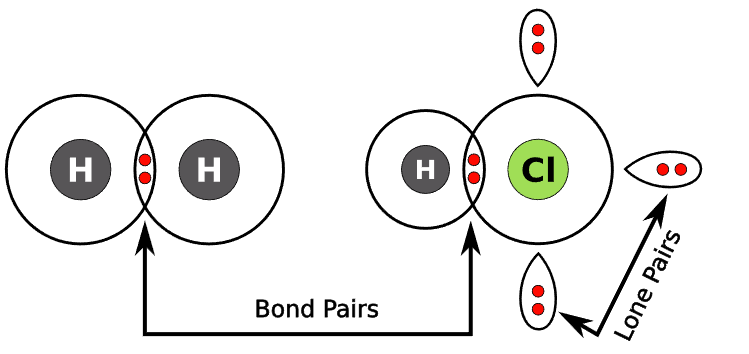
There are two main types:
- Bonding pairs: Shared electrons in a single, double, or triple bond (each counts as one domain)
- Lone pairs (non-bonding pairs): Unshared electron pairs on the central atom
The sum of the number of atoms and lone pairs is called Steric Number (SN)

Key Points:
- Electron domain geometry is based on the total number of electron domains (bonding + lone pairs).
- Molecular geometry considers only the arrangement of atoms (bonding domains), not lone pairs.
- Lone pairs repel more strongly than bonding pairs, so they compress bond angles.
- Multiple bonds (double or triple) count as a single electron domain but exert slightly more repulsion than single bonds.
Geometries for Species with up to Four Electron Domains
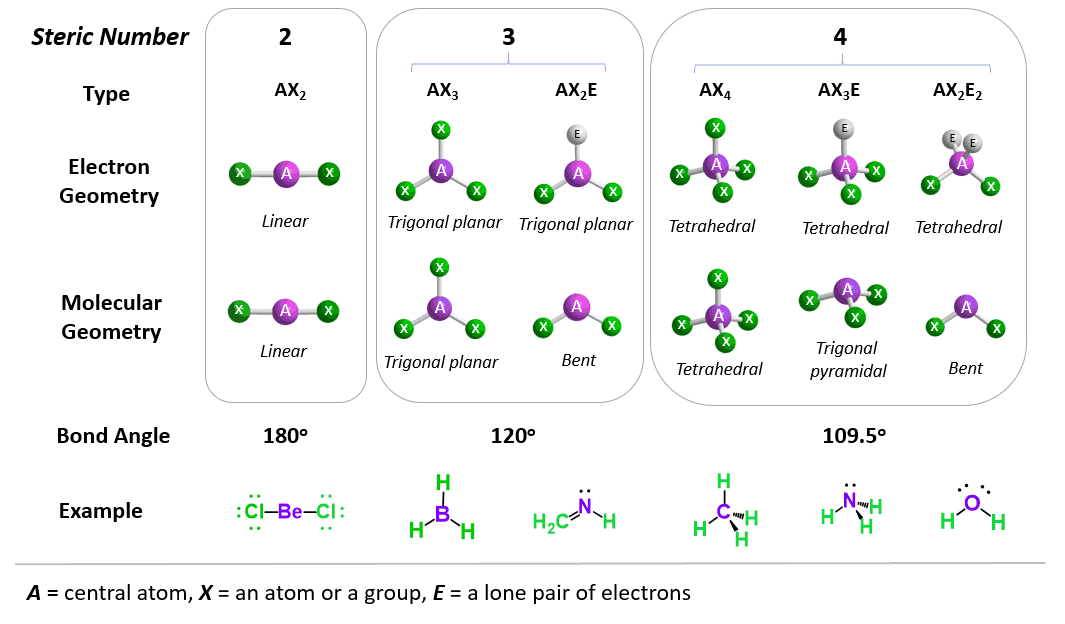
| Number of Electron Domains ( Steric number) | Electron Domain Geometry | Number of Bonding Pairs | Number of Lone Pairs | Molecular Geometry | Bond Angle | Example |
|---|---|---|---|---|---|---|
| 2 | Linear | 2 | 0 | Linear | \( 180^\circ \) | CO2 |
| 3 | Trigonal planar | 3 | 0 | Trigonal planar | \( 120^\circ \) | BF3 |
| 3 | Trigonal planar | 2 | 1 | Bent (V-shaped) | \( \sim117^\circ \) | SO2 |
| 4 | Tetrahedral | 4 | 0 | Tetrahedral | \( 109.5^\circ \) | CH4 |
| 4 | Tetrahedral | 3 | 1 | Trigonal pyramidal | \( \sim107^\circ \) | NH3 |
| 4 | Tetrahedral | 2 | 2 | Bent (V-shaped) | \( \sim104.5^\circ \) | H2O |
Effect of Lone Pairs on Geometry
- Lone pairs repel more strongly than bonding pairs because they are located closer to the nucleus.
- This increases the repulsion and reduces bond angles between bonded atoms.
- More lone pairs = more distortion from ideal angles.
Effect of Multiple Bonds
- A double or triple bond counts as one electron domain.
- However, it exerts more repulsion than a single bond → slight bond angle distortion may occur.
Example
Predict the shape and bond angle of ammonia (NH3) using VSEPR theory.
▶️Answer/Explanation
Step 1 – Count electron domains:
Nitrogen has 5 valence electrons. It forms 3 single bonds with hydrogen and has 1 lone pair.
→ Total = 4 electron domains.
Step 2 – Electron domain geometry:
4 domains → tetrahedral arrangement.
Step 3 – Molecular geometry:
One of the domains is a lone pair → shape = trigonal pyramidal.
Step 4 – Bond angles:
Ideal tetrahedral angle = \( 109.5^\circ \).
Lone pair repels more strongly → bond angle slightly reduced to ~\( 107^\circ \).
Final Answer:
Trigonal pyramidal shape, bond angle ≈ \( 107^\circ \)
Example
Predict the geometry and bond angle of carbon dioxide (CO2) using VSEPR theory.
▶️Answer/Explanation
Step 1 – Count electron domains:
Carbon forms two double bonds with oxygen atoms (each double bond = one electron domain).
→ Total = 2 electron domains.
Step 2 – Electron domain geometry:
2 domains → linear arrangement.
Step 3 – Molecular geometry:
No lone pairs on central atom → molecular shape = linear.
Step 4 – Bond angles:
Linear molecules → bond angle = \( 180^\circ \)
Final Answer:
Linear shape, bond angle = \( 180^\circ \)
Example
Predict the shape and bond angle of water (H2O) using VSEPR theory.
▶️Answer/Explanation
Step 1 – Count electron domains:
Oxygen has 6 valence electrons. It forms 2 single bonds with hydrogen and has 2 lone pairs.
→ Total = 4 electron domains.
Step 2 – Electron domain geometry:
4 domains → tetrahedral arrangement.
Step 3 – Molecular geometry:
2 lone pairs → shape = bent (V-shape).
Step 4 – Bond angles:
Ideal tetrahedral angle = \( 109.5^\circ \).
Lone pairs repel more → bond angle reduced to ~\( 104.5^\circ \).
Final Answer:
Bent (V-shaped) geometry, bond angle ≈ \( 104.5^\circ \)